


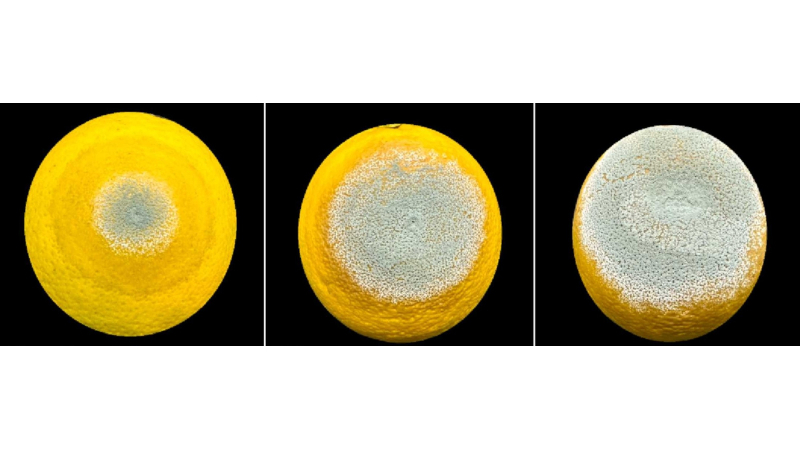
Brazil is the world’s largest producer of oranges and the leading exporter of orange juice. However, the country faces serious post-harvest losses caused by fungi (image: Taicia Fill/IQ-UNICAMP)
Published on 07/13/2026
By Maria Fernanda Ziegler | Agência FAPESP – Almost every farmer knows that when they see a tiny bluish-white spot on oranges, lemons, or tangerines, the result will be an entire crate of moldy fruit. When the Penicillium fungus, which causes blue mold, takes hold of the fruit’s peel, the plant quickly activates a veritable chemical arsenal of defenses in an attempt to prevent the invasion.
However, this effort is practically in vain since P. italicum releases molecules that can neutralize the fruit’s natural defenses and beneficial (endophytic) microorganisms.
Researchers in Brazil affiliated with the State University of Campinas (UNICAMP) and the University of São Paulo (USP) first uncovered this pattern of attack by the pathogen in studies supported by FAPESP (projects 22/02992-0 and 19/17721-9). This discovery paves the way for new strategies to combat the fungus, one of the main pests affecting Brazilian citrus cultivation.
The study detailing these findings was published in the Journal of Agricultural and Food Chemistry and selected by the American journal as the best scientific article of 2025.
“Brazil is the largest producer of oranges and a world leader in juice exports, but it faces serious post-harvest losses caused by fungi. Blue mold [P. italicum] is the second most problematic after green mold [P. digitatum], which is responsible for up to 90% of losses in tropical regions. Despite that, blue mold still receives little attention,” says Taícia Pacheco Fill, a professor at UNICAMP’s Institute of Chemistry (IQ) and the lead author of the study.
“That’s why gaining a better understanding of these pathogens’ strategies and chemical arsenal is essential for developing more effective control methods without relying on pesticides,” the researcher adds.
Currently, blue mold control relies on synthetic fungicides such as imazalil and thiabendazole, but these are becoming increasingly resistant and raising environmental concerns.
To identify the molecules that attack beneficial microorganisms, the researchers used advanced metabolomics techniques (which analyze the products of an organism’s metabolism) to study the set of chemical substances produced by the pathogen during infection in the fruit. “As a result, we were able to identify essential compounds for the development of the infection. In the laboratory, we verified that without these chemicals, the fungus P. italicum grows only slightly, opening the door to new strategies for combating it. In fact, our next step is to develop specific inhibitors of these metabolic pathways capable of neutralizing the pathogen without affecting the host [the fruit],” says Fill. This part of the study was published in a subsequent article in the journal Postharvest Biology and Technology.
Step by step
The rapid spread of the fungus in fruit crates is a process known as “nesting,” which accounts for up to 50% of crop losses in China, the world’s third-largest orange producer. China is a predominantly temperate country where blue mold thrives.
By analyzing the different stages of infection, the researchers discovered that the fungus enters the peel of the fruit through microlesions. “In the early stages, it breaks down the fruit’s cell wall with enzymes, while the fruit responds by producing natural, bioactive, antifungal compounds [flavonoids], such as naringenin and diosmin. However, the fungus counterattacks by also producing bioactive natural compounds, such as brevianamide F and deoxybrevianamide E,” explains Evandro Silva, a FAPESP scholarship recipient and first author of the study.
The researchers also used mass spectrometry imaging techniques to map the spatial distribution of the molecules during infection. “The pathogen battles not only the fruit’s defenses but also the ‘good’ [endophytic] microorganisms that live on the peel and try to protect it. It uses these compounds to modulate the microbial community and establish itself while confronting the fruit’s defenses. It ends up being a multi-front battle in which it manages to outcompete those other microorganisms and thrive,” Fill explains.
The scientists emphasize that identifying the molecules produced by the pathogen is the first step toward developing specific control strategies. “Our laboratory has been working with this approach to describe how pathogens attack and identify the metabolites [products of metabolism] they use. This enables the development of inhibitors that are safer for the environment, less harmful to human health, and pose a lower risk of fungal or bacterial resistance,” says the researcher.
The article “Decoding the Penicillium italicum-citrus interaction: untargeted metabolomics sheds light on a neglected postharvest pathogen” can be read at pubs.acs.org/doi/10.1021/acs.jafc.5c07618.
Source: https://agencia.fapesp.br/58668


