


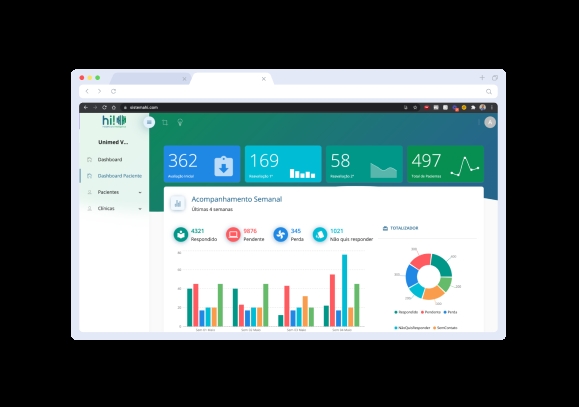
To show how much each protocol costs in relation to its practical results, the startup performs pharmacoeconomic analyses using data obtained from active contact with patients and scientifically validated questionnaires (image: Hi! Healthcare)
Published on 03/09/2026
By Roseli Andrion | Agência FAPESP – Most patients leave medical appointments with test requests and prescriptions, feeling that treatment has begun. However, a few weeks later, they are rarely asked if their lives have actually improved, such as whether their pain has subsided, their sleep has improved, or their emotional state has withstood the impact of the disease.
This silence in the healthcare system is costly but rarely appears in financial statements. Although doctors check for disease regression and adjust medication doses, patients may be cured “on paper,” yet not in reality. Hi! Healthcare Intelligence is a startup based in the São José dos Campos Technology Park in the state of São Paulo, Brazil. It was created to bridge this gap between clinical success and well-being.
The startup monitors patients’ well-being to make hospital management more efficient. Developed with support from FAPESP’s Innovative Research in Small Businesses Program (PIPE) the solution collects outcomes reported by patients themselves, known as Patient-Reported Outcome Measures (PROMs), and cross-references this information with cost data. Hospital managers, healthcare providers, and public administrators receive the results to transform the clinical experience into operational efficiency.
The current healthcare system tends to measure the success of a procedure using cold metrics, such as hospital discharge, absence of infection, and rate of return to the emergency room within two weeks. “The current system measures spending very well, but it measures delivery very poorly,” summarizes Felipe Fagundes, a physical therapist, researcher, and co-founder of Hi! “The solution addresses this imbalance.”
Combating waste
According to data from the DRG Brasil platform and IAG Saúde, waste accounts for 53% of healthcare costs in Brazilian hospitals. With an estimated sector spending of around BRL 980 billion in Brazil in 2024, more than BRL 500 billion is expected to be wasted annually.
“Reducing waste isn’t about cutting what’s most expensive; it’s about cutting what doesn’t work,” explains Fagundes. “To do that, you need to evaluate effectiveness.” Hi! presents cases in which two hospitals with identical immediate clinical results have different impacts on patients’ quality of life months later.
As a “technological concierge,” Hi! manages the entire process, from creating scientifically validated questionnaires to contacting patients and performing automated economic analyses. The results are integrated into pharmacoeconomic analyses that demonstrate the cost of each protocol in relation to its practical outcome.
Results in oncology and mental health
The startup’s first major project was carried out in partnership with the Hospital de Amor in Barretos, which is also located in the state of São Paulo. The hospital is a national reference in oncology and is linked to the SUS (Sistema Único de Saúde), the acronym by which Brazil’s national public health network is known. The startup administered quality of life questionnaires to endometrial cancer patients undergoing outpatient treatment.
Cross-referencing the data revealed BRL 147 million in potential waste in the company’s active projects in 2025 alone. “When managers observe the patient experience, the indicators are no longer the same,” Fagundes points out. The platform acts as a “GPS” for management, pointing the way to savings and efficiency. However, the final decision to follow this path remains with the manager.
In another collaboration, with a mental health operator, the startup detected alarming data: 12% of patients under observation reported having suicidal thoughts daily. This risk remained invisible in routine monitoring because the treatment followed official protocols. “Health can’t be reduced to the absence of disease,” the researcher emphasizes.
Model change
The methodology can be applied to various costly conditions, including heart disease, spinal treatments, and immunobiological drug use. According to the Valor Saúde Brasil platform, 13.5% of the sector’s total waste stems from avoidable early readmissions that could be prevented with better monitoring.
Fagundes argues that the fee-for-service model, which encourages a high volume of interventions, is unsustainable. Hi!’s proposal is to enable value-based healthcare that rewards improvements to patients’ lives.
The startup has the support of PIPE-FAPESP. “PIPE was essential in transforming an idea into a validated, published solution that’s ready to scale,” says Fagundes. The results of the projects have already been presented at national oncology conferences and published in specialized journals.
Global reach
The challenge of hospital efficiency is global. Public systems in Portugal, France, and the United Kingdom face similar challenges, prompting Hi! to conduct research and testing projects outside of Brazil.
Brazil has the potential to lead this transition with more than 6,000 hospitals and one of the largest public systems in the world. By placing patients at the center of the data, technology reveals that increased spending does not necessarily equate to better care.
Source: https://agencia.fapesp.br/57404


