


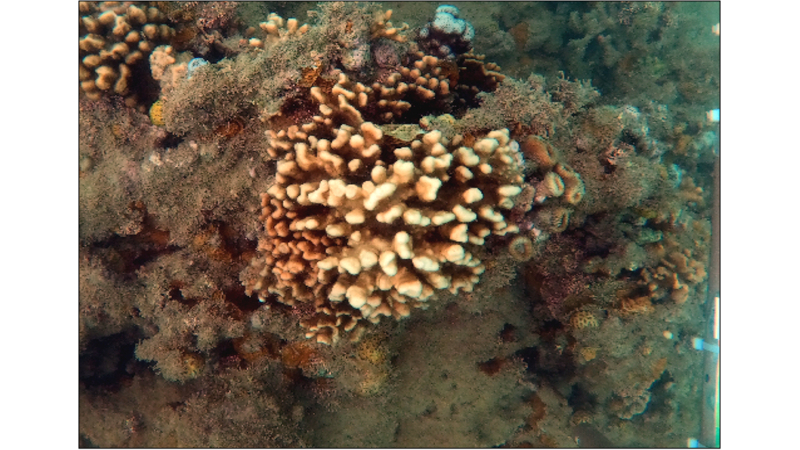
A partially bleached colony of Millepora nitida in Recife de Fora, southern Bahia, following the 2023 heat wave (photo: Ralf Cordeiro/UFRPE)
Published on 03/23/2026
By André Julião | Agência FAPESP – According to the authors of a study supported by FAPESP and published in the journal Coral Reefs, fire corals may be undergoing a “silent extinction.” The data were obtained during the Coral Vivo Institute’s monitoring of fire corals, supported by Petrobras, which began after the first wave of bleaching severely affected Brazil in 2019.
Coral bleaching occurs when seawater temperatures rise, causing the zooxanthellae (microalgae that live inside the coral skeleton and provide food for the corals) to produce harmful compounds and be expelled. Consequently, the corals turn white and may die from a lack of energy.
Monitoring was conducted before, during, and after the most recent bleaching event, which occurred during a heat wave in early 2024. This event was a consequence of the El Niño-Southern Oscillation phenomenon.
The study indicates that Millepora braziliensis, a species endemic to Brazil, experienced 100% bleaching and lost all living cover in the monitored colonies in the municipality of Tamandaré in the state of Pernambuco. This species is listed as critically endangered by the Chico Mendes Institute for Biodiversity Conservation (ICMBio, linked to the Brazilian Ministry of the Environment) and the International Union for Conservation of Nature (IUCN).
Meanwhile, another endemic species, Millepora nitida, experienced 40% bleaching without significant loss of coverage.
“The results reinforce the need for conservation measures to protect corals, especially M. braziliensis populations, which face a high risk of extinction due to heat waves caused by phenomena such as the warm phase of the El Niño-Southern Oscillation, in conjunction with global warming caused by greenhouse gas emissions,” explains Miguel Mies, a professor at the Oceanographic Institute of the University of São Paulo (IO-USP) and one of the coordinators of the study.
Mies also coordinates the project “The Global History of Climate Change Impacts on Coral Reefs: The Role of Refuges and Oceanographic and Functional Attributes”, which is supported by FAPESP.
Fire corals have historically been neglected in monitoring efforts of this kind. In part, this is due to the difficulty of accessing the colonies and their position on reef edges. Another factor influencing the limited attention given to them is the lower abundance of three of the fire coral species found in Brazil compared to so-called true corals.
“However, fire corals have ecological importance comparable to that of true corals, as they contribute to the complexity of the ecosystem by providing shelter and hiding places for other animal species,” explains the researcher, who is also the scientific director of the Coral Vivo Institute.
Laura Marangoni, also from the Coral Vivo Institute, and Tarciso Roberto Sena da Silva, a master’s student at the Federal Rural University of Pernambuco (UFRPE) under Ralf Cordeiro (https://bv.fapesp.br/en/pesquisador/702624/ralf-tarciso-silva-cordeiro), are the lead authors of the study. Cordeiro coordinated the monitoring of the fire corals.
Bleaching is the greatest threat to the world’s coral reefs. The 2023-2024 event was the fourth global occurrence of this phenomenon and affected true corals along the Brazilian coast, as reported in a study by the same group published in September 2025
For instance, bleaching reached 96% in Maragogi in the state of Alagoas and 84% in Porto de Galinhas in Pernambuco. Worldwide, 84% of coral reefs were affected by bleaching during the same period.
Silent extinction
Fire corals of the species M. nitida were monitored at three sites in Recife de Fora in the municipality of Porto Seguro in the state of Bahia. The M. braziliensis species was studied in colonies in Tamandaré, Pernambuco, which is part of the Costa dos Corais Environmental Protection Area stretching from that municipality to Maceió in Alagoas.
Two other fire coral species are found in Brazil. M. alcicornis, which is also found in the Caribbean, is closely monitored and more abundant, though it raises concerns as well.
M. laboreli, the third species endemic to Brazil, is restricted to Parcel do Manuel Luís on the coast of the state of Maranhão. The site is difficult to access, resulting in a significant information gap regarding its conservation status.
“The latest news we received from a group that was there in 2022 is that there were few living colonies. The situation may have worsened after the 2023-2024 heat wave. However, we don’t have enough data to say for certain,” says Mies.
However, the researcher does not hesitate to state that these species may become extinct in the coming years during new bleaching events that are sure to occur. For now, reducing greenhouse gas emissions that warm the planet and contribute to events like heat waves is the only way to find an immediate solution to the problem.
Restoration initiatives, in which corals are cultivated in laboratories and introduced into the wild, have not yet been successful. This practice is costly and competes with other conservation initiatives for resources. Moreover, the introduced corals die in subsequent bleaching events.
However, the researchers note that studies have shown that corals in conservation areas tend to suffer less from bleaching than those outside these protected areas.
“Unlike the 2019 bleaching event, for which we were unprepared, what’s happening now is being well documented to inform public policy. We need to strengthen conservation efforts and raise awareness about the importance of curbing climate change,” Mies concludes.
The article “A fragile branch: the silent decline of neglected Brazilian milleporids amid the fourth global bleaching event” can be read at link.springer.com/article/10.1007/s00338-025-02793-9.
Source: https://agencia.fapesp.br/57551


