


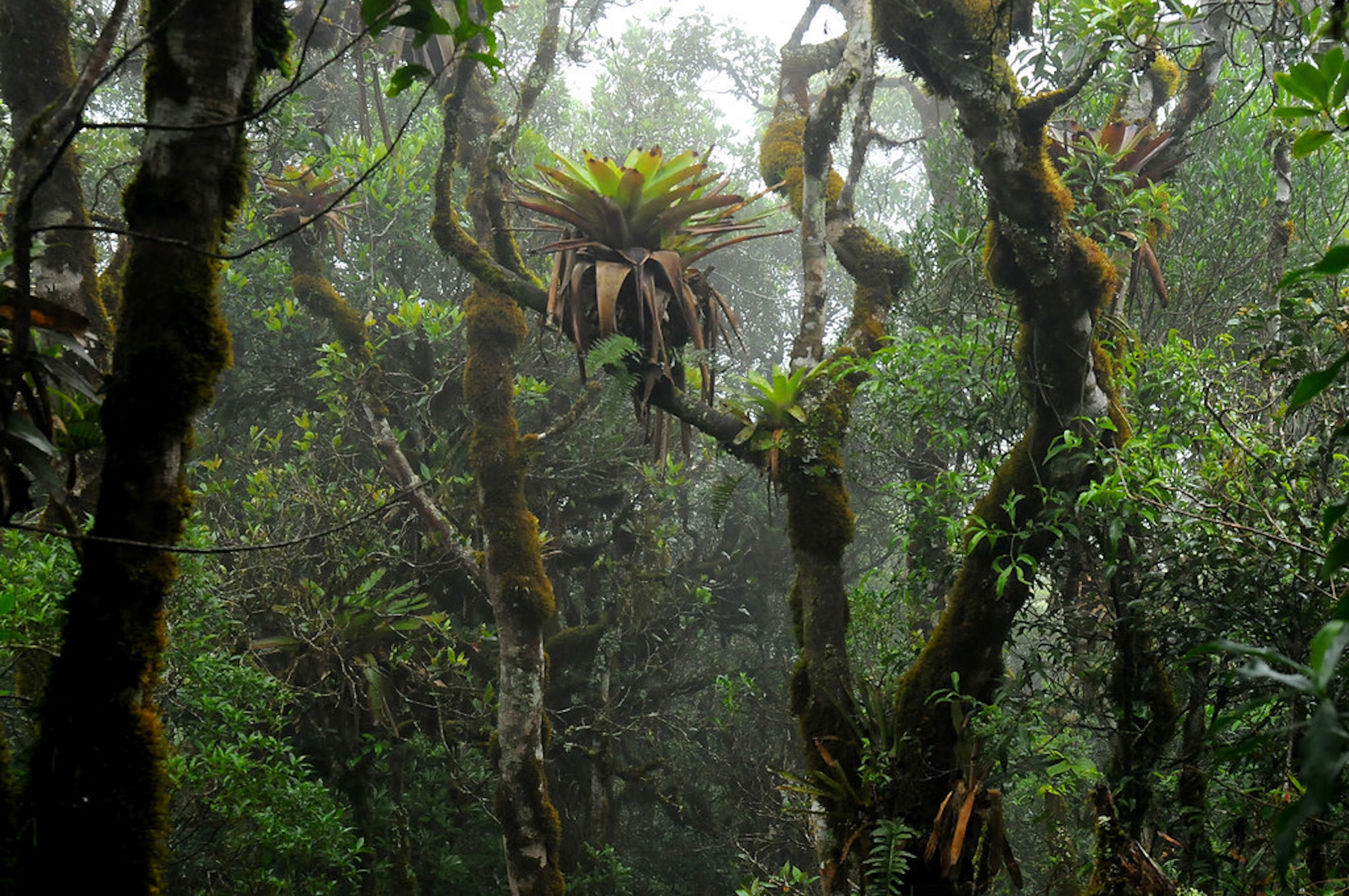
A bromeliad high up in a tree at the Santa Virgínia Center in the Serra do Mar State Park. Water accumulates in its tanks, concentrating nutrients that fertilize the soil below during rainfall events (photo: Rafael S. Oliveira/IB-UNICAMP)
Published on 12/15/2025
By André Julião | Agência FAPESP – Anyone seeing a white jacaranda (Jacaranda puberula), also known as caroba, blooming in the sandbank forest might assume that the leafy tree could not survive in such sandy soil. They would be right. This type of Atlantic Forest, located very close to the sea, is characterized by species that thrive in acidic soil with few nutrients.
In a study published in the journal Plant and Soil and supported by FAPESP, researchers from the State University of Campinas (UNICAMP) in the state of São Paulo, Brazil, found that this apparent contradiction is favored by the presence of a specific group of plants that live in the treetops: epiphytic tank bromeliads. These bromeliads are known for accumulating water between their leaves and living on other plants.
In addition to water, these bromeliads accumulate debris, such as plant and animal remains. When the tanks overflow, the nutrients from this debris, dissolved in the water, fertilize the soil beneath the branches where the bromeliads live. This fertilized area facilitates the growth of plants with high nutritional demands compared to other species in the study area, such as caroba.
This previously unknown relationship between epiphytes and ground-dwelling plants has been described as a new type of plant interaction called remote plant interaction because it occurs between physically distant organisms.
In their experiments, the researchers found that caroba seedlings irrigated with bromeliad water had leaves with 35% more potassium, 36% more phosphorus, and 3% more iron. These leaves also had 24% less manganese, which can be toxic to some species. The plants also produced nearly twice as many leaves as those irrigated only with rainwater.
“Bromeliads can accumulate up to 50,000 liters of water per hectare in tropical forests. We’ve now found that overflow from the tanks of these plants, by creating patches of soil richer in nutrients, can facilitate the growth of plants with high nutritional demands, such as caroba,” says Tháles Pereira, the first author of the study. Pereira conducted the study during his doctoral studies at the Institute of Biology (IB) at UNICAMP with a scholarship from FAPESP.
The work integrates three projects supported by FAPESP. One of these is “Influence of Aquatic Subsidies on the Resilience of Recipient Food Webs in Riparian Forests”, which is linked to the Thematic Project “Continental Aquatic Ecosystems Under Climate Change: Impacts at Multiple Levels of Organization”. Additional support is provided under the FAPESP Research Program on Biodiversity Characterization, Conservation, Restoration, and Sustainable Use (BIOTA-FAPESP). Gustavo Quevedo Romero, a professor at IB-UNICAMP who supervised Pereira’s doctoral studies, coordinates all three projects.
“Although epiphytic tank bromeliads occur in the tree canopy, they also play an important ecological role for soil communities, a function that was unsuspected until recently. They harbor complete ecosystems, tolerate various stresses, and exhibit great phenotypic plasticity, giving them high facilitating potential. This study reveals a new ecological role for these plants and reinforces the need for their conservation, since reducing them could trigger losses of species and ecological functions,” says Romero.
Adaptation
In a previous study, the researchers showed how water from bromeliads alters the diversity of plants in the soil beneath them. “We found that some species in the sandbank forest are so adapted to nutrient scarcity that when they receive the pulse of nutrients from bromeliad water, their growth is reduced, possibly due to intoxication caused by excess nutrients,” says Pereira.
However, he explains, the patches irrigated by bromeliads form a small fraction of the area. Caroba, for example, represents around 5% of the plants in the sandbank forest analyzed by the researchers at the Picinguaba Center in Ubatuba, part of the Serra do Mar (“Sea Ridge”) State Park in the state of São Paulo.
“Although it reduces the presence of some species in these patches, the nutrient-rich water from bromeliads contributes to the functional diversity of the system as a whole, favoring species with high nutritional demands that couldn’t grow in other parts of the same forest,” Pereira says.
In both studies, the researchers analyzed water from bromeliads living on horizontal branches with water dripping directly onto the ground, bypassing other parts of the tree entirely.
Experiment
In the current study, the group sought to eliminate other factors that could affect plant growth in the soil and isolate the role of bromeliad water in the system. To accomplish this, the researchers collected bromeliad and rainwater directly from the study area. The water was frozen and used to irrigate young caroba seedlings acquired from the region in a greenhouse in Campinas.
Ten of the 30 bromeliads from which water was collected also had pitanga (Eugenia uniflora) leaves enriched with a type of nitrogen uncommon in nature that can be traced by chemical analysis. The researchers demonstrated that nutrients were transferred from the debris in the bromeliad tanks to the leaves of plants irrigated with water from these epiphytes.
Compared to rainwater, bromeliad water had twice as much nitrogen, four times as much calcium, ten times as much magnesium, six times as much sulfur, and at least eleven times as much phosphorus, among other nutrients.
The researcher is now studying the role of bromeliads in the diversity and functioning of soil microbial communities. He received a research internship for this work at Pennsylvania State University in the United States.
The article “Epiphytic tank bromeliads enhance nutrition and growth of terrestrial seedlings: Experimental evidence of a novel mechanism of facilitation” can be read at link.springer.com/article/10.1007/s11104-025-07945-y.
Source: https://agencia.fapesp.br/56827


