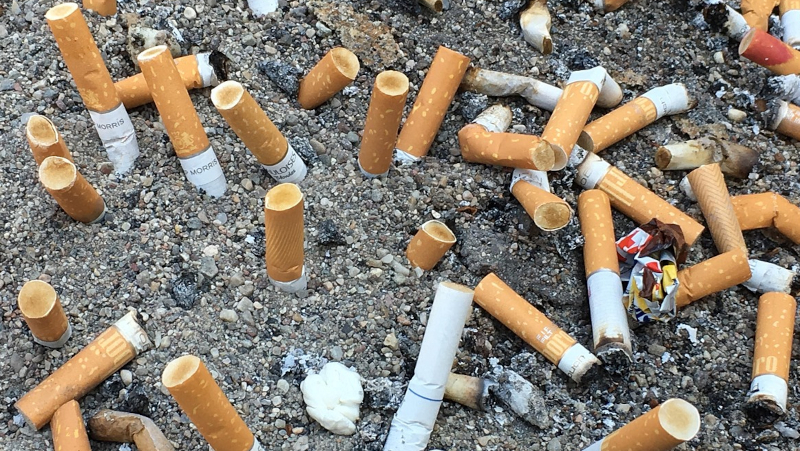
“For decades, the tobacco industry has promoted the idea that the filter is biodegradable,” says the researcher (image: P. Schreiner/Pixabay)
Published on 09/07/2026
By José Tadeu Arantes | Agência FAPESP – Every year, no fewer than 4.5 trillion cigarette butts are improperly discarded, forming one of the most ubiquitous – and least noticed – forms of global environmental pollution. This equates to about 550 cigarette butts per person per year.
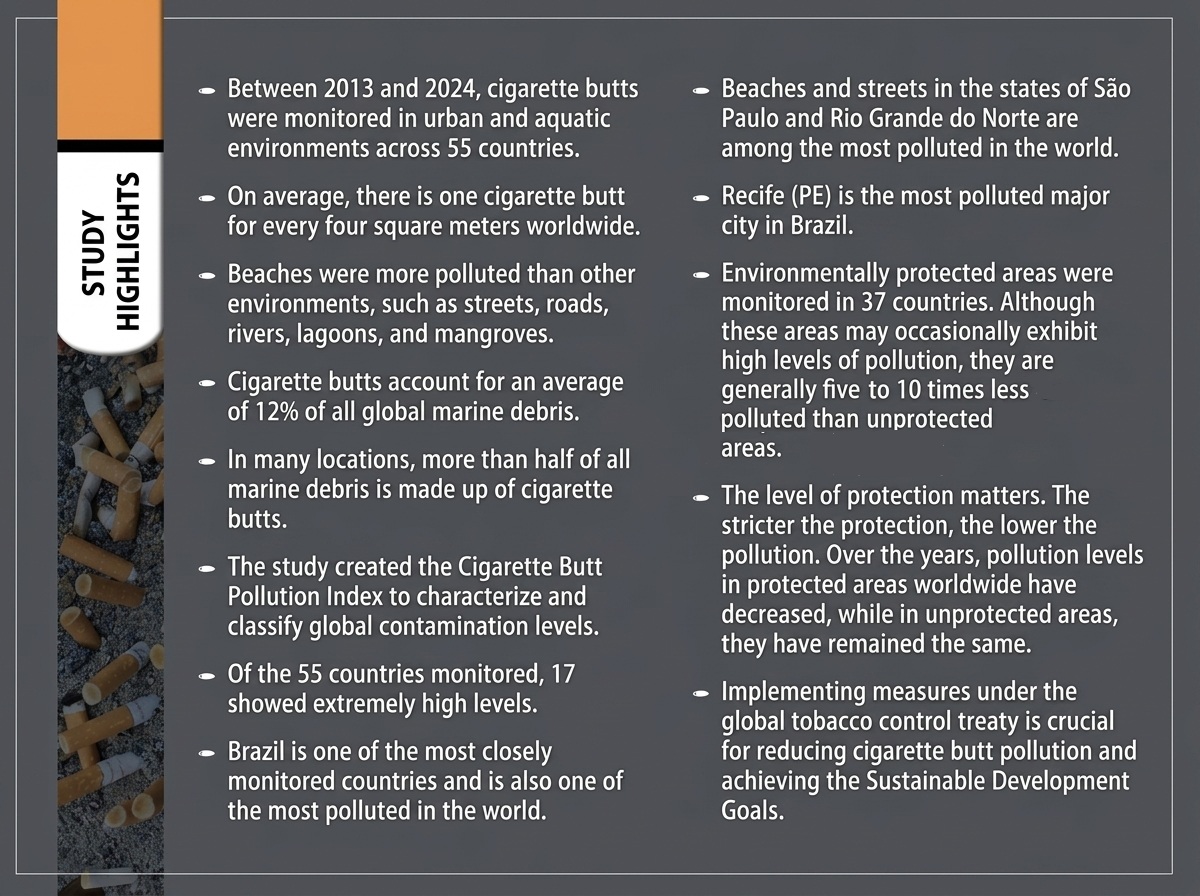
A comprehensive analysis of 130 scientific studies conducted in 55 countries between 2013 and 2024 reveals that these small pieces of litter reach an average density of 0.24 butts per square meter in urban and aquatic environments. That’s like finding one cigarette butt every four square meters. Extreme peaks worldwide have exceeded 38 cigarette butts per square meter on highly populated and frequently visited beaches and coastal areas. The total mass of cigarette butts discarded into the environment annually is approximately 766.6 million kilograms.
The study also shows that environmentally protected areas, especially those with stricter regulations, can reduce pollution by up to tenfold compared to unprotected areas. Nevertheless, neither national parks nor marine reserves are entirely free from the problem since ocean currents can carry trash discarded far away, whether on beaches or in urban areas, to these locations.
The review is the result of a partnership between researchers from the Federal University of São Paulo (UNIFESP), São Paulo State University (UNESP), and the National Cancer Institute (INCA) in Brazil; Johns Hopkins University in the United States; and the San Ignacio de Loyola University in Peru. It is the most comprehensive synthesis ever produced on the global distribution of cigarette butts and their environmental implications. An article on the subject with Victor Vasques Ribeiro, an environmental engineer and Ph.D. candidate at UNIFESP’s Institute of Marina Sciences, as the first author was published in the journal Environmental Chemistry Letters. The article describes the spatial patterns, or pollution hotspots, and the effect of environmental protection levels on mitigating the problem.
“The chemical contaminants present in cigarette butts spread rapidly, especially when in contact with seawater. Within a few weeks, this toxic material is released into the environment and can be lethal to various aquatic species,” says Ribeiro. Cigarettes contain more than 7,000 chemical compounds, at least 150 of which are toxic. But the problem doesn’t end there. The filter core is made of cellulose acetate, a polymer that, like other plastics, persists in the environment for an extremely long time. It breaks down into microplastics that contaminate marine organisms and can re-enter the human food chain when these organisms are consumed.
In addition to addressing the environmental impact, the study discusses the public health debate and the role of filters in the history of cigarettes. André Salem Szklo, who supervised the review study and is part of INCA’s Tobacco Control Division, says that the existence of the filter has historically been used as a marketing ploy. “It conveys the idea that cigarettes are a healthier product with a filter, thereby encouraging people to start smoking and continue the habit. But that claim doesn’t hold up. In fact, after filters were introduced, there was an increase in a specific type of lung cancer linked to fine particles,” he explains.
Szklo draws attention to the narrative promoted by the tobacco industry regarding individual responsibility for littering. “It’s important not to blame the smoker. For decades, the tobacco industry has spread the idea that filters are biodegradable. That has influenced – and continues to influence – behavior. The truth is that cigarette butt pollution exists solely because there’s an industry that profits from the sale of cigarettes.”
“If people understood that they’re throwing away a chemical bomb when they discard a cigarette butt, perhaps they wouldn’t act so casually,” Ribeiro adds.
The figure of 4.5 trillion cigarette butts ending up in urban and aquatic environments each year was not derived directly from the new review but from a World Health Organization (WHO) compilation. Ribeiro notes that about 12 trillion cigarettes are smoked each year globally. “A huge fraction ends up in the oceans, where almost all waters converge,” he states. Beaches experience heavy foot traffic, intense tourism, and recreational activity, all of which encourage improper disposal. However, that is not the only reason they are the most polluted areas; they also function as veritable “sinks” for solid waste. Cigarette butts discarded in cities or distant regions can be carried by rain and rivers to the sea. In addition to the direct environmental impact of discarding smoked cigarettes, the production and consumption of cigarettes emit 84 million metric tons of carbon dioxide into the atmosphere each year.
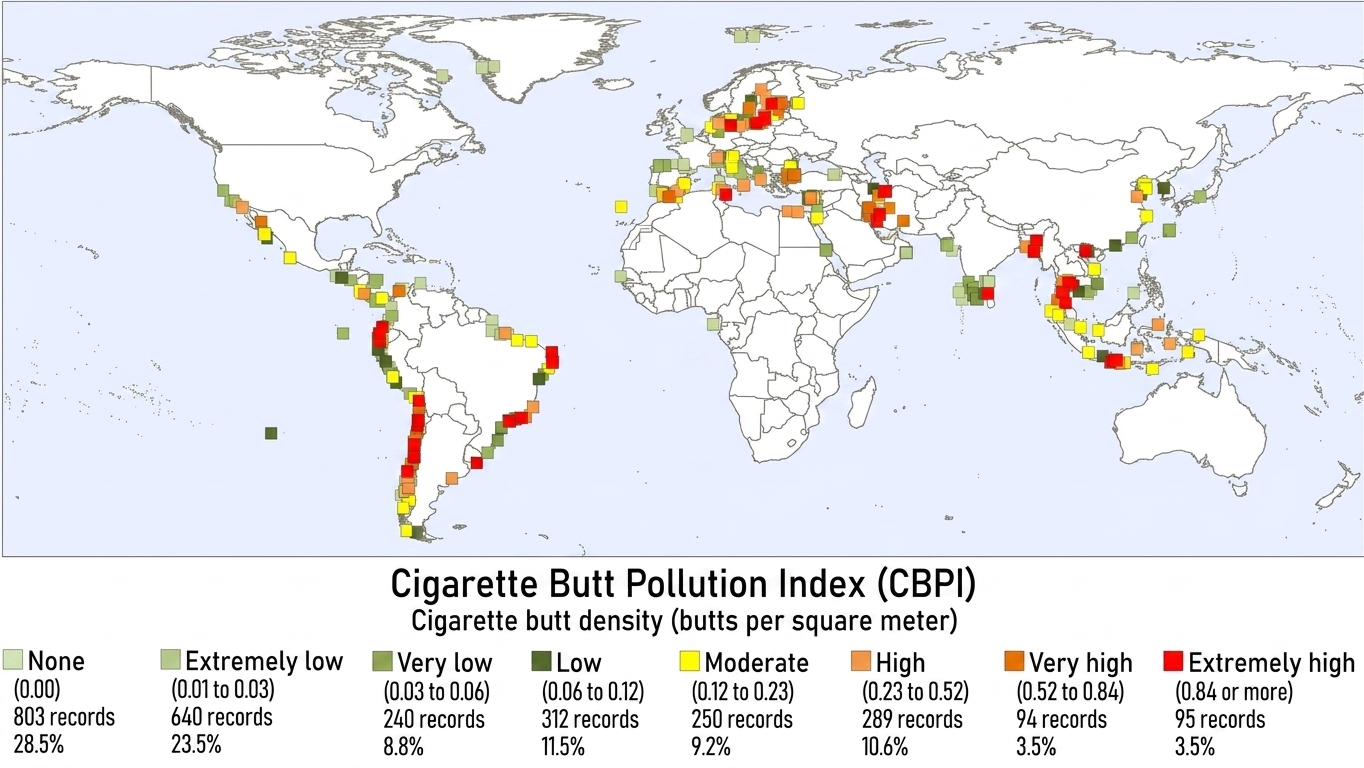
A global analysis revealed high concentrations of hotspots – critical areas accounting for the top 5% of the most polluted locations among all monitored sites worldwide – in 17 countries, primarily in South America, the Middle East, and Southeast Asia. On Persian Gulf beaches, for instance, more than 38 cigarette butts per square meter have been found. In South America, beaches in Chile, Brazil, Uruguay, and Ecuador repeatedly appear among the most critical sites, with cigarette butts accounting for more than half of all collected trash in some cases.
The authors of the study created the Cigarette Butt Pollution Index (CBPI), which ranges from “none” to “extremely high.” Published data are lacking for most of North America, Africa, Central Asia, East Asia, and all of Oceania, making global comparisons difficult.
Status of cigarette butt pollution in different regions of the world. The red dots, which indicate the most polluted areas, are spread across 17 countries. Most of North America, Africa, Central and East Asia, and all of Oceania appear in white. This is due to a lack of published data in these regions (image: Victor Vasques Ribeiro)
By cross-referencing records with international maps of conservation areas, the authors identified 165 monitored protected areas in 37 countries. Even areas officially established for nature conservation are not immune to cigarette butt pollution. The average density of cigarette butts in protected areas was nearly five times lower than in unprotected areas, and the reduction was greater in the most restrictive protection categories. “Even so, hotspots were found within protected areas, including parks and reserves, especially in areas with heavy tourism or limited enforcement. Legal designation alone isn’t enough. A general reduction in the number of smokers, as well as improvements in infrastructure, enforcement, and environmental education, make a difference,” Ribeiro comments.
Szklo believes that it is impossible to discuss plastic pollution without considering the enormous negative impact of cigarette butts on the Sustainable Development Goals established by the United Nations (UN). “We’re talking about the most discarded item in the world. In some places, more than half of the trash on a beach consists solely of cigarette butts. There have even been cases where nearly 100% of the waste consisted of cigarette filters. How can we conceive of a global treaty against plastic while ignoring the need to strengthen the implementation of the tobacco control measures outlined in the World Health Organization’s Framework Convention on Tobacco Control?” he emphasizes.
The researchers argue that the findings of the study should inform international negotiations, such as the UN treaty against plastic pollution, as well as local measures, including bans on smoking on beaches and in parks, educational campaigns, improved waste management, and, above all, greater accountability on the part of the tobacco industry.
The study received support from FAPESP through a Doctoral Scholarship (https://bv.fapesp.br/en/bolsas/206287) for Ribeiro under the supervision of Ítalo Braga de Castro and a Young Investigator Research Grant awarded to the second author, Lucas Buruaem Moreira.
The article “Global cigarette butt contamination: A review” can be accessed at link.springer.com/article/10.1007/s10311-026-01897-0.
Source: https://agencia.fapesp.br/59143