


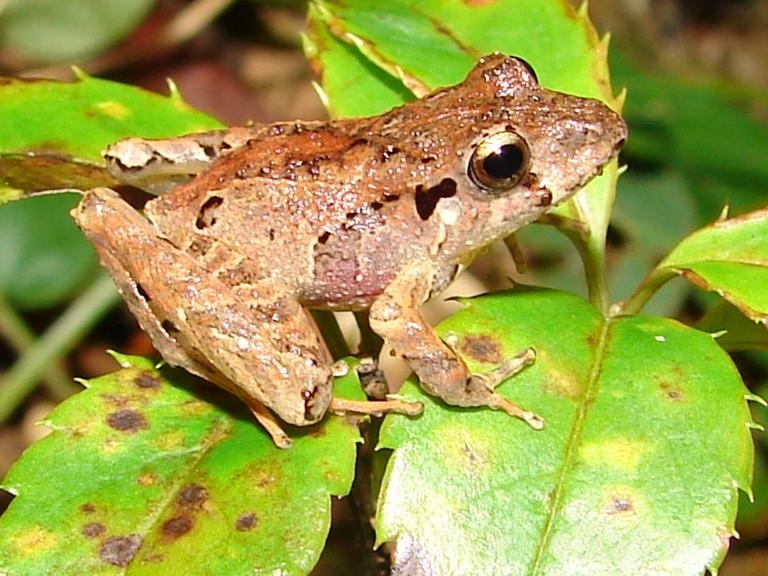
Two migratory species, Ischnocnema henselii (pictured) and Rhinella ornata, had higher fungal loads precisely where habitat split was greatest (image: Raquel Rocha Santos/Wikimedia Commons)
Published on 07/13/2026
Agência FAPESP* – A study published in the Proceedings of the National Academy of Sciences indicates that a frog’s resistance to a fungus that has decimated hundreds of amphibian species worldwide is due not only to its genes, but also to the beneficial bacteria living on its skin and to the organization of its surrounding landscape.
Scientists have demonstrated that a disconnect between forests and bodies of water impairs amphibians’ ability to recruit defensive microbes, making them more susceptible to Batrachochytrium dendrobatidis (Bd), a fungus that is one of the most devastating pathogens for this class of animals.
This phenomenon is called “habitat split” – the spatial separation of the terrestrial and aquatic environments required by many amphibian species to complete their life cycle (reproduction in water and adulthood in the forest).
Led by Daniel Medina, a professor at the School for Field Studies in the United States, and Renato A. Martins, the team collected skin samples from 586 frogs of four species in the Atlantic Forest of the state of São Paulo, Brazil. The team also included Guilherme Becker from Penn State University in the United States and Célio Haddad from São Paulo State University (UNESP) in Rio Claro, who is the scientific coordinator of the Center for Research on Biodiversity Dynamics and Climate Change (CBioClima). Using high-resolution genetic sequencing, the researchers identified the present bacteria and cross-referenced this information with the AmphiBac database, which contains over 7,800 bacterial isolates tested in a laboratory for their ability to inhibit Bd growth.
CBioClima is one of FAPESP’s Research, Innovation, and Dissemination Centers (RIDCs).
The team then quantified the fungal infection load in each animal, as well as landscape metrics such as the percentage of forest cover, edge density within the fragments, and most importantly, the distance between forest fragments and bodies of water. Advanced statistical models (GLMMs and joint species distribution models) isolated the effect of habitat split from other variables, such as collection date and surrounding landscapes.
The results were striking. In areas with high habitat split, the proportion of genetic reads corresponding to bacteria capable of inhibiting Bd dropped sharply. Two migratory species, Ischnocnema henselii and Rhinella ornata, exhibited higher fungal loads precisely where habitat split was greatest. In contrast, species able to use tank bromeliads (such as Boana faber) were less affected. The data suggest that moist microhabitats within the forest itself can mitigate the effects of fragmentation.
According to the authors, the study provides the first robust field evidence for the “adaptive microbiome principle”: repeated, low-level exposure to the pathogen – which occurs naturally in connected landscapes – selects for microbial communities that are better prepared to cope with future infections. When connectivity is disrupted, amphibians lose access to beneficial microbes in the environment and the opportunity to “train” their microbial defenses.
“The significance of this study lies in the evidence that preserved and connected habitats are the cradle of healthy populations – a reality that dissipates under the impact of human-caused fragmentation. More than just a diagnosis, the research provides insights for forest reconnection strategies that focus on combating the aftermath of the illegal deforestation plaguing the country. It’s crucial to acknowledge that human survival is inextricably linked to environmental health. In this context, amphibians emerge as sentinels of environmental quality, reminding us that functional ecosystems are the foundation of our own health and longevity,” says Haddad.
The article “Connecting habitats, boosting disease resistance: Spatial connectivity enhances amphibian microbiome defenses against fungal pathogens” can be read at pnas.org/doi/10.1073/pnas.2520745123.
* With information from CBioClima
Source: https://agencia.fapesp.br/58666


