


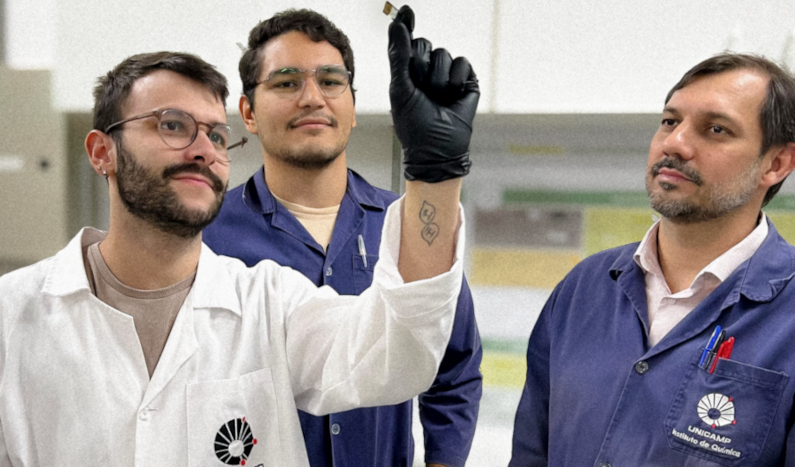
Using an electrochemical method, in which electricity generates chemical reactions, the UNICAMP researchers were able to remove cyanides from catalysts, generating vacancies (photo: CINE)
Published on 01/30/2026
Agência FAPESP* – In a study by the Center for Innovation on New Energies (CINE) published in the journal Electrochimica Acta, a group of scientists from the State University of Campinas (UNICAMP) in the state of São Paulo, Brazil, significantly increased the efficiency of low-cost catalysts using a simple approach: introducing defects into the material.
The CINE is an Applied Research Center (ARC) established by FAPESP and Shell in 2018. The center is based at UNICAMP, the University of São Paulo (USP), and the Federal University of São Carlos (UFSCar), with the participation of eight other Brazilian institutions.
Currently, splitting water molecules using energy from renewable sources is the most effective method for producing hydrogen with the lowest possible carbon emissions. In this process, two reactions occur simultaneously, generating the release of oxygen and hydrogen, respectively.
Efficient water splitting requires good catalysts, especially for the oxygen release reaction, which is much slower. Currently, the cost of these materials represents 20% to 30% of the total cost of the hydrogen obtained at the end of the process. Therefore, developing efficient, inexpensive catalysts is an important scientific challenge.
The CINE scientists selected materials known as “Prussian blue analogues,” which are composed of metal atoms and chemical groups called cyanides. These catalysts are made of elements that are abundant on Earth and relatively inexpensive. However, their performance is limited by the low concentration of active catalytic sites.
Using an electrochemical method in which electricity generates chemical reactions, the UNICAMP researchers were able to remove cyanides from these materials and create vacancies in their structure. “It may seem strange, but these ‘defects’ caused by vacancies can be a very good thing. The structure of the material changes slightly, creating more active spaces where important chemical reactions can occur more easily,” explains Juliano Bonacin, a professor at the Institute of Chemistry (IQ-UNICAMP) and CINE researcher who led the research.
The activated materials were then used as catalysts in the oxygen release reaction. The experiments showed a significant improvement: the catalyst with 30% more defects generated 32% more oxygen than the original. In addition, the vacancies in the catalysts were studied using techniques available at the Brazilian National Synchrotron Light Laboratory (LNLS), which is part of the Brazilian Center for Research in Energy and Materials (CNPEM). This study aimed to clarify the mechanisms that led to the favorable results.
According to Bonacin, the catalysts developed in the study are a promising step toward large-scale, low-carbon hydrogen production. However, tests outside the laboratory have not yet been conducted. “Although there’s still a way to go, the results obtained indicate a concrete and viable advance toward cheaper and more sustainable industrial technologies,” the scientist adds.
The work was funded by FAPESP through seven other projects (14/50867-3, 17/50085-3, 18/25092-9, 18/25207-0, 19/00063-9, 19/24445-8 and 21/05976-2). It was also supported by Shell and the National Council for Scientific and Technological Development (CNPq), as well as the National Agency of Petroleum, Natural Gas, and Biofuels (ANP).
The article “Electrochemical generation of unconventional cyanide vacancies to boost the catalytic performance of Co-Prussian Blue on oxygen evolution reaction under mild conditions” can be read at doi.org/10.1016/j.electacta.2025.146327.
* With information from Verónica Savignano from the CINE
Source: https://agencia.fapesp.br/57066


