


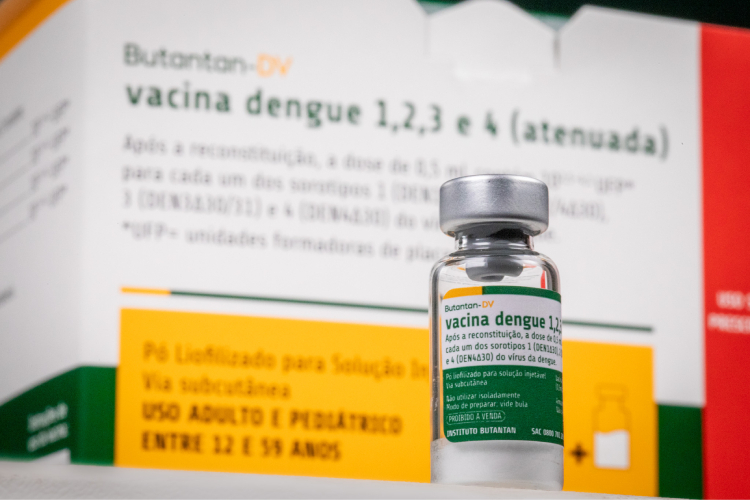
In January of this year, the Brazilian Ministry of Health began a pilot project to vaccinate 90% of the target population in the cities of Nova Lima, Maranguape, and Botucatu (image: Butantan Institute)
Published on 03/09/2026
Agência FAPESP – The tetravalent dengue vaccine, developed by the Butantan Institute in São Paulo, Brazil, with support from FAPESP, was 80.5% effective against severe dengue cases with warning signs over a five-year period. The results of the phase 3 clinical trial were published on March 4 in Nature Medicine.
Funded by the Brazilian Ministry of Health, the Brazilian Development Bank (BNDES), and the Butantan Foundation, the study was conducted at 16 research centers across Brazil’s five regions. From February 2016 to July 2019, 16,235 participants between the ages of 2 and 59 were recruited. Of those, 10,259 received a single dose of the vaccine, while 5,976 received a placebo.
There were no reports of hospitalization in the vaccinated group, compared to eight cases in the placebo group.
Overall, the vaccine was 65% effective in preventing symptomatic dengue (caused by any serotype) during the five years of monitoring.
The vaccine, called Butantan-DV, was approved by the Brazilian Health Regulatory Agency (ANVISA) on November 26, 2025, for use by the Brazilian population aged 12 to 59. Since then, the institute has sent 1.3 million doses to the National Immunization Program (PNI), which distributes them to Brazil’s national public health network, the SUS (Sistema Único de Saúde).
In January of this year, the Ministry of Health began a pilot project to immunize 90% of the target population in Nova Lima (Minas Gerais state), Maranguape (Ceará state), and Botucatu (São Paulo state). The vaccination of primary care health professionals began on February 9.
The vaccine protects against different types of the dengue virus because of its tetravalent composition. This means that it contains specific components to combat the four known serotypes: DENV-1, DENV-2, DENV-3, and DENV-4.
The vaccine uses live viruses that have been “weakened” (attenuated) in a laboratory setting so that they cannot cause disease, yet are still able to stimulate an immune response. The strains used are based on technology originally developed by the United States National Institutes of Health (NIH).
For DENV-1, DENV-3, and DENV-4, the vaccine uses nearly complete genomes of the respective viruses. For DENV-2, protection is built using a chimeric virus consisting of DENV-2 surface proteins mounted on the attenuated structure (“skeleton”) of the DENV-4 virus.
Once administered, the vaccine generates vaccine viremia, the controlled replication of these attenuated viruses in the body. This process induces the immune system to produce neutralizing antibodies specific to each of the four serotypes. The goal is to create specific immunity to each serotype so that the body recognizes and neutralizes each variant individually.
“This vaccine is establishing itself as a very important tool in the fight against dengue in Brazil, with the potential to contribute to reducing the circulation of the virus, in addition to individual protection,” Fernanda Boulos, the institute’s medical director of clinical trials, told the Butantan Communications Office.
The article “Long-term efficacy and safety of the single-dose tetravalent Butantan dengue vaccine” can be read at nature.com/articles/s41591-026-04255-3.
Source: https://agencia.fapesp.br/57407


