


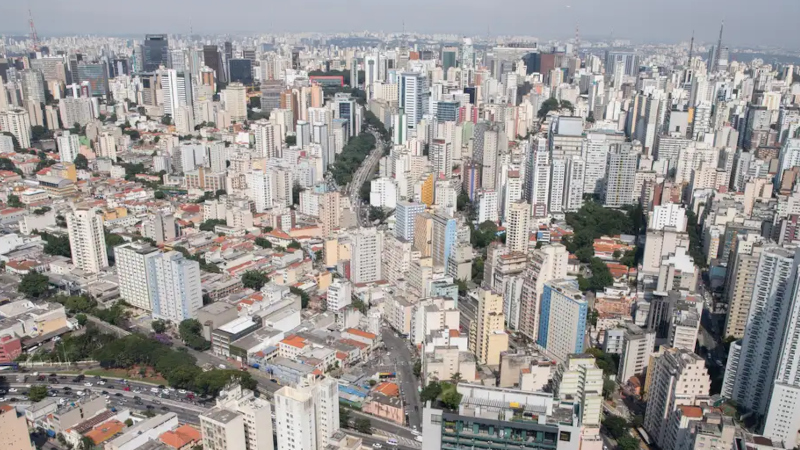
Villages and local centers received an average of BRL 1,816.21 per capita in federal transfers, while metropolises and regional centers received BRL 392.77 (photo: Diogo Moreira/São Paulo State Government)
Published on 12/10/2025
Agência FAPESP* – A study by the Center for Metropolitan Studies (CEM) shows that the distribution of federal funds and parliamentary amendments in Brazil favors very small municipalities. The CEM is a FAPESP Research, Innovation, and Dissemination Center (RIDC) based at the University of São Paulo (USP) and the Brazilian Center for Analysis and Planning (CEBRAP).
According to CEM researchers, larger municipalities – even though they generate more than half of Brazil’s wealth, require intensive urban and social policies due to their complexity, and are home to almost half of the population – receive fewer funds per capita than towns, villages, and local centers.
This information is presented in the Technical Note on Public Policies, Cities, and Inequalities, “Municipalities and the Fiscal Issue in Brazil: More Than Heterogeneous?”. The note is based on research conducted by Ursula Peres and Eduardo Marques, co-principal investigators at the CEM, and Gabriela Armani, a doctoral student in political science at Harvard University in the United States.
The research explores the fiscal and spending imbalances that benefit smaller municipalities in Brazil by examining the volume of per capita funds originating from federal and state transfers, own revenues, and capital, as well as the spending structure.
For the analysis, the researchers created a typology of municipalities based on the reorganization of the Regions of Influence of Cities (REGIC) classification from 2018. They distributed fiscal, demographic, and political variables over this typology for the period between 2005 and 2022. REGIC is a survey conducted by the Brazilian Institute of Geography and Statistics (IBGE) that identifies and analyzes the Brazilian urban network. It establishes the hierarchy of urban centers and their regions of influence and contains data from 5,215 municipalities.
Based on this reorganization, the researchers propose three distinct types of territorial units. The first type is villages and local centers, which includes 84% of Brazilian municipalities and accounts for about 25% of the population and 20% of wealth. These areas have low urbanization, a significant agricultural economy, substantial public services, less development, and greater relative poverty.
Towns, which constitute 13% of municipalities, are home to 25% of the population and wealth. They have intermediate levels of development and productive activities.
Finally, metropolises and regional centers represent less than 4% of the units but account for nearly 50% of the population and national wealth. They have lower average poverty levels, higher development indices, and significant industrial and service activities, with almost no agricultural activity.
Revenues
The researchers point out that villages and local centers depend heavily on federal transfers and, more recently, capital revenues linked, among other resources, to parliamentary amendments. Metropolises and regional centers, on the other hand, receive lower transfers and capital revenues than smaller municipalities when considering per capita values, and they have much more significant revenues of their own, especially from the Urban Property Tax (IPTU) and the Services Tax (ISS). Towns are positioned in between, but closer to cities and regional centers.
The researchers estimate that villages and local centers received an average of BRL 1,816.21 in federal transfers and BRL 964.04 in state transfers. For towns, these amounts were BRL 686.12 and BRL 919.63, respectively. Metropolises and regional centers received an average of BRL 392.77 and BRL 912.85, respectively.
Even the highest level of revenues from metropolitan areas and regional centers does not come close to compensating for the differences in federal and state transfers to smaller localities. Villages and local centers obtained an average of BRL 181.05 in own revenues for the mentioned period. Towns received an average of BRL 399.58, while metropolitan areas and regional centers received an average of BRL 664.11 per capita. All figures cited are averages for the period from 2005 to 2022.
“Analyzing the per capita revenue data for all units, it is clear that the disproportionate amounts allocated to villages, local centers, and towns are not even remotely offset by the own revenues of larger units and have recently been reinforced by capital revenues,” the researchers point out.
They add: “We did not explore municipal needs in terms of social and urban problems in the Technical Note, but considering that urban scales tend to generate growing problems due to agglomeration, there seems to be no doubt that very small units receive much more than they should in Brazil today, considering their actual needs.”
The Technical Note can be read at centrodametropole.fflch.usp.br/sites/centrodametropole.fflch.usp.br/files/inline-files/nt23.pdf.
* With information from Janaína Simões from the CEM.
Source: https://agencia.fapesp.br/56772


