


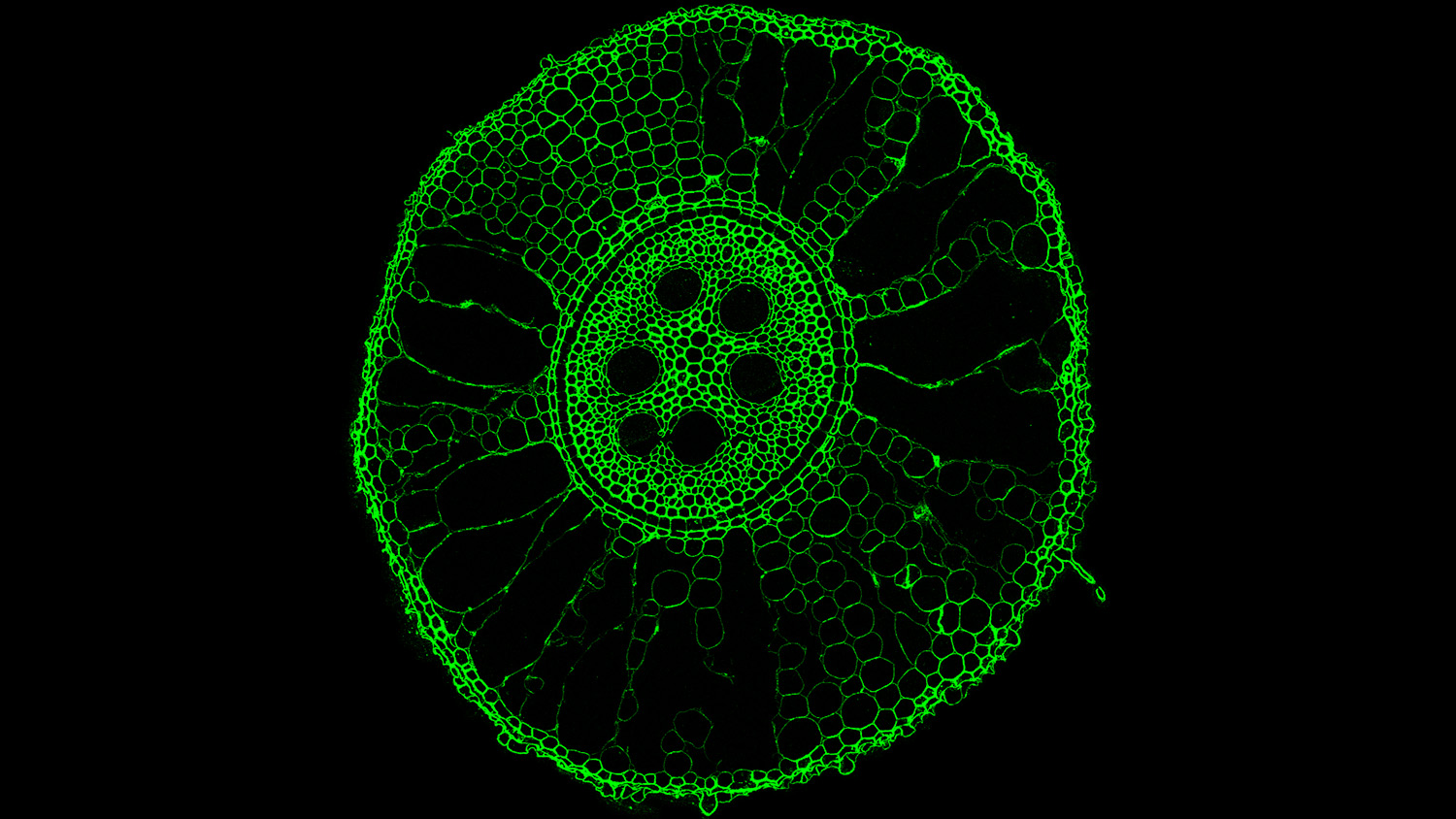
Cell walls of the sugarcane root cortex showing aerenchyma formation (larger spaces between the green lines) (image: Grayce Romim)
Published on 10/19/2026
By Karina Ninni | Agência FAPESP – Scientists at the University of São Paulo (USP) discovered that the key to breaking down tough sugarcane bagasse is found within the plant itself. By mapping the development of aerenchyma, which are porous structures found in the roots, the researchers identified a set of enzymes used by the plant to remodel its fibers. Using a single molecule from this “toolkit” in commercial enzyme cocktails increased the release of sugar from sugarcane waste by up to six times – an essential step toward accelerating the production of second-generation ethanol.
Currently, utilizing this biomass fully is hindered by the rigidity of lignocellulose, the material forming the plant’s “skeleton.” Due to this challenge, a Danish company has held a monopoly for years on an enzyme cocktail capable of breaking down this barrier, prompting scientists worldwide to investigate alternatives. The team at the Laboratory of Ecological Plant Physiology (LAFIECO) in the Department of Botany at the Institute of Biosciences of the University of São Paulo (IB-USP) spent 17 years researching to achieve their most recent results.
Marcos Silveira Buckeridge, coordinator of LAFIECO and co-author of the paper published in the Journal of Experimental Botany, explains that existing enzyme cocktails are derived from microorganisms, mostly fungi. This is the first time scientists have identified a plant-derived molecule with this property.
“And it’s not just any plant source – it comes from sugarcane itself,” the researcher points out. In 2008, Buckeridge proposed the concept of “papaya sugarcane,” which involves treating the plant so that it softens like a ripe papaya. He developed the concept with his student at the time, Aline Cavalari, who is now a professor at the Federal University of São Paulo. The idea was based on the observation that papaya softens when its cell walls separate, which facilitates the release of sugar. The goal was to replicate this process of cell separation in sugarcane.
First, the team had to map the chemistry and structure of the sugarcane cell wall and understand how cellulose is organized. “Several LAFIECO students took part in the research over the course of these 17 years, passing the baton from one to the next,” recalls the biologist, whose group published the first structural data on this topic in 2013.
In this regard, Buckeridge emphasizes the significance of long-term funding, like that provided by FAPESP through projects 14/50884-5, 14/50279-4, 20/15230-5, 22/00441-6, 19/13936-0, 15/13479-8, and 21/08334-1. “If funding agencies don’t understand the importance of this topic, we can’t sustain such complex research for 17 years.”
Aerenchyma and cell wall
The group already knew that aerenchyma formation in sugarcane roots was a natural process involving cell separation. These structures typically appear in response to a lack of oxygen (hypoxia), but in sugarcane, they form independently. As aerenchyma develops, the plant modifies and breaks down the walls of its roots, creating air tunnels. This process includes cell separation and the breakdown of complex sugars – two essential steps in using bagasse for ethanol production.
“Aerenchyma appears progressively in the sugarcane root. There's less of it at the tip, and its formation becomes more frequent as you move upward,” explains Bruno Viana Navarro, a postdoctoral researcher at LAFIECO and the first author of the article. The team wanted to observe which “microscopic tools” (enzymes) the plant activated during root remodeling.
Navarro describes the experiment: “We planted stalks of a well-studied sugarcane cultivar [SP80-3280] and, after three months, collected roots from tillers [new shoots], which were divided into four 1-cm segments. Thus, each segment had a different proportion of aerenchyma formation.”
By mapping cellular activity in these root segments, the scientists identified more than 32,000 active genes, about 5,000 of which were related to the cell wall. “We analyzed what changed throughout the progressive process of aerenchyma formation, comparing one root segment with the next,” Navarro explains.
The team focused on enzymes that function as “chemical scissors,” cutting the fibers of the cell wall and releasing the sugars. One of Buckeridge’s Ph.D. students, Eveline Tavares, identified a key molecule in this process: the enzyme ASD (α-L-arabinofuranosidase). Later, Ph.D. student Adriana Grandis elaborated on its importance in aerenchyma formation. Navarro summarizes the function of ASD: “It acts in a very specific way to rearrange the cell wall, breaking the bonds of one of the most abundant structural materials in sugarcane.”
100% plant-based
Recognizing the potential of ASD, the group led by postdoctoral researcher Débora Pagliuso produced this enzyme in the lab using yeast with the goal of testing it in practice. “We added ASD to the commercial cocktail and tested it on sugarcane bagasse. That addition alone increased the production of sugar, which is later converted into ethanol, by up to six times,” Navarro points out.
According to the researcher, the study reveals a vast molecular repertoire. The team has already identified approximately 530 genetic sequences and enzyme classes in sugarcane. This means there are dozens of other biological “tools” waiting to be tested.
“We found a second enzyme that’s also very promising whose function is to break down pectins. It attacks the middle lamella, the ‘cement’ between the cells. When those structures are broken down, the cells begin to separate, and that’s when the so-called ‘papaya sugarcane’ occurs. It becomes much easier to break down the structure and extract the sugars, which impacts the production of first- and second-generation ethanol,” says Navarro.
For Buckeridge, the success of the study reinforces the theory that “in-house” enzymes (from the plant itself) are better at decoding and breaking down the sugarcane structure than microorganisms. “It’s possible that these plant enzymes we’re presenting in the article have characteristics that microbial enzymes lack and that could be the key to highly efficient conversion of waste into higher-value products. We may have discovered a gold mine, but so far, we’ve only used a single coin.”
One of the group’s most ambitious future goals is to produce a customized, 100% plant-based enzyme cocktail. “By analyzing the biochemical composition of sugarcane biomass, we can create the enzyme cocktail best suited for its hydrolysis, which would increase ethanol production yields. We hope to achieve that one day,” says Navarro.
The article “Aerenchyma in sugarcane roots: a toolbox for tailoring biomass for bioenergy” can be read at academic.oup.com/jxb/advance-article-abstract/doi/10.1093/jxb/erag174/8658895.
Source: https://agencia.fapesp.br/59431


