


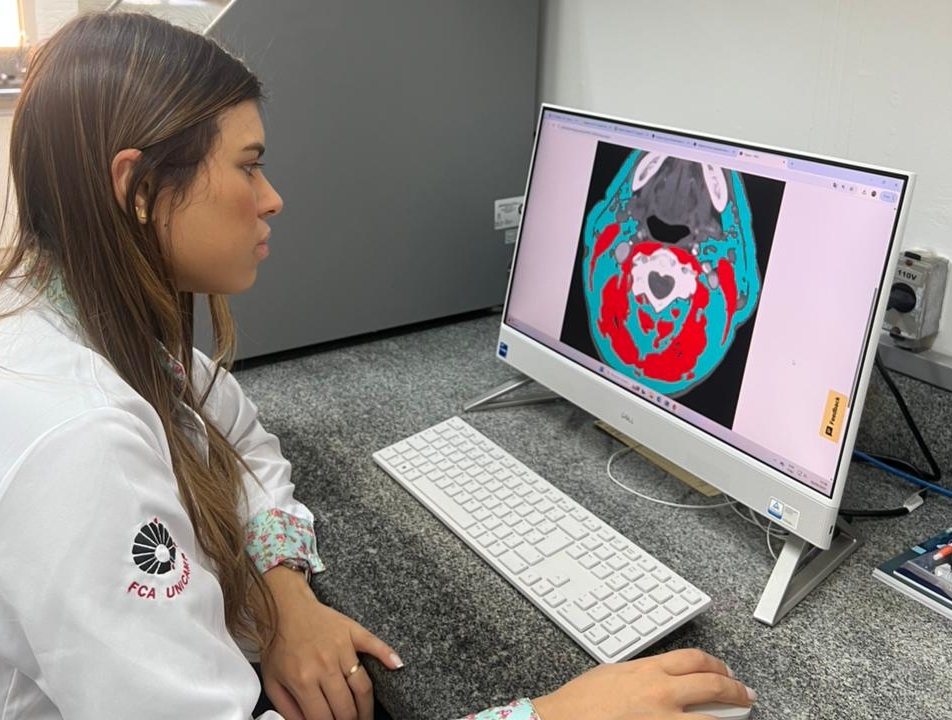
Although the role of obesity as a risk factor for the development of different cancers is already well-established, the influence of adipose tissue after the onset of the disease is a relatively unexplored field (photo: Maria Carolina Santos Mendes/CancerThera)
Published on 05/20/2026
By Fernanda Bassette | Agência FAPESP – In recent years, advances in oncology have revealed that understanding cancer requires more than just examining the tumor. For example, the nutritional status and body composition of patients have revealed themselves to be increasingly relevant factors in prognosis and response to treatment, especially with regard to head and neck cancer.
Two studies supported by FAPESP and conducted by researchers from the Center for Theranostic Innovation in Cancer (CancerThera) provide new evidence in this regard. CancerThera is one of the Research, Innovation, and Dissemination Centers (RIDCs) funded by the Foundation. It is based at the Hematology and Hemotherapy Center of the State University of Campinas (Hemocentro-UNICAMP) in São Paulo, Brazil.
Supervised by José Barreto Campello Carvalheira, the studies were published in international nutrition and clinical oncology journals. They investigated the relationship between adiposity (fat deposits), muscularity (amount of muscle mass), and survival in people with head and neck cancer, which is one of the most complex types of tumors to manage.
Head and neck cancer is a group of tumors that can develop in various regions, including the mouth, tongue, pharynx, larynx, sinuses, and salivary glands. Oral cavity tumors, which include those of the lips, oral cavity, salivary glands, and oropharynx, are the eighth most common type of cancer in Brazil, primarily affecting men over 40. According to data from the National Cancer Institute (INCA), it is not among the ten most frequent types of cancer among women.
“Patients with head and neck cancer are among those most likely to become malnourished. That’s because, in addition to issues related to the tumor and the treatment itself, the disease directly affects areas involved in chewing and swallowing, which makes it difficult to eat. Naturally, these patients experience greater weight loss and more severe malnutrition and are therefore considered to be at high nutritional risk,” explains Maria Carolina Santos Mendes, a nutritionist, co-supervisor of the studies, and associate researcher at CancerThera.
Although obesity is well-established as a risk factor for the development of different cancers, the influence of adipose tissue after the disease has taken hold is still an under-explored field. “In cancer, there’s something called the ‘obesity paradox.’ We know that obesity increases the risk of developing various types of tumors, but in some situations, adipose tissue can act as a protective factor when the patient already has the disease. That’s what we also observed in head and neck cancer,” Mendes explains.
The group’s first study, which analyzed 132 patients with locally advanced head and neck cancer, was published in March 2025 in Frontiers in Nutrition. The team used computed tomography images at the level of the third cervical vertebra (C3) to assess body composition parameters, such as total adipose tissue index and muscle mass.
The results showed that patients with higher levels of adiposity had a reduced risk of mortality compared to those with low fat indices. Individuals with more adipose tissue had a median overall survival of 27.9 months compared to 13.9 months among those with low indices – twice the lifespan.
“This data is noteworthy because it confirms that patients with higher amounts of fat in the C3 region had longer survival rates. This makes us think about the importance of early nutritional therapy. If I identify early in the diagnosis that the patient has low fat reserves, I can intervene more specifically and perhaps increase their survival,” Mendes explains.
This first study also found that preserving muscle mass in these patients was an independent protective factor for overall survival. The authors found that patients with greater muscle mass survived an average of 22.9 months, while those with low muscle mass lived an average of 8.6 months.
“These results clearly demonstrate the impact of body composition in this group and the importance of also evaluating adipose tissue. They raise new questions for science: What’s the impact of adipose tissue metabolism on the prognosis of these patients? Can we reverse this situation and increase the survival of these people with early nutritional support? It’s this type of research that guides the focus of our laboratory,” the nutritionist adds.
Impact on metastatic cancer
The team’s second study, published in August 2025 in Clinical Nutrition ESPEN, analyzed another group of 101 patients with metastatic or recurrent head and neck cancer treated at UNICAMP’s general teaching hospital (“Hospital de Clínicas”). This study reinforces the relevance of body composition.
Once again, CT scans of the C3 cervical region were used to map muscle and fat. The results showed that low muscularity is strongly associated with worse clinical outcomes. “All individuals with low muscle mass died within 24 months of follow-up. In contrast, some with higher muscularity were still alive after 40 months. This reinforces how it can be decisive for survival,” Mendes emphasizes.
Together, the findings of the two studies highlight the importance of viewing patients holistically and incorporating body composition assessments into clinical care. According to the researcher, assessment by CT scans, which are routinely performed, facilitates this type of analysis and makes it accessible to most cancer patients.
“Most studies only look at muscle mass. What sets our research apart is that we also included adipose tissue and found very relevant results. However, it’s not just the amount of fat that matters, but also its metabolism and how it can provide valuable information during treatment,” Mendes says.
According to the researcher, these studies are significant because they open the door to new therapeutic strategies that consider the interaction between muscle, fat, and cancer. “The idea is to reinforce what we already know: monitoring nutrition is essential. But that’s often neglected in practice. We want to show that body composition assessment should be routinely incorporated because it can make a difference in these patients’ time and quality of life,” Mendes concludes.
The article Adipose tissue characteristics as a new prognosis marker of patients with locally advanced head and neck cancer can be read at frontiersin.org/journals/nutrition/articles/10.3389/fnut.2025.1472634.
The article Prognostic impact of low muscularity in metastatic and recurrent head and neck cancer: insights from C3-based assessments can be read at clinicalnutritionespen.com/article/S2405-4577(25)00375-4.
Source: https://agencia.fapesp.br/58148


