


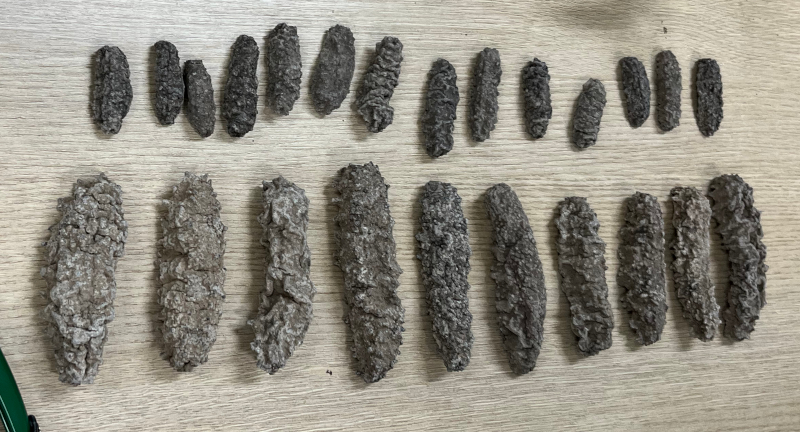
Two species were identified in the sea cucumber samples collected during the IBAMA seizure: Holothuria grisea and Isostichopus badionotus, the most abundant species along the Brazilian coast (image: Fábio Porto-Foresti/FC-UNESP)
Published on 10/19/2026
By André Julião | Agência FAPESP – Hidden inside suitcases, boxes, and even packed in small bags resembling those used for packaged snacks, an illegal shipment of dehydrated swim bladders from fish caught off the coast of the Amazon was intercepted at Guarulhos International Airport, Brazil’s largest airport. The shipment was bound for Hong Kong, the United States, the United Kingdom, and China. In another seizure at the same location, thousands of dried sea cucumbers bound for Italy were detained.
Due to the poor state of preservation of the samples, it was difficult to identify the species based on shape and physical characteristics. Therefore, DNA analysis was necessary to accurately determine the species seized in 2022 and 2023. This work, carried out through a partnership between the Faculty of Sciences at São Paulo State University (FC-UNESP) in Bauru in the Southeast region of Brazil and the Brazilian Institute of the Environment and Renewable Natural Resources (IBAMA), was reported in articles published in the journals Forensic Science International: Reports and Scientific Reports.
“Sea cucumbers are neglected animals in terms of conservation, with little data available and lacking the appeal of so-called ‘cute fauna’ species, such as dolphins and whales. Furthermore, they are very easy to catch and are collected by hand on rocky shores. Although data are scarce, in recent years, researchers monitoring these populations have noted a decline in their abundance,” reports Auany Camila Fantinelli, first author of the article published in Scientific Reports. The research was conducted at FC-UNESP with a Scientific Initiation Scholarship from FAPESP.
The research is part of a project supported by the Foundation under its Research Program on Biodiversity Characterization, Conservation, Restoration and Sustainable Use (BIOTA-FAPESP).
Through a partnership between the Fish Genomics and Conservation Laboratory at FC-UNESP and the IBAMA Technical Unit at Guarulhos International Airport, researchers from the university have access to material seized at the cargo and passenger terminals. A small portion is taken for analysis to identify species using genomic techniques.
“Not all material is necessarily prohibited from export, but it may be seized due to documentation issues,” explains Fábio Porto-Foresti, a professor at FC-UNESP and coordinator of the project.
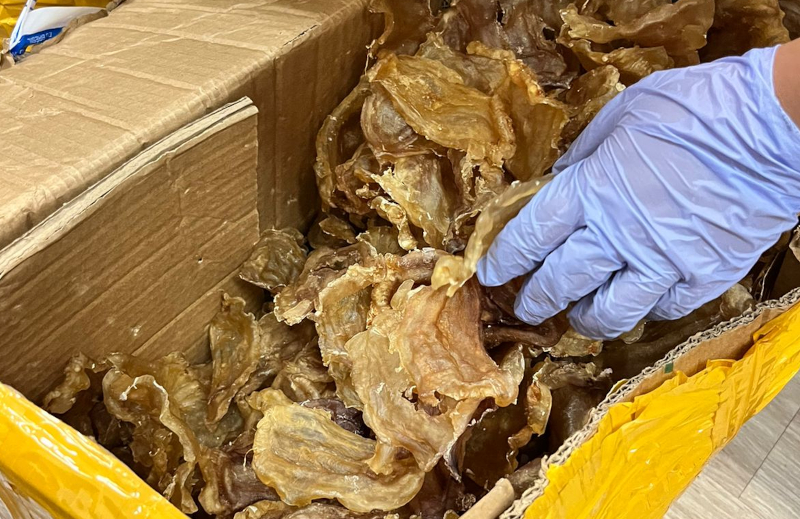
A kilo of swim bladders fetches around BRL 3,000 in Pará, about 100 times the price of meat from species such as acoupa weakfish (Fábio Porto-Foresti/FC-UNESP)
This is the case with fish swim bladders, which are typically harvested from Amazonian species. Export is permitted if certain rules are followed, such as proper storage and documentation certifying the origin. The seized shipments did not comply with these legal procedures.
In fish, this organ controls buoyancy, enabling the animal to rise or sink in the water column as it fills with or releases air. When dehydrated, the product is known as “grude” and is used in the food and beverage industries. An ingredient for the beverage industry, ichthyocoll, is extracted from it and used to clarify wines and accelerate the filtration, clarification, and refining of beer.
In China and Hong Kong, it is used in broths, soups, and traditional medicine. In Pará, in the North region of Brazil, a kilogram of the product sells for about BRL 3,000, which is 100 times higher than the price of fish such as acoupa weakfish (Cynoscion acoupa) and gillbacker sea catfish (Sciades parkeri). These species are listed as “vulnerable to extinction” by the International Union for Conservation of Nature (IUCN).
“Our study showed that the vast majority of the samples were from these two species, which raises concerns about their actual conservation status and whether natural stocks are being exploited at a rate greater than what can be replenished through fish reproduction,” says Ricardo Utsunomia, a professor at FC-UNESP who coordinated the research with Porto-Foresti.
Gabriela Idaline de Freitas was the first author of the study on swim bladder, which she conducted as part of her master’s degree at the institution.
Sea cucumbers
Trade of sea cucumbers is prohibited. Of the samples collected during the IBAMA seizure, two species were identified: Holothuria grisea and Isostichopus badionotus. These species are the most abundant along the Brazilian coast.
“It was like extracting DNA from a rock,” Fantinelli jokes, commenting on the sea cucumbers’ condition. They were completely dehydrated. Typically, the animals are exported in this state to reduce volume and extend the shelf life of the product, a process that can also compromise the DNA.
An example of the lack of conservation attention given to sea cucumbers is that one of the species found, Holothuria grisea, which is listed by the IUCN as “least concern” regarding the risk of extinction, did not even have genetic sequences deposited in databases.
This is an important prerequisite for monitoring trade in a given species since identification based solely on morphological characteristics is difficult when specimens have lost their distinctive features. In the absence of genetic data, the researchers collected fresh specimens in Ubatuba, on the northern coast of São Paulo. From these animals, they sequenced a specific region of the genome called COI, which functions as a “barcode” unique to each species. By comparing the “code” of the fresh animals with that of the dehydrated samples from the airport, the researchers confirmed that the animals belonged to the same species.
The authors note that the sea cucumber species Apostichopus japonicus, once abundant in China, was heavily harvested, resulting in a significant population decline and prompting an increase in imports from other countries.
“Although their appearance may seem unappealing to us, these organisms play important ecological roles in the environment by filtering detritus and serving as food for other species. The reduction or extinction of populations may also result in the loss of bioactive compounds with potential benefits for global health. Sea cucumbers are widely studied because of their remarkable regenerative capacity, for example,” says Porto-Foresti.
The researchers’ findings highlight the need for continuous monitoring of exported species and the expansion of genetic databases to address knowledge gaps. Furthermore, they underscore the importance of coordinated efforts among governments, conservation organizations, and communities for species conservation.
The partnership with IBAMA is ongoing. Currently, in addition to continuing molecular analyses, the researchers are developing and validating faster, more sensitive, and more efficient methodologies for identifying seized species.
These approaches include DNA metabarcoding, which simultaneously identifies multiple species in a single sample, and real-time PCR (qPCR) assays for rapidly screening species of interest.
“These methodologies aim to make the identification process increasingly agile, reliable, and cost-effective, expanding its potential for application in enforcement actions,” Fantinelli concludes.
The article “DNA-based identification uncovers the illegal trade of sea cucumbers from Brazil” can be read at nature.com/articles/s41598-025-31971-6.
The study “DNA barcoding for the identification of swim bladders: An approach to international trade monitoring” is available at sciencedirect.com/science/article/pii/S2665910725000362.
Source: https://agencia.fapesp.br/59430


