


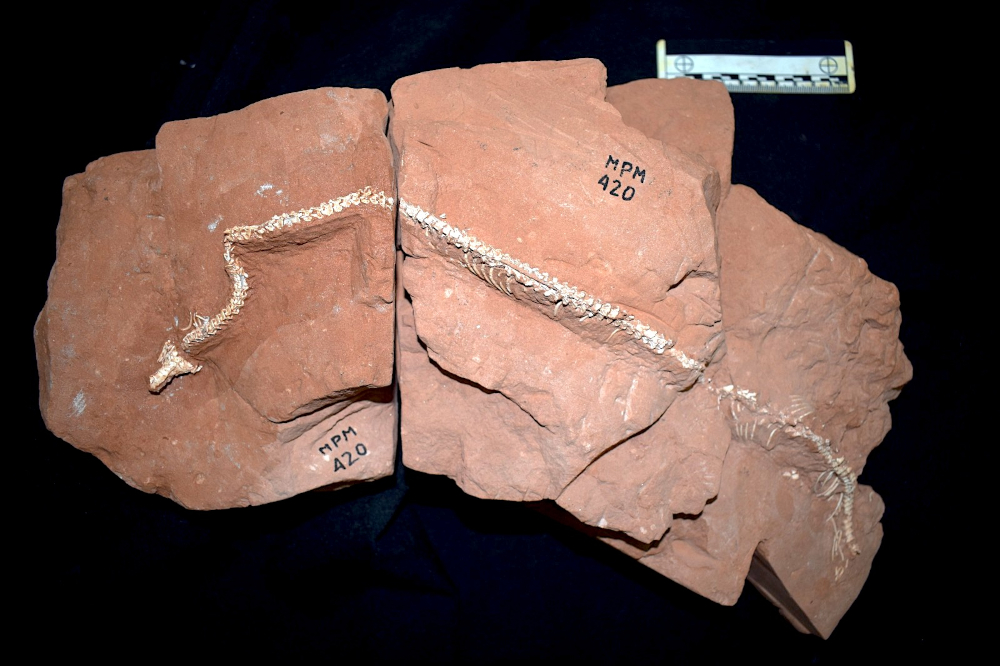
Articulated fossil of Tametara mirim, with part of the skull and spine preserved in rock blocks (image: Agustín Martinelli)
Published on 10/05/2026
By Jennifer Ann Thomas | Agência FAPESP – The fossil of a 42-centimeter snake that lived 80 million years ago in the interior of the state of São Paulo, Brazil, is reigniting a century-long evolutionary debate among paleontologists regarding the environment in which the first snakes emerged: the sea, underground, or the Earth’s surface. The species, named Tametara mirim, had an endocranial anatomy and inner ear consistent with an underground lifestyle, according to a study supported by FAPESP and published in Nature, one of the world’s leading scientific journals.
To determine the uniqueness of this anatomy, the researchers applied the same analysis to a fossil of the Argentine species Dinilysia patagonica. This species lived during the same period as Tametara and is the only other member of the stem group with a well-preserved skull and publicly available CT scan data. The stem group belongs to an extinct lineage outside the group that includes all modern snakes but is evolutionarily close to it. The casts of the internal skull cavities of the two species were quite different, with Dinilysia exhibiting an anatomy consistent with a lifestyle not adapted to subterranean (fossorial) or, most likely, terrestrial life.
In 2020, William Nava and Giovanna Paixão from the Marília Museum of Paleontology discovered the Tametara fossil in a quarry in the municipality of Presidente Prudente in the far west of São Paulo. The rock is estimated to be between 85 and 75 million years old and belongs to the Adamantina Formation of the Bauru Group. This series of Upper Cretaceous sedimentary rock outcrops in the states of São Paulo, Minas Gerais, Mato Grosso do Sul, Paraná, and Goiás is famous for its dinosaur fossils. According to the authors, this is the first articulated snake fossil found in Brazil, with the bones still connected as they were at the time of the animal’s death. Previous records of Cretaceous-period snakes in Brazil consisted only of isolated vertebrae.
The study was led by Tiago Simões of Princeton University, Nicolas Di-Poï of the University of Helsinki, and Annie Hsiou of the University of São Paulo (USP), and it was supported by FAPESP through projects 24/17970-7 and 25/01077-4.
“Almost everything we know about the origin of snakes is based on a very limited number of well-preserved fossils from the Mesozoic Era,” explains Simões, the first author of the study and a professor in the Department of Ecology and Evolutionary Biology at Princeton University in the United States. He adds that fewer than ten articulated snake fossils are known from the entire Mesozoic Era, which spanned from approximately 252 to 66 million years ago and comprises the Triassic, Jurassic, and Cretaceous periods. Only three other fossils have three-dimensional preservation comparable to that of Tametara. “Every new species from that era with this degree of preservation holds enormous potential for shedding light on questions about their origins,” he says.
While the study does not resolve the debate over where snakes first appeared, it shows that they had already diversified ecologically by the Cretaceous period. Closely related lineages on the evolutionary tree occupied very different environments, indicating that subterranean, terrestrial, and marine habitats coexisted early in the group’s history rather than originating from a single common ancestral environment.
Digital analysis
In order to reconstruct the internal anatomy of the skull without destroying the fossil, the team used computed microtomography. This technology is similar to that used in hospital X-ray exams, but it has a much higher resolution. Gabriela Sobral, an associate researcher at the Natural History Museum in Stuttgart, Germany, and at the University of Brasília (UnB), was responsible for separating the structures in the images. “Based on the CT scans, we segment the structures of interest. We can draw and color each one to tell the program what should be separated from the rest,” Sobral explains. This process generates a three-dimensional model that can be rotated and zoomed in on a computer screen.
This work revealed a set of clues pointing to Tametara’s subterranean lifestyle. The bones of the cranial vault were dense and heavily overlapping, a pattern that distinguishes fossorial and semifossorial animals, which are adapted to digging burrows and living underground, from non-fossorial ones. The inner ear reinforced this suspicion with its large, rounded vestibule and thin semicircular canals. “The reduced semicircular canals indicate that the animal’s spatial orientation isn’t critical for its perception, which makes sense when living underground,” Sobral explains. The large, globular vestibule suggests that low-frequency sounds, which travel better through the ground than through the air, were important to the animal.
The focus in the brain was on a poorly developed region. The optic roof, a structure involved in visual processing, was more atrophied in Tametara than in most burrowing snakes and lizards studied to date. “Atrophied regions indicate that function isn’t vital,” says Sobral. However, she offers an important methodological caveat: the virtual cast of the interior of the skull, the endocast, does not reproduce the brain itself, but rather the set of structures that were juxtaposed within the skull when the animal was alive. In Tametara's case, the region corresponding to the optic roof formed a very thin band. “That’s an extremely unusual condition, even among modern burrowing snakes, which rely almost entirely on vision to survive,” she summarizes.
Evolutionary implications
When the endocranial anatomy reconstructions of Tametara and Dinilysia were compared side by side, they proved to be different from one another and distinct from most modern lizard and snake lineages. For Simões, this suggests that the two animals inhabited different environments and likely perceived the world differently. “They exhibited broad neuroanatomical – and likely sensory – diversity early in their evolutionary history,” the researcher says.
By combining quantitative analyses of telencephalic shape (the most anterior portion of the brain, where the olfactory bulb and tract are located) and bone microstructure with anatomical evidence from the inner ear, the team was able to demonstrate, for the first time using statistical methods, that Cretaceous snakes exhibited ecological diversity. This finding has implications that extend beyond the biology of Tametara.
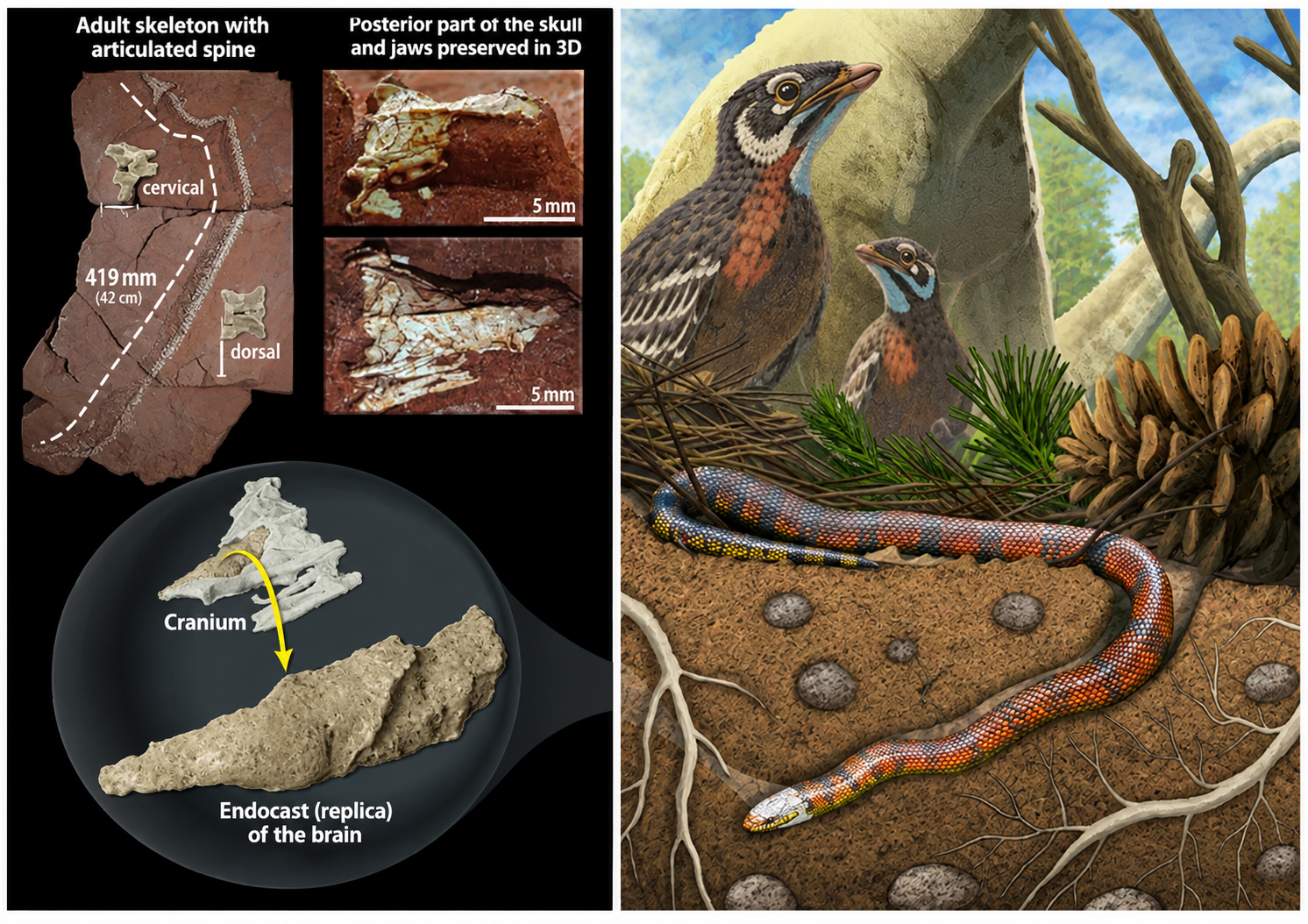 For decades, fossils of primitive snakes have been used to reconstruct the appearance of the common ancestor of modern snakes. However, the new study shows that none of these species alone represents this ancestral condition (image: Gabriel Ugueto and Simone Macri)
“To better understand the group’s origin, we need to discover highly preserved fossils, such as Tametara, from earlier periods, especially the Jurassic period, which spanned from 201 million to 145 million years ago,” says Simões.
The species’ name reflects its uniqueness. “Tametara” means “adorned,” referring to the pronounced crest on top of the skull, and “mirim,” of Tupi-Guarani origin, indicates the animal’s small size.
The discovery also expands our knowledge of historically understudied groups within the Bauru Group. “The region’s potential for understanding life in the Cretaceous period has long been recognized internationally. However, research has historically focused more on other groups, such as non-avian dinosaurs,” Simões notes. There are still gaps in our understanding of Tametara itself. It is unclear if the animal had developed hind limbs because the region of the body where they would have been located, near the cloaca, was not preserved in the fossil.
“From the very beginning, I knew I was looking at a very special fossil because of those unusual characteristics. As the work progressed, Tametara revealed itself to be truly unique,” Sobral summarizes. “Unfortunately, I wasn’t part of the discovery of this fossil. It must have been thrilling to find a gem like this. Maybe on the next field trip?” he adds.
The article “Exceptional brain and ecological diversity in the earliest snakes” can be read at https://nature.com/articles/s41586-026-10809-9.
Source: https://agencia.fapesp.br/59337


