


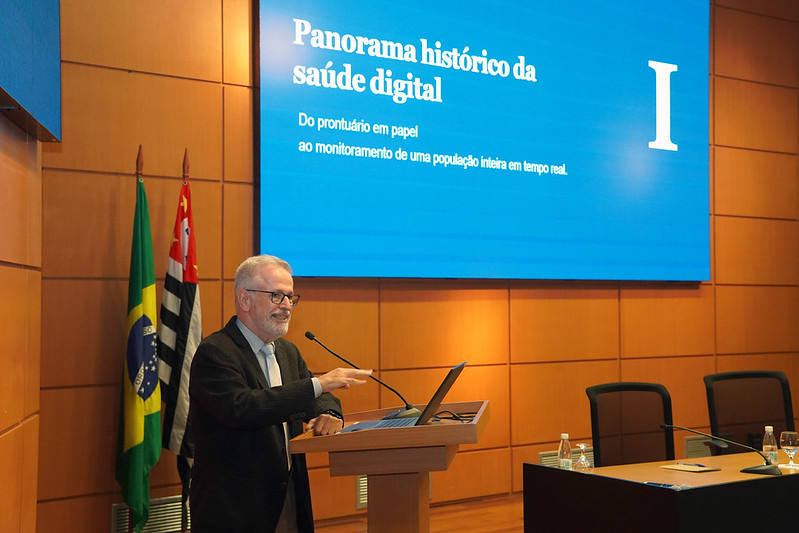
Barral-Netto presented the concept of precision public health, which involves offering “the right intervention to the right population at the right time” (photo: Phelipe Janning/Agência FAPESP)
Published on 07/13/2026
By José Tadeu Arantes | Agência FAPESP – In Brazil, the daily records produced by the national health information systems, many of which are linked to the Unified Health System (SUS), the national public health network, are being transformed into powerful tools for informing public policy, measuring vaccine effectiveness, identifying social inequalities, and detecting infectious disease outbreaks early. Brazil is an ideal location for this type of research because it has one of the world’s largest health data sets, accumulated over decades and covering nearly the entire population, according to Manoel Barral-Netto, an immunologist and researcher at FIOCRUZ-Bahia, the regional unit of the Oswaldo Cruz Foundation (FIOCRUZ), the Ministry of Health’s research and development arm for the biological sciences.
“The challenge is to transform this data into useful knowledge to improve the population’s health,” Barral-Netto said during the 4th FAPESP 2026 Conference on June 26.
These information assets include national records of births, deaths, hospital admissions, vaccinations, primary care, and epidemiological surveillance. These records have been organized into consolidated databases since the creation of the Department of Information and Informatics of the Unified Health System (DATASUS) in 1991. DATASUS is the agency within the Ministry of Health responsible for developing, maintaining, and integrating the SUS’s national health information systems.
According to the researcher, few countries have such broad population coverage. “Our data aren’t perfect, but they’re much better than many people in Brazil think. They allow us to answer extremely important questions, provided they’re analyzed rigorously,” Barral-Netto emphasized.
The conference, titled “It Isn’t Luck, It’s Science: Putting Data to Work for Health” was opened by the Foundation’s president, Marco Antonio Zago. Zago highlighted the researcher’s scientific career and his contributions to Brazilian public health. “I’ve known Professor Barral for over 20 years. We’ve worked together and interacted frequently. As a result, my admiration for his clarity of thought, creativity, and work ethic has grown steadily,” he said. According to Zago, Barral-Netto’s career “combines basic research, translational research, and the formulation of scientific policies.” More recently, Barral-Netto has made decisive contributions to Brazil’s infrastructure for analyzing large health databases, enabling the development of evidence-based public policies.
Throughout the lecture, Barral-Netto demonstrated how organizations such as the Center for Data and Knowledge Integration for Health (CIDACS) at FIOCRUZ-Bahia and the National Institute of Science and Technology in Digital Health (DigiSaúde), headquartered at FIOCRUZ-Bahia and coordinated by Barral-Netto, are using this infrastructure.
CIDACS was created in 2016 from an initiative conceived by epidemiologist Maurício Barreto, whose contribution Barral-Netto made a point of highlighting. CIDACS benefited from the support of national and international funding agencies and began integrating large administrative databases. This process preserves citizens’ identities in a highly secure information environment, enabling the databases to be used for public policy and scientific research.
Today, CIDACS maintains the world’s largest population cohort. In epidemiology and public health, a cohort is a group of people who share a characteristic and are observed over time to study the influence of various factors on their health or the occurrence of specific events. The essential aspect of a cohort is longitudinal follow-up. Rather than observing only a snapshot of the population, researchers track individuals’ trajectories over the years. They determine who develops a disease, who is hospitalized, who receives a vaccine, and which factors are associated with a higher or lower risk of certain outcomes.
Although it retains the historical name “100 Million Brazilians Cohort,” CIDACS currently gathers information on approximately 140 million people registered in the Single Registry for Social Programs (CadÚnico). This registry is integrated with various national databases, including the Mortality Information System (SIM), the Live Birth Information System (SINASC), the SUS Hospital Information System (SIH/SUS), and the National Immunization Program Information System (SI-PNI). Depending on the research project, integration may also include other databases and records from social programs, such as Bolsa Família, thereby expanding the capacity to investigate health determinants, evaluate public policies, and track health outcomes over time.
The results produced thus far illustrate the potential of this approach. For example, studies have shown that cash transfer programs significantly reduce preventable infant mortality in the Northeast region, that socioeconomic inequalities influence health outcomes even under universal SUS coverage, and that extreme weather events severely impact children from the poorest families.
One study revealed that prolonged drought increases child mortality by over 18%, especially among low-income families. Another recently published study in Nature Medicine demonstrated that people considered cured of tuberculosis continue to face a high risk of death for up to 14 years after diagnosis. This indicates that clinical follow-up should continue well beyond the end of treatment.
DigiSaúde is a National Institute of Science and Technology (INCT) that uses data science and artificial intelligence to transform large databases into tools that can predict risks, guide public policy, and strengthen the SUS’s response to major health challenges in the country.
Precision public health
Barral-Netto noted that digital health has come a long way since the implementation of the first electronic medical records in the 1960s and 1970s. Today, in addition to digitized clinical records, digital health incorporates real-time genomic sequencing, artificial intelligence for diagnosis, telemedicine, wearable devices, population mobility analysis (essential for predicting pathogen spread), and epidemiological surveillance systems capable of integrating information from different sources. “We can make decisions based on very recent data, which provides a significant gain in agility,” he said.
Building on this infrastructure, the researcher introduced the concept of precision public health. Adapting an idea originally developed on an individual scale to public health, the proposal consists of offering “the right intervention for the right population at the right time.” Rather than formulating one-size-fits-all policies for the entire population, the approach seeks to identify specific groups that are more vulnerable or respond differently to health interventions.
Barral-Netto illustrated this approach using the recent debate over the precautionary suspension of the dengue vaccination strategy developed by the Butantan Institute. The measure was adopted after 42 adverse events were reported among approximately 500,000 vaccinated individuals, and a possible causal link to the vaccine is still being investigated. According to Barral-Netto, even when a risk exists, it is often limited to very specific groups defined by factors such as age or clinical condition. “Sometimes it’s enough to modify the recommendation for a particular group. The collective benefit of vaccination far outweighs the risk of an extremely rare adverse event,” he pointed out.
The researcher also recalled a principle often attributed to Rui Barbosa: treating different people equally does not produce justice. In the field of public health, he explained, this principle means acknowledging biological, social, economic, and environmental differences in order to develop more efficient and equitable policies.
VigiVac, an active surveillance system created by the federal government to continuously assess the effectiveness and safety of vaccines under real-world conditions, was launched during the pandemic based on this infrastructure. As Barral-Netto explains, efficacy and effectiveness are distinct concepts. Efficacy is measured in randomized clinical trials conducted under strictly controlled conditions. Effectiveness, on the other hand, corresponds to how the vaccine performs in a population when factors such as age, preexisting conditions, socioeconomic differences, and delays in administering doses are taken into account. “It’s effectiveness that matters for public health. It shows how much vaccination actually protects the population,” he explained.
VigiVac produces these estimates by integrating individual vaccination records from the National Immunization Program (SI-PNI) with information on hospitalizations, deaths, and reports of severe cases. This process leverages existing databases from the SUS. Since all data are routinely generated by the health system, monitoring can be conducted continuously and at virtually no additional cost.
One of the system’s first applications was evaluating vaccines used during the pandemic. The team’s studies demonstrated that the heterologous regimen consisting of two doses of CoronaVac followed by a Pfizer-BioNTech BNT162b2 booster achieved approximately 91% effectiveness against hospitalization and 94% against death. These results were later published in the journal Nature Medicine. The studies also showed that combining different vaccine platforms provided greater protection than initially anticipated.
Another recent contribution presented at the conference concerns the vaccination against human papillomavirus (HPV), the cause of cervical cancer. Using the same data integration infrastructure, researchers at CIDACS demonstrated that immunization significantly reduces both precursor lesions and cervical cancer incidence. This finding is particularly relevant because it was obtained in a middle-income country using real-world data.
According to Barral-Netto, VigiVac’s primary advantage is its ability to demonstrate that administrative records originally produced for managing the SUS can generate world-class scientific research. “These data weren’t collected for research. They were produced to manage the healthcare system. But when properly analyzed, they allow us to answer extremely important scientific questions,” he emphasized.
Early detection of infectious outbreaks
The same principle guides AESOP (an acronym for Alert-Early System of Outbreaks with Pandemic Potential), a project currently coordinated by Barral-Netto and designed for the early detection of infectious outbreaks. Rather than waiting for critically ill patients to arrive at hospitals, the system aims to identify signs of infectious agent circulation much earlier. It integrates three main sets of information to do so: primary care visits for flu-like symptoms, weekly data on the sale of over-the-counter medications, and metagenomic analyses capable of identifying hundreds of pathogens through genetic evidence.
The system detects anomalies based on data from patient visits, pharmacies, and other sources. Then, it directs the collection of clinical samples from patients in the region under alert. These samples undergo metagenomic sequencing, which allows for the identification of known pathogens and new viruses. Therefore, genetic evidence is found in patients’ clinical samples rather than in environmental samples. However, the AESOP project is also developing a complementary line of environmental surveillance with specific studies on virus detection in wastewater, for example.
Statistical models and machine learning algorithms process these layers of information to identify significant deviations from expected behavior and issue alerts before an outbreak takes hold.
According to Barral-Netto, this strategy enables the anticipation of respiratory outbreaks two to three weeks in advance. This provides states and municipalities with time to strengthen surveillance efforts, expand healthcare capacity, and guide the public. “The municipality gains two or three weeks to act. In epidemiological surveillance, that makes a huge difference,” he summarized.
The first results from AESOP were obtained in a pilot project conducted in the state of Amazonas. According to data presented at the conference, the project trained 72 surveillance professionals, detected 86 respiratory outbreaks, and confirmed 87% of the system’s alerts, benefiting a population of approximately 4 million people. The platform is expanding nationwide to include the surveillance of arboviruses, infectious diseases transmitted by insects, primarily mosquitoes. In this case, in addition to information from health services, indicators such as sales of insect repellent and other products related to dengue control are being incorporated to identify changes in population behavior that may serve as early warning signs of these viruses circulating.
Data governance, privacy, and sovereignty
Barral-Netto emphasized that none of these initiatives would be feasible without a robust data governance framework. As he noted, public trust hinges on the assurance that personal information will never be misused. At CIDACS, researchers are never granted access to the original databases. A specialized team integrates the different databases in a high-security computing environment. Personal identifiers are used only during the record-linking process. Afterward, these identifiers are removed, and only de-identified datasets are made available for analysis. Barral-Netto also described the center’s physical infrastructure, which includes access-controlled rooms, computers isolated from the internet, dedicated connections, round-the-clock monitoring, and mechanisms that prevent the unauthorized extraction of information.
When addressing future challenges, he advocated for three priorities in Brazilian digital health: expanding interoperability among different SUS information systems, incorporating artificial intelligence tools into epidemiological surveillance activities more frequently, and strengthening national sovereignty over strategic data. For Barral-Netto, the last point deserves special attention: “Today, often even our institutional emails aren’t hosted on national infrastructure. When we’re talking about the health data of more than 200 million Brazilians, the responsibility is much greater,” he noted.
Professor Oswaldo Baffa Filho, coordinator of the organizing committee for the FAPESP 2026 Conferences, and Soraya Smaili a professor at the São Paulo School of Medicine of the Federal University of São Paulo (EPM-UNIFESP) and vice president of the Brazilian Society for the Advancement of Science (SBPC), attended the event. Baffa noted that one of the major contemporary challenges is extracting knowledge from enormous volumes of information to support informed decisions. Along the same lines, Smaili emphasized that large national databases represent a new frontier for health research. According to her, the initiative developed by CIDACS and DigiSaúde demonstrates how the secure integration of this information expands the possibilities of biomedical research, strengthens epidemiological surveillance, and informs public policy.
In closing the conference, Barral-Netto returned to the theme that had run throughout his presentation. He reiterated that the true value of large databases does not lie in the volume of information they store but rather in their ability to transform that information into useful knowledge for society. “It isn’t luck; it’s science,” he summarized, echoing the motto that served as the title of his talk. He added, “The data already exists. What we need is to know how to use it to produce evidence that improves people’s lives.”
The 4th FAPESP 2026 Conference, “It Isn’t Luck, It’s Science: Using Data to Improve Health,” is available at youtu.be/fPF-A90MWQI.
Source: https://agencia.fapesp.br/58669


