


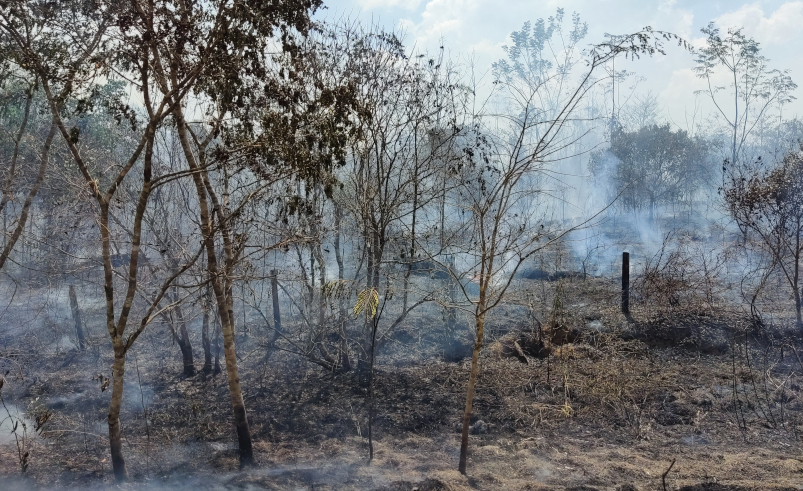
Wildfires in Acre state, in the Brazilian Amazon (photo: Beatriz Cabral)
Published on 05/25/2026
By Luciana Constantino | Agência FAPESP – According to two recently published studies led by scientists from Brazil’s National Institute for Space Research (INPE), the Brazilian Amazon is already beginning to experience scenarios previously projected for the coming decades, including longer dry seasons and changes in rainfall patterns. Without integrated policies and initiatives to combat climate change, the situation could rapidly intensify, posing risks to biodiversity, the replenishment of natural water reservoirs, and the functioning of the forest.
The studies, which are based on climate models that incorporate regional dynamics, also serve as a warning for this year and next, as there is the possibility of a “super El Niño.” This phenomenon is characterized by the warming of the Pacific Ocean in the equatorial region. In its most intense form, it can raise temperatures by more than 2 °C above average, causing major changes in atmospheric circulation and rainfall patterns on a global scale.
One of the studies indicates that the dry season in the Amazon is lengthening from four to six months, with a water deficit exceeding -150 millimeters (mm) during that period. The article, published in the International Journal of Climatology, points to greater climate instability, more extreme events outside seasonal patterns, and increased forest degradation associated with fire.
Another study, which appears in the March issue of Perspectives in Ecology and Conservation, analyzes the drought recorded in the Amazon between 2023 and 2024, during which Brazil was heavily affected by El Niño. The findings reveal a 9% increase in burned areas and a 19% increase in forest degradation alerts, with up to 4.2 million hectares impacted by fire at the peak of the drought. These results demonstrate that the cycle of drought, fire, and degradation is intensifying and reducing the ability of the ecosystem to recover.
“A few years ago, when we started talking about climate scenarios for the Amazon, that future often seemed far off in the most pessimistic scenarios. However, we’re now observing the most pessimistic anomaly extremes occurring in the present. When we compare today’s data with the projections, we see how critical the situation is becoming as we include pessimistic scenarios in the climate analysis,” summarizes Débora Dutra, an environmental and sanitation engineer, doctoral candidate in remote sensing at the INPE, and the first author of the two articles.
Biologist Liana Anderson, Dutra’s advisor and a researcher at the INPE, highlights the role of scientists in light of the disconnect between the scientific evidence of the impacts of climate change on ecosystems and the responses to mitigate and contain them.
“We’re at a crucial moment with national and international goals to be met by 2030. If we direct our efforts in that direction, we can achieve them. We must view the connection between the environment, development, and the economy as an inseparable triad in terms of both exploitation and the cost of reconstruction following the impacts. I believe this climate crisis presents an opportunity to rethink our paths and accelerate sustainable initiatives that promote quality of life, social justice, and environmental justice. There’s mobilization within the scientific community to contribute and present alternatives. The question is, who’s willing to listen to what’s been studied over the past few decades?” adds Anderson, who leads Tropical Ecosystems and Environmental Sciences (TREES) alongside researcher Luiz Aragão. Aragão is also one of the authors of the articles.
Building models
In the research published in the International Journal of Climatology, the scientists used a metric that Aragão has been developing since 2007, the maximum cumulative water deficit (MCWD). MCWD is considered a key indicator of water stress in tropical ecosystems. The scientists combined the metric with data from phase six of the Coupled Model Intercomparison Project. This project provides a standardized framework for climate modeling aligned with the Shared Socioeconomic Pathways (SSPs) assessments of the United Nations Intergovernmental Panel on Climate Change (IPCC).
The study was conducted in the southwestern Amazon, covering the state of Acre and parts of the states of Amazonas and Rondônia. The region is home to areas with over 90% forest cover and is under intense pressure from deforestation.
The results show that under high greenhouse gas emission scenarios, water deficits intensify during the dry season in the Amazon, particularly in the southwestern portion of the forest. Projections indicate longer and more intense dry seasons with increased water stress between June and September, with deficits that could exceed -21 mm/month by the end of the century in the most pessimistic scenario.
This worsening trend will likely have direct impacts on the forest, including increased tree mortality, forest degradation, and biodiversity loss. It will also reduce the Amazon’s capacity to act as a carbon sink, which will reinforce a feedback loop between degradation and global warming.
To improve future projections and climate risk assessments in the region, the researchers suggest adopting integrated analyses that incorporate changes in land use, atmospheric circulation anomalies, and interactions between fires and droughts, among other measures.
In the study analyzing the extreme droughts of 2023 and 2024, the research team mapped and quantified water stress, forest degradation, and fire dynamics. They identified implications for environmental management. They concluded that the drought intensified the interaction between water deficits, fires, and degradation. Fires were increasingly associated with the weakening of standing forests rather than deforestation alone. Deforestation completely removes vegetation cover, whereas degradation weakens forests without destroying them entirely.
The results of the study highlight the need for integrated fire governance that combines climate indicators with early warning systems and strengthens institutional coordination. This governance must also incorporate forest degradation into mitigation and adaptation strategies.
Bridging science and practical initiatives
Under Anderson’s coordination, Dutra has studied the impacts of fire on the Amazon rainforest for several years and published an article on wildfires in the municipality of Boca do Acre in the state of Amazonas (read more at agencia.fapesp.br/40932).
Since last year, the researchers have been part of the “Fire in Focus” initiative, a partnership between firefighting and prevention operational forces, such as the military fire departments of various states, and research institutions. To mark the launch of the program, the TREES laboratory, the Brasa Research Network, and the League of Military Fire Departments held an event in October 2025. There, they released the “Fire in Focus 2024-2025” report and the international article “State of Wildfires 2024-2025”.
According to Anderson, the continuation of this joint effort with firefighters was authorized through 2026 in April. “This collaboration is a way to combine what science can deliver with the reality of those working on the front lines, in both prevention and firefighting strategies. We try to bridge science and action in society. But there’s still one area where we need to make progress: the magnitude of the economic impact and what that means for the country’s development,” says the researcher.
For this reason, Dutra decided to delve into the topic and will work on her doctoral thesis using data on the potential economic losses resulting from wildfires. Her thesis will address not only forestry issues, but also health and social impacts.
Dutra receives a scholarship from FAPESP, which also supported the two articles through five projects: 21/04019-4, 20/08916-8, 25/28244-8, and 25/07124-4. These projects include the Research Center for Greenhouse Gas Innovation (RCGI).
The article “Dry-season water deficits in the Southwestern Amazon under high emissions” can be read at rmets.onlinelibrary.wiley.com/doi/10.1002/joc.70331.
The article “Intensification of drought-associated wildfires challenges actions for Amazonia’s sustainable development” can be read at sciencedirect.com/science/article/pii/S2530064426000295.
Source: https://agencia.fapesp.br/58183


