


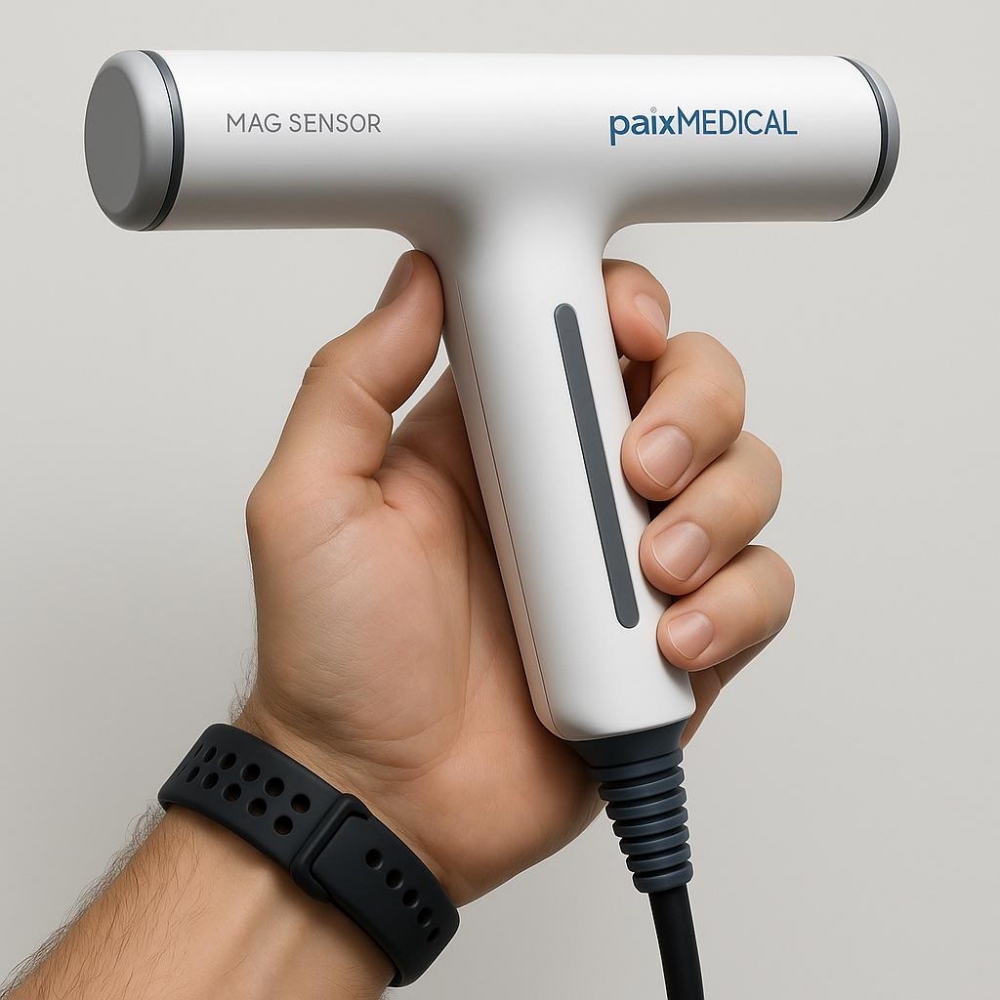
To assess physiological parameters of the gastrointestinal tract in a primary care setting, Paix Medical uses non-toxic magnetic markers, whose precise location is detected by magnetic sensors positioned externally on the patient (image: Paix Medical)
Published on 12/15/2025
By Roseli Andrion | Agência FAPESP – In a regular doctor’s office, without expensive equipment or special rooms, a patient with gastrointestinal complaints is given a pill. It is not medication; it is a magnetic marker that will allow the doctor to map the functioning of the entire digestive system in real time in the following minutes. This scene, which seems like science fiction, is increasingly close to becoming reality thanks to the work of Brazilian researchers.
The technology was developed by the startup Paix Medical with support from FAPESP’s Innovative Research in Small Businesses Program (PIPE). It was born in academic laboratories and may soon become a commercial product with the potential to reach international markets. “It’s a complementary tool that can be used in the doctor’s office,” explains Caio Quini, a medical physicist and co-founder of the company. “The patient swallows a pill [a magnetic marker] and the doctor can assess whether there are any abnormalities in the functioning of the digestive system.”
Quini and physicist Fabiano Paixão developed the idea while working together in the same research laboratory on the development of medical equipment and instrumentation for the gastrointestinal tract. “During our master’s, doctoral, and postdoctoral studies, we developed sensors and magnetic markers,” says Quini. “At one point, we thought, ‘If they help our research, they could be extremely useful in doctors’ offices and hospitals.’”
The principle behind the technology is ingenious and simple. It works similarly to nuclear medicine, a technique in which patients receive radioactive markers that are monitored by external detectors. The crucial difference is the absence of radiation. Instead of using radioactive substances, Paix Medical uses non-toxic magnetic markers whose precise location is detected by magnetic sensors positioned outside the patient’s body.
Rapid diagnostics
The system allows the assessment of physiological parameters of the gastrointestinal tract. “We can identify whether movement in the stomach and intestines is within the expected range,” he explains. “It’s also possible to check whether the marker reaches its destination or lingers too long in a certain region. The marker is then naturally eliminated by the body without any adverse effects.”
The speed is impressive as well: passage from the esophagus to the stomach is practically instantaneous. Gastric emptying time and intestinal transit time vary from person to person. This is precisely what the test evaluates, allowing individual results to be compared with established normal parameters. “If the tracer remains in the stomach for too long, it may indicate delayed gastric emptying. If it passes through the intestine too quickly, it may suggest changes in motility. This information is valuable for diagnosis.”
Based on this, it is possible to evaluate gastric emptying, intestinal motility, and other factors. According to the World Gastroenterology Organization, functional gastrointestinal disorders affect approximately 40% of the world’s population at some point in their lives. In Brazil, epidemiological studies indicate that up to 35% of Brazilians suffer from functional gastrointestinal symptoms, many of whom remain undiagnosed due to the difficulty of accessing specialized tests.
Paix Medical’s technology is not intended to replace established hospital equipment; rather, it offers a complementary alternative to expand access to diagnosis. “It’s like a second diagnostic option,” Quini explains. “It’s a simple and practical tool that doctors can have in their offices. If there’s a suspicion that needs to be investigated, the exam can be performed right then and there, without the need for prior scheduling or special preparation by the patient.”
While exams such as MRIs and CT scans remain essential for complex cases requiring detailed images, magnetic medicine allows for screening and functional assessment in primary care settings. The fundamental difference lies in logistics and accessibility. Traditional imaging exams require specific hospital infrastructure, whereas magnetic medicine can be performed in conventional clinical settings.
Democratization of access
The potential social impact of the technology is significant. If it is available in primary care offices, communities that currently need to transport patients to urban centers for specialized exams may be able to access gastrointestinal diagnostics locally. “This is especially relevant in the Brazilian context, with large regional disparities in access to medical technologies,” Quini notes.
According to data from the National Registry of Health Establishments (CNES), the distribution of diagnostic imaging equipment in Brazil is highly concentrated in the South and Southeast regions, while vast areas of the country have limited access to it. Thus, the startup’s technology represents a potential tool for health equity, capable of providing quality diagnostics to regions where large hospital equipment is scarce or nonexistent.
Cost is also an important factor: even in the prototype phase, the technology is more affordable than traditional methods. “When we’re able to produce on a large scale, the price will be even lower,” Quini projects. In Brazil, an MRI scan can cost between BRL 800 and BRL 2,500, and nuclear medicine gastric emptying studies can cost between BRL 600 and BRL 1,500. These amounts represent a significant barrier for much of the population.
The technology is already protected by a patent. “In this specific format, we’re the only ones with this solution.” This technological exclusivity represents a significant competitive advantage in a market that constantly seeks complementary alternatives for medical diagnostics.
Outlook
However, the journey from academic research to commercial product was not easy. Part of the process took place during the pandemic, which delayed development. “Building the hardware was easier since we had a lot of experience. However, transitioning from an academic environment, which accepts partial solutions, to a corporate one, which requires finished, robust products, was quite challenging,” Quini acknowledges.
The development process went through several phases. It began with a proof of concept to confirm that the system worked. Then, they moved on to constructing both the hardware and software. Finally, they reached the tests required for medical equipment. Currently, the startup is developing the system software and establishing partnerships for final validation in animal and human models.
Surgeon Beatriz Turquiai Luca Blasio, a company partner, is leading clinical studies in collaboration with research centers and hospitals in England and other European countries. “The idea is to have global validation, not to be restricted to the Brazilian reality,” says Quini. This internationalization strategy from the early stages demonstrates the startup’s ambition to compete in the global medical solutions market.
Quini does not give an exact date for the product’s commercial launch – this depends on the completion of ongoing validation tests. “We want to ensure that the option meets the highest quality and safety standards,” he emphasizes. “Validations in partnership with international centers are crucial for this.”
During the research phase, the team tested various forms of the marker, including traditional tablets, controlled-dissolution capsules for slow or rapid release, and markers incorporated into liquid solutions resembling yogurt. “We tested associations between different physiological properties and the responses of the markers,” the researcher explains.
Each formulation type allows for the evaluation of different aspects of gastrointestinal physiology and adapts to the specific needs of each diagnosis type. “For example, slow-dissolving capsules allow for the evaluation of the gastric emptying process in a different way than traditional tablets. Markers in liquid solution respond differently because the process of emptying liquids from the stomach follows its own dynamics.”
Other possibilities
The versatility of the technology extends beyond the gastrointestinal tract. During his postdoctoral studies, Quini researched the detection and monitoring of magnetic nanoparticles in liquid solutions. “The product was similar, with some technical changes, but the objective and application were completely different,” he says. “We conducted studies to evaluate cardiac flow, renal flow, and even cerebral perfusion.”
Magnetic nanoparticles are extremely small and can reach virtually any region of the body. Therefore, there are possibilities for diagnosis in various medical specialties. “The physical principle and idea are similar, but different configurations are necessary for each application,” Quini explains. “For nanoparticles, for example, the sensors must be much more sensitive to detect much smaller concentrations of magnetic material.”
Thus, the technology developed by Paix Medical has the potential to become a multi-applicable diagnostic platform rather than a one-off solution for gastroenterology alone. The research group is considering exploring these different applications.
Combining skills
The success of the project is largely due to the team’s interdisciplinary background. Quini, a medical physicist, has a master’s and a doctorate in general and applied biology and specializes in signal and image processing. Paixão has extensive experience in electronic circuits and instrumentation development. “He’s always worked in instrument development, and me in applying these instruments for testing and experimentation,” he says.
This complementarity of skills was fundamental to the project. “It was cool to do the reverse process,” he reflects. “Not just understanding how a sensor measures physiological parameters, but thinking, ‘I want to capture this specific physiological property. What do I need to build for that?’ It was a very interesting process.”
The fact that Paix Medical's solution was developed in Brazil is an additional source of pride for the national scientific community. “It’s gratifying that years of academic research have turned into something that can really help people,” Quini reflects. “Being able to do this in Brazil shows the potential we have when there’s investment in science and innovation.”
Source: https://agencia.fapesp.br/56822


