Currently, the available treatment relies primarily on dressings, antibiotics, and anti-inflammatory drugs that help control infection and inflammation but do not always succeed in halting the mechanisms that keep the wound open (image: Shutterstock)
Published on 08/17/2026
By Fernanda Bassette | Agência FAPESP – Researchers at the University of São Paulo (USP) in Ribeirão Preto, Brazil, have developed a nanoparticle that can address the various factors hindering the healing of chronic wounds, which include ulcers associated with diabetes and pressure ulcers common to bedridden individuals. These wounds, which may persist for months or even years, affect about 1% to 2% of the population and represent a significant public health concern because they increase the risk of infection and amputation, besides significantly impairing patients’ quality of life.
In in vitro tests, the technology reduced inflammation and protected tissue from oxidative stress damage – a pathological condition in which excessive reactive molecules (such as oxygen free radicals) damage cells and impede cell regeneration. Also, the formulation favored the migration of skin fibroblasts, which play a key role in wound healing. The results were published in the journal Colloids and Surfaces B: Biointerfaces.
Currently, the available treatment relies primarily on dressings, antibiotics, and anti-inflammatory drugs. These help control infection and inflammation, but they do not always succeed in halting the mechanisms that keep the wound open.
“These wounds are difficult to treat because several mechanisms involved in healing cease to function properly. There’s persistent inflammation, an excess of enzymes that degrade tissue, oxidative stress, and difficulty forming new skin. That’s why we devised a strategy that could act on several of these processes simultaneously,” explains Maria Vitória Lopes Badra Bentley, a pharmacist, professor at USP’s Ribeirão Preto School of Pharmaceutical Sciences (FCFRP) who acted as advisor for the research, which received funding from FAPESP.
Two therapeutic strategies
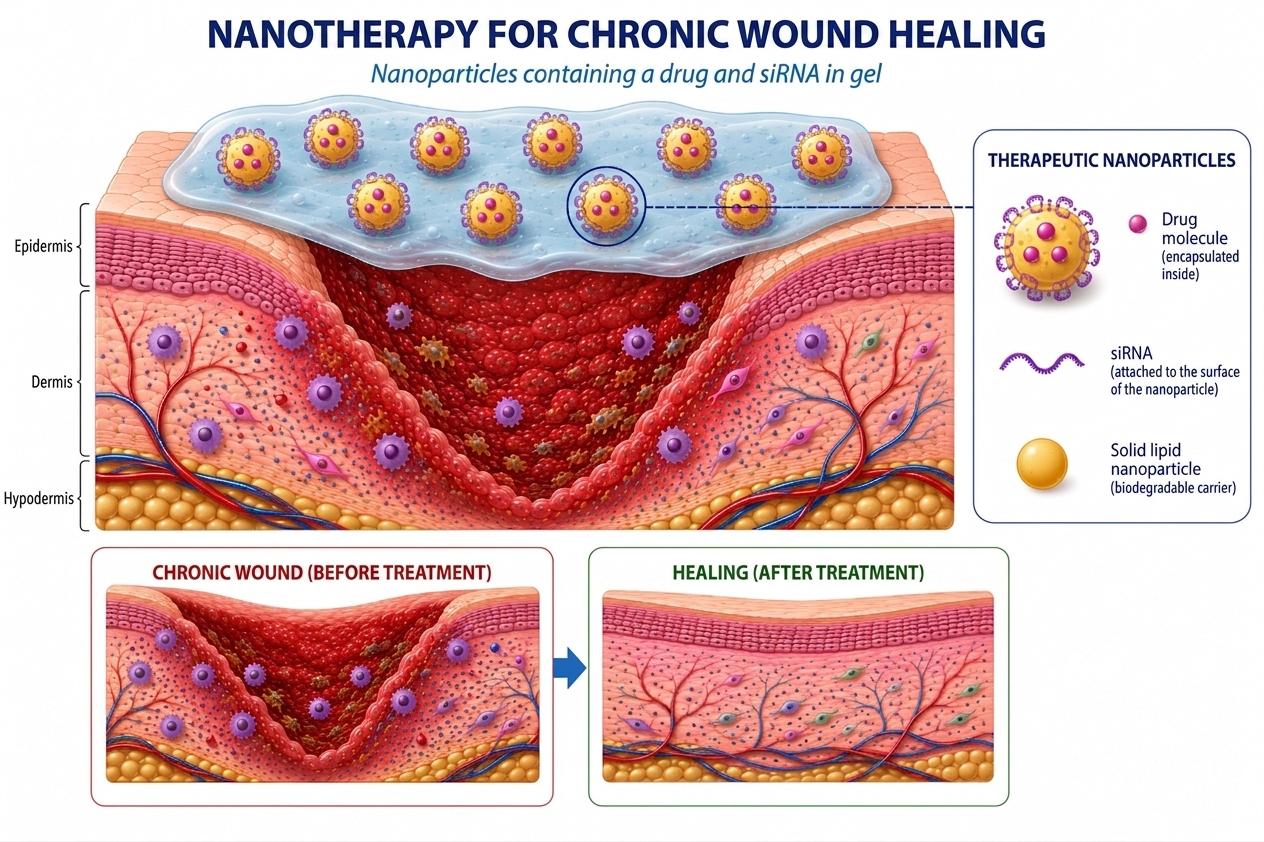
To achieve the results, the researchers developed a hybrid nanoparticle capable of carrying two complementary molecules.
One of the main targets of the research was the enzyme MMP-9, which plays a role in tissue remodeling at normal levels. However, in chronic wounds, its production becomes excessive, leading to the degradation of essential proteins for skin reconstruction, such as collagen, elastin, and growth factors. To mitigate this effect, the researchers employed a small RNA molecule (siRNA) that can specifically silence the gene responsible for producing the enzyme.
The team also used resveratrol, a widely used cosmetic ingredient chosen for its antioxidant and anti-inflammatory properties, as well as its ability to promote the migration and proliferation of fibroblasts, which are cells responsible for producing collagen and other components of the extracellular matrix essential for wound healing. “Resveratrol had already been investigated for wound applications. Our approach was to combine it with MMP-9 silencing on a single platform to simultaneously target different mechanisms responsible for the chronicity of these wounds,” explains Milena Finazzi Morais, a FAPESP scholarship holder during her Master’s studies and first author of the study.
To ensure both compounds reached the lesion site efficiently, the team developed a lipid nanoparticle embedded in a hydrogel. The researchers explain that the nanoparticle protects the molecules, enhances their penetration into the skin layers, and promotes the gradual release of the active ingredients. This prolongs their action at the application site. Professor Bentley explains that this is necessary because resveratrol is poorly soluble in water and easily degrades, and siRNA is an unstable molecule rapidly destroyed by enzymes in the body.
“The system was incorporated into a hydrogel, increasing its viscosity and retention on the wound. In experiments conducted on cell cultures and porcine skin [a model widely used in dermatological research because its characteristics are similar to those of human skin], the formulation demonstrated greater retention of the compounds in the tissue and improved delivery of the molecules to the lesion site,” Bentley explains.
The results showed that the strategy significantly reduced MMP-9 production, lowered levels of reactive oxygen species and inflammatory cytokines, and restored the migration capacity of fibroblasts. In the in vitro wound-healing model, the complete combination promoted near-complete closure of the simulated lesion after 72 hours.
According to Bentley, one of the key strengths of the study is its ability to combine different mechanisms of action into a single therapeutic platform. “No chronic disease is caused by a single factor. Multiple mechanisms are altered simultaneously. Therefore, it makes more sense to develop a multifunctional product than to try to solve the problem by targeting just one mechanism,” she states.
Although the results are promising, the researcher emphasizes that the technology is still in the research phase. The next steps include testing the efficacy and safety of the formulation on three-dimensional skin models and, subsequently, on animals before moving on to clinical trials.
Schematic diagram summarizing the research (image: Milena Finazzi Morais/AI-generated)
Platelet-rich plasma
The group’s research on chronic wounds has also given rise to another project. In her master’s program (also at FCFRP-USP), which is funded by an FAPESP scholarship, researcher Lorena Amorin Tiritan is studying the combination of these nanoparticles with a gel produced from platelet-rich plasma. This plasma is obtained from platelet concentrates that would otherwise be discarded by blood centers. The goal is to harness the natural growth factors present in this material to enhance tissue regeneration.
“In addition to its therapeutic potential, our proposal aims to put a material that would normally be discarded to good use. We expect that the growth factors present in this plasma will complement the action of the nanoparticles and promote healing,” says Tiritan.
The article “Multifunctional hybrid lipid-polymeric nanoparticle enabling resveratrol and siRNA co-delivery for enhanced cutaneous wound repair” can be read at www.sciencedirect.com/science/article/pii/S0927776526004042.
Source: https://agencia.fapesp.br/58992