


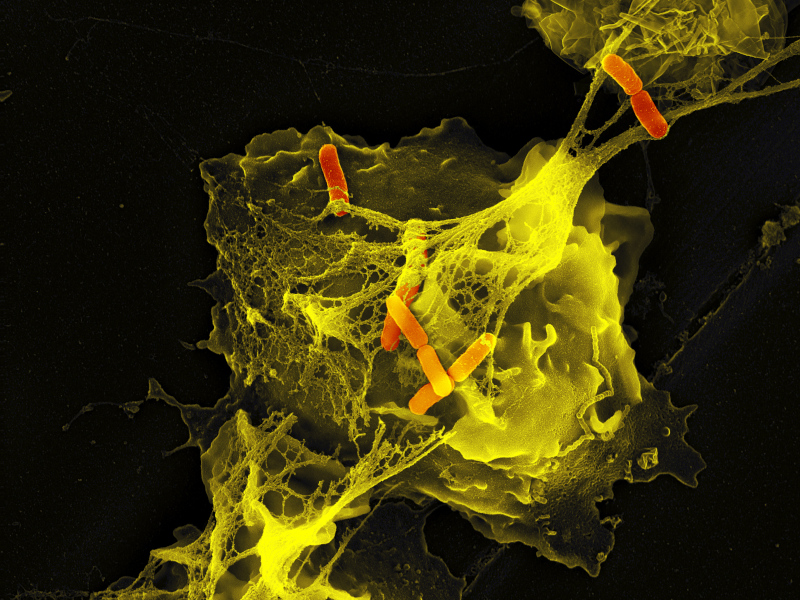
Scanning electron microscopy shows a neutrophil stimulated with NETs and trapped Shigella bacteria (image: Max Planck Institute for Infection Biology)
Published on 06/05/2026
Agência FAPESP* – Neutrophils are the body’s first line of defense against pathogens, including viruses, bacteria, and fungi. They also play a significant role in regulating the inflammatory response. They employ various mechanisms to neutralize threats, such as degranulation, phagocytosis, and the release of extracellular traps (NETs), which are structures formed by DNA and microbicidal proteins.
Researchers from the Research Center for Redox Processes in Biomedicine (REDOXOMA) led by Graziella Eliza Ronsein, from the Institute of Chemistry at the University of São Paulo (IQ-USP), Brazil, investigated how neutrophils respond to two well-known activators, PMA and ionomycin, and discovered that activation occurs through different biochemical pathways. The results show that these cells modulate their immune response according to the stimulus received.
REDOXOMA is a Research, Innovation, and Dissemination Center (RIDC) funded by FAPESP and based at IQ-USP.
“In the literature, all stimuli received by neutrophils are treated in the same way, as if every neutrophil reaction were the same. Our study shows that they react differently depending on the stimulus, and the consequences of these responses also appear to be quite different,” Ronsein explains.
These different reactions may have significant implications for our understanding of inflammatory and autoimmune diseases. “We observed that citrullinated peptides generated by activating neutrophils with ionomycin are very similar to those formed when neutrophils interact with specific bacterial toxins. And many of these peptides act as autoantigens involved in autoimmune diseases such as rheumatoid arthritis,” says Rafaela Oliveira Nascimento, a doctoral student at IQ-USP and a FAPESP scholarship recipient.
The study was published in the scientific journal Redox Biology.
Defense strategies
One well-known immune response strategy is the rapid production of large quantities of reactive species. During an infection, neutrophils are recruited to the affected site, where they activate the enzyme NADPH oxidase. This enzyme generates the superoxide radical. The superoxide radical is a precursor of hydrogen peroxide and other reactive species formed by myeloperoxidase.
However, the researchers found that only PMA-activated neutrophils generate these reactive species; those stimulated by ionomycin do not.
Degranulation is another essential defense mechanism involving the release of granules containing cytotoxic enzymes. Proteomic analysis revealed that PMA causes mild degranulation, whereas ionomycin induces massive degranulation of primary and secondary granules.
In a previous study, the researchers developed a method to isolate granules from neutrophils in a small blood sample and characterized these organelles proteomically.
Another crucial antimicrobial strategy is the formation of neutrophil extracellular traps (NETs). As neutrophils release NETs, they undergo a form of cell death known as “NETosis,” which can be triggered by various stimuli.
The study showed that both PMA and ionomycin induce NET formation, but with significant differences. Live-cell microscopy revealed that ionomycin-triggered NET formation occurs much faster than PMA-induced NET formation, suggesting different mechanisms.
Citrullination
The research also revealed an extensive process of citrullination of proteins in ionomycin-activated neutrophils, including essential components of the cytoskeleton, nucleus, and NADPH oxidase. According to Nascimento, citrullination of these components could explain the inactivation of the enzyme and the absence of superoxide production in ionomycin-activated neutrophils.
Ionomycin increases intracellular calcium concentration, activating an enzyme called PAD4 that converts arginine residues into citrulline. This modification of proteins is called citrullination.
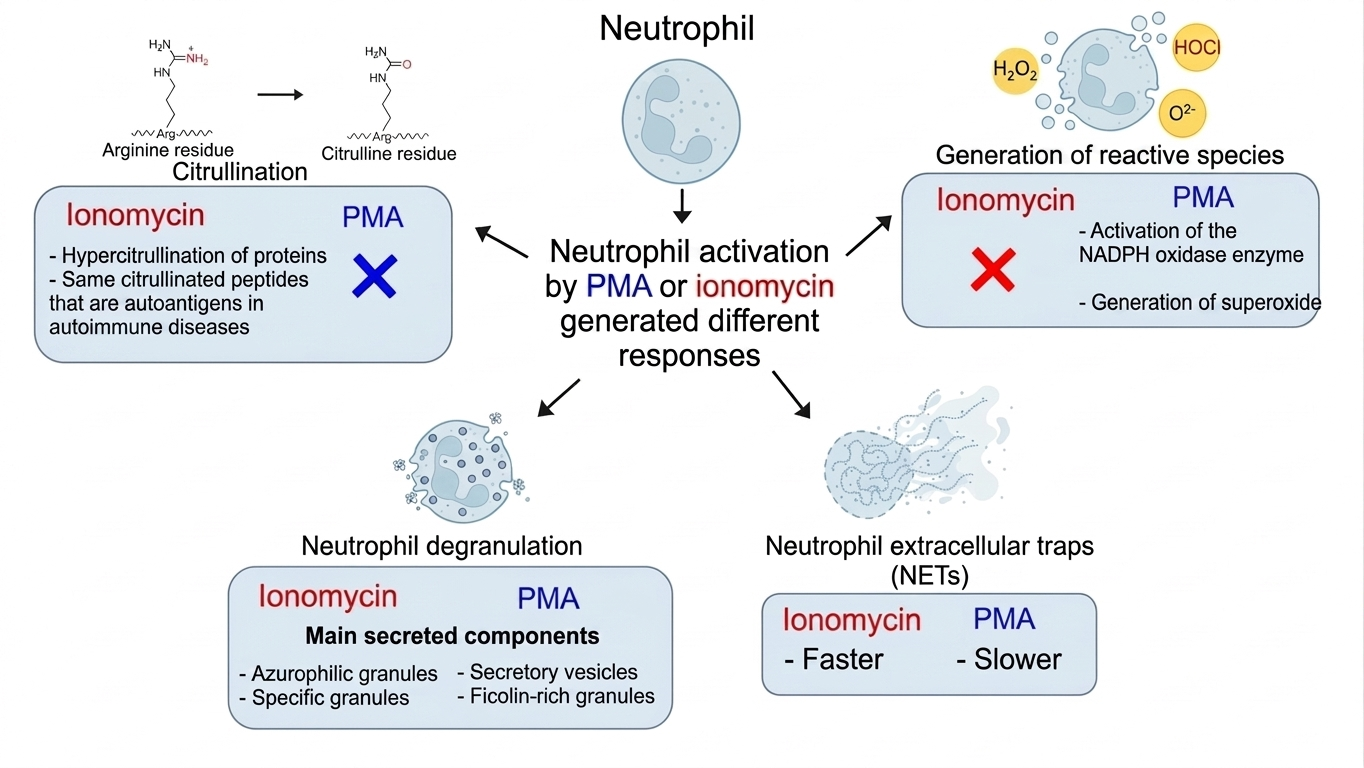
The activators ionomycin and PMA act differently on the defense mechanisms employed by neutrophils in infectious processes (figure: REDOXOMA/IQ-USP)
Next, the researchers plan to investigate how neutrophils respond to milder stimuli, such as physiological ones, to better understand immune regulation. “Ionomycin is a very strong stimulus that rapidly remodels intracellular proteins,” says Ronsein.
The article “Investigating neutrophil responses to stimuli: comparative analysis of reactive species-dependent and independent mechanisms” can be read at www.sciencedirect.com/science/article/pii/S2213231725000539.
* With information from Maria Celia Wider from REDOXOMA
Source: https://agencia.fapesp.br/58310


