


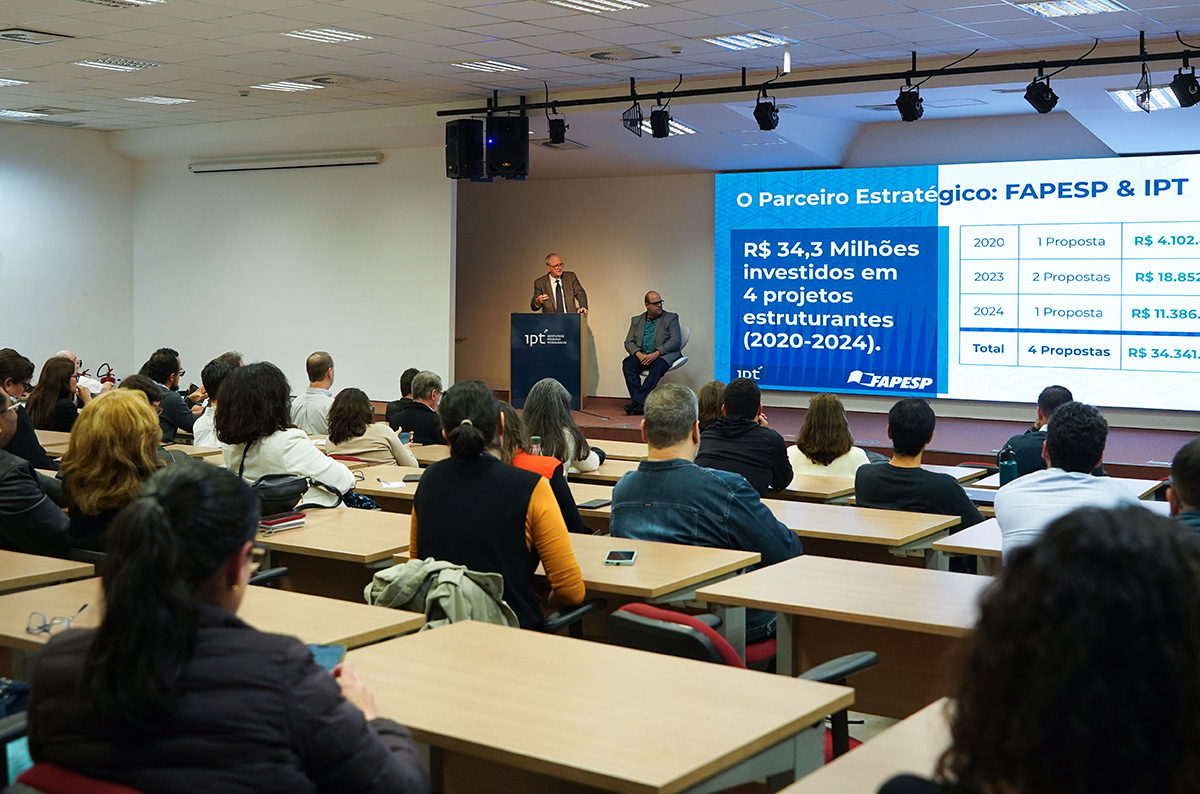
Marco Antonio Zago, president of FAPESP, and Filipe Falcetta, coordinator of the center, at an event at the IPT (photo: Daniel Antônio/Agência FAPESP)
Published on 06/01/2026
By André Julião | Agência FAPESP – According to a study conducted by the federal government in 2024, Brazil has 1,942 municipalities that are susceptible to disasters associated with landslides, flooding, flash floods, and inundations. To address this issue, the Institute for Technological Research (IPT), FAPESP, and several public and private sector partners inaugurated the Flood-Resilient Cities Science Center for Development on May 19. The project aims to generate technological solutions and inform public policies to mitigate the problem.
“The city of São Paulo is a vast laboratory demonstrating how, within a small area, we have several distinct realities. To tackle a challenge of this magnitude, we need to work as a network,” said Filipe Falcetta, the coordinator of the center and a researcher at the IPT’s Cities, Infrastructure, and Environment unit.
Partners include the institute, FAPESP, the São Paulo State Department of Science, Technology, and Innovation (SCTI), the São Paulo State Department of Urban Development and Housing (SDUH), the São Paulo State Water Agency (SP Águas), the São Paulo Metropolitan Subway Company (Metrô-SP), the São Paulo Metropolitan Train Company (CPTM), the University of São Paulo (USP), the State University of Campinas (UNICAMP), the Federal University of ABC (UFABC), Insper, the Mackenzie Presbyterian University (UPM), and the Nove de Julho University (UNINOVE), as well as international institutions.
The partnership foresees an investment of BRL 15 million from FAPESP, matched by an equal amount from the other partners. According to Anderson Ribeiro Correia, director-president of the IPT, the goal is to provide the most modern flood solutions by working in partnership with communities.
“Among our partners, we also have companies that will test technologies that could be incorporated into future solutions to the problem,” he said.
FAPESP President Marco Antonio Zago said that the Science Centers for Development (SCDs) represent “a major science and technology initiative in the state of São Paulo and a model for the country.”
Currently, the foundation supports 83 SCDs, with a total investment of BRL 570 million in the program. Five calls for proposals have already been issued, and another is expected to be published by the end of the year.
“It’s a program aimed at solving problems faced by public authorities that can be resolved through science and technology. The selected centers receive initial support for five years. This is only possible because FAPESP has budget predictability, which allows for projects of this duration and even ten-year projects, as is the case with the RIDCs [Research, Innovation, and Dissemination Centers],” stated Zago.
Floods
The event featured two keynote lectures. In the first lecture, Valter Caldana, an urban planner and coordinator of the Laboratory of Projects and Public Policies at UPM, discussed how the center represents the city “embracing” knowledge production.
“We need to bring back the small scale. If there were an equivalent investment in various small, nature-based interventions for every major infrastructure project, we’d solve most of our flooding problems,” he said.
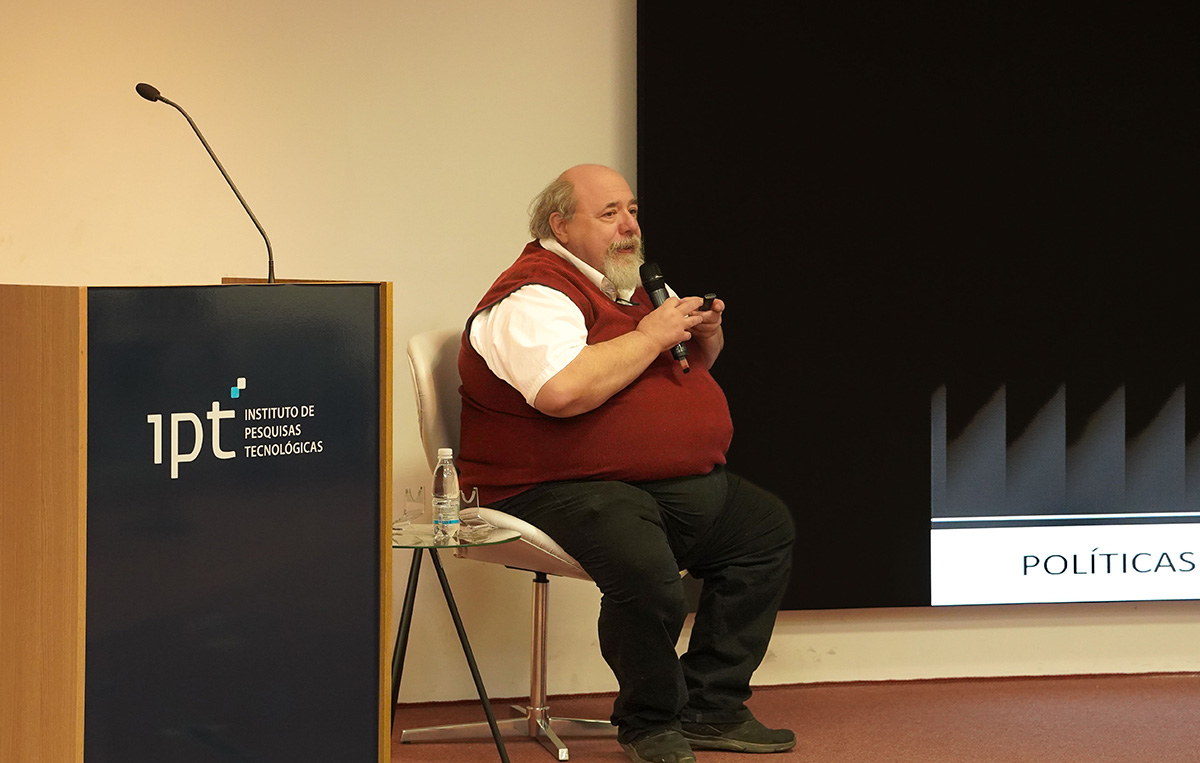
Valter Caldana, coordinator of the Laboratory of Public Projects and Policies at Mackenzie Presbyterian University (photo: Daniel Antônio/Agência FAPESP)
Similarly, Tatiana Tucunduva Philippi Cortese, a researcher at USP’s Institute of Advanced Studies (IEA) and a professor at UNINOVE, introduced the audience to the concept of “Build Back Better.” In this context, it involves rebuilding structures destroyed by natural disasters with technologies that increase resilience to future extreme weather events.
Cortese also emphasized the need to strengthen cooperation networks among different stakeholders and highlighted the human dimension of the work to be carried out by centers such as the Flood-Resilient Cities initiative.
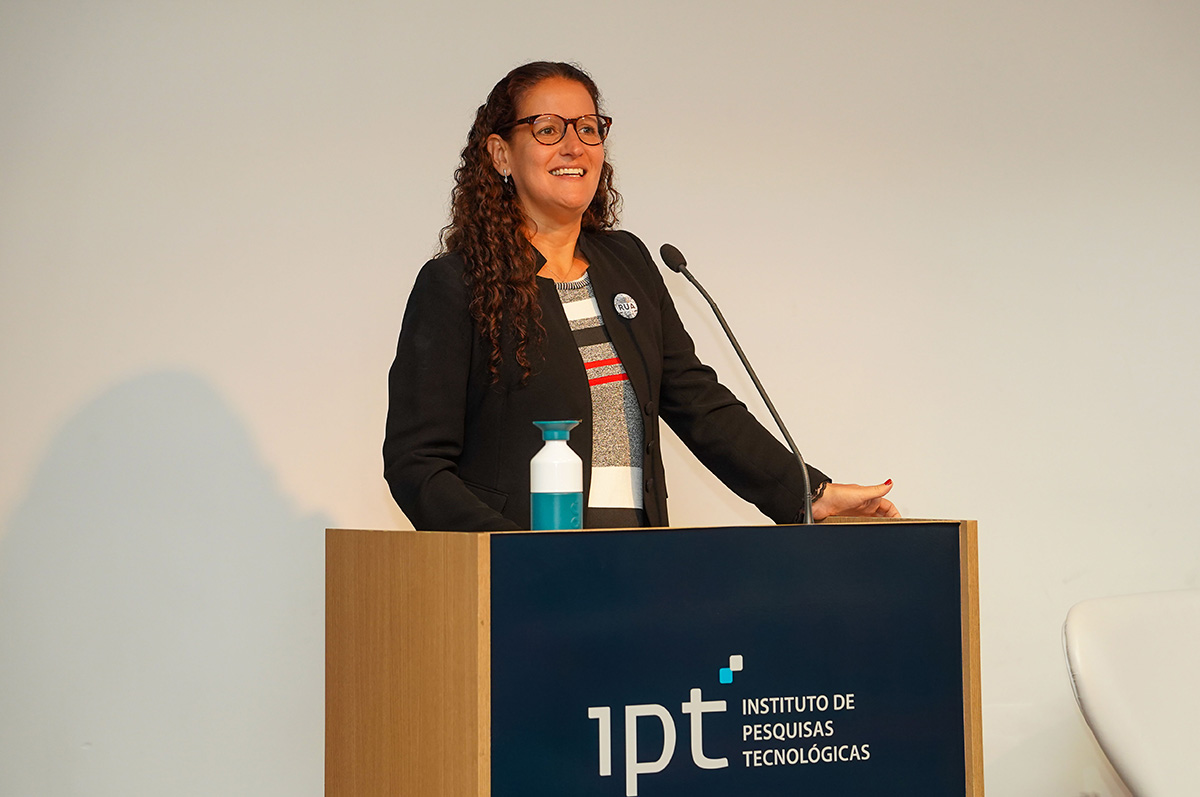
Tatiana Cortese, a researcher at the Institute of Advanced Studies at USP (photo: Daniel Antônio/Agência FAPESP)
Source: https://agencia.fapesp.br/58267


