


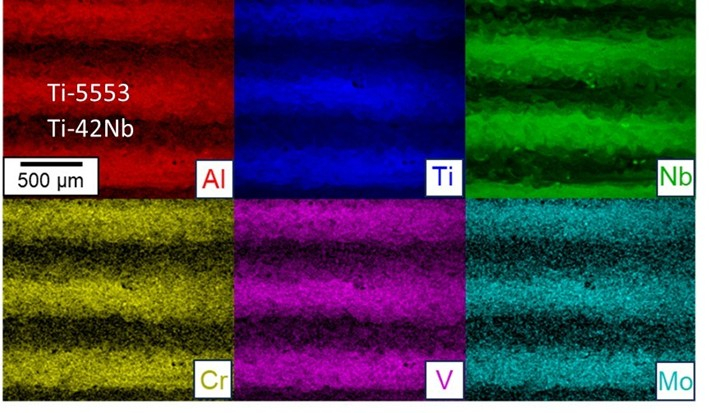
Electron microscope image of the Ti-5553/Ti-42Nb material showing layers containing aluminum, titanium, niobium, chromium, vanadium, and molybdenum (image: Rubens Caram Junior/FEM-UNICAMP)
Published on 06/29/2026
By José Tadeu Arantes | Agência FAPESP – Researchers at the School of Mechanical Engineering at the State University of Campinas (FEM-UNICAMP) in the state of São Paulo, Brazil, have developed a multilayer metallic material produced through additive manufacturing. The material combines high mechanical strength and good ductility, which are difficult properties to reconcile in structural metal alloys. Possible applications range from prosthetics to structural aircraft components.
The study, published in the journal Additive Manufacturing, demonstrates that various parameters can be modulated through the controlled alternation of layers of two distinct titanium alloys. The material was manufactured using a computer-controlled 3D printer that was specially modified for this purpose and capable of producing micrometer-thick layers via laser powder bed fusion. Rubens Caram Junior a full professor at FEM-UNICAMP, coordinated the study. “The idea was to combine a very strong alloy with a more ductile one so that the composite would exhibit an adjustable balance between those properties,” says Caram.
The research received funding from FAPESP (project numbers 18/18293-8, 23/13947-8, 22/10049-6, 21/06156-9, 24/13761-4, and 22/10350-8) and utilized the infrastructure of the Brazilian Nanotechnology National Laboratory at the Brazilian Center for Research in Energy and Materials (LNNano-CNPEM).
In materials engineering, increasing the mechanical strength of a material usually means reducing its ductility, or its ability to undergo plastic deformation before fracturing. This behavior, known as the “strength-ductility paradox,” severely limits applications. “In a single material, when mechanical strength increases, ductility decreases. And that poses a major problem because ductility is essential for absorbing energy before fracture. Otherwise, it can fracture abruptly,” explains the researcher. The controlled alternation of distinct layers – one more resistant and the other more ductile – solved the problem.
The strategy was to combine two metastable titanium alloys: a high-strength alloy sensitive to heat treatment, widely used in aerospace applications and containing aluminum (Al), molybdenum (Mo), vanadium (V), and chromium (Cr) – resulting in Ti-5Al-5Mo-5V-3Cr, or Ti-5553 – and an alloy containing niobium (Nb) with high ductility used in biomaterials – namely, Ti-42Nb.
The Ti-5553 alloy can achieve a strength of over 1,200 megapascals (MPa). The pascal (Pa) is a standard unit of pressure in the International System of Units (SI) and is defined as one Newton per square meter (1 N/m²). It is named after the French physicist, mathematician, and philosopher Blaise Pascal (1623–1662).
Ti-42Nb has a low elastic modulus and greater deformability.
“The Ti-5553 alloy is highly sensitive to heat treatment. Without treatment, it can have a tensile strength of about 600 MPa. After proper heat treatment, it can exceed 1,200 MPa. However, the stronger it becomes, the less ductile it is. The Ti-42Nb alloy, on the other hand, maintains greater ductility and has a lower elastic modulus,” says Caram.
The “elastic modulus” (also known as the “modulus of elasticity”) is a physical quantity that measures how stiff a material is – that is, how much it deforms elastically when subjected to a force. In simple terms, it is the ratio of the applied stress to the resulting deformation. A high value for this ratio indicates that a great deal of force is required to cause deformation. This is the case with rigid materials such as steel. Conversely, a low value indicates that the material can deform under much smaller forces, as is the case with rubber.
The heterostructure was produced using Powder Bed Fusion – Laser Beam (PBF-LB) technology, in which very small, spherical metal powder particles are deposited onto a substrate, leveled by a powder distributor, and selectively fused by a laser beam.
A key innovation of the study was modifying a Brazilian additive manufacturing machine to incorporate two independent powder reservoirs, allowing for automatic alloy feed switching during fabrication.
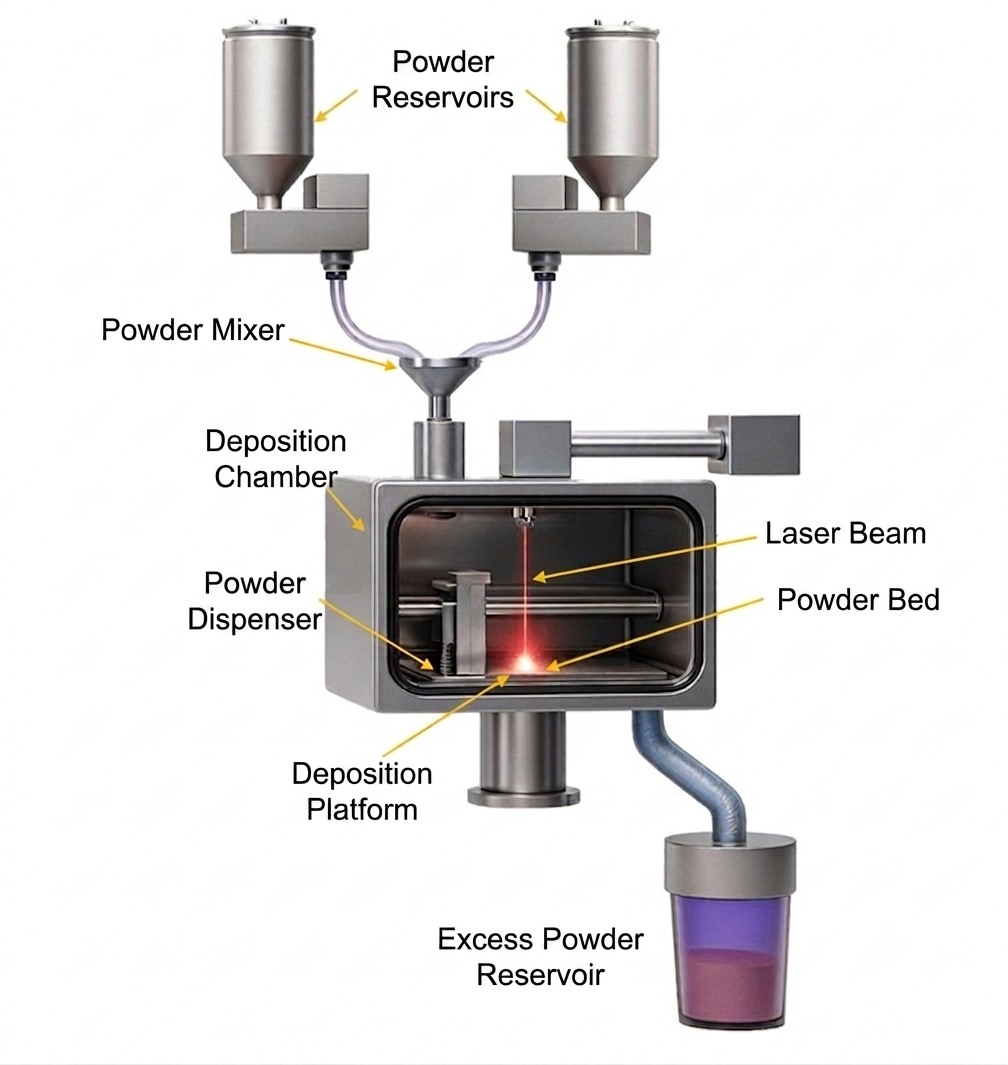
The 3D printer adapted for the study (image: Rubens Caram Junior/FEM-UNICAMP)
“We developed a device that enables us to alter the composition with each layer. Traditional machines don’t allow for that controlled alternation,” Caram emphasizes. In the study, alternating layers approximately 300 micrometers thick were produced and clearly identified by electron microscopy.
One of the key findings of the study was the interruption of “continuous epitaxial growth” between layers. This occurs when a material is deposited onto a substrate in such a way that the deposited layer has the same crystallographic orientation as the base material. In other words, the new crystal grows by “copying” the crystallographic orientation of the crystal beneath it. In the present study, alternating materials interrupted continuous epitaxial growth, thereby avoiding the drawback of mechanical anisotropy. An anisotropic material does not behave the same way when stretched, compressed, or bent in different directions. Isotropic materials, on the other hand, have uniform properties in all directions.
Even in its initial state, without heat treatment, the new material exhibited impressive performance, with a tensile strength of approximately 800 MPa and an elongation exceeding 10%. Heat treatments followed by aging allowed the properties to be tailored and improved further.
“What happens is a modification of the internal microstructure. By raising the temperature and controlling the cooling process, we significantly increase the strength of the Ti-5553 layers and, consequently, the strength of the entire heterostructure,” the researcher comments.
Applications
The Ti-5553 alloy is already used in the landing gears of commercial aircraft. According to Caram, replacing steel with titanium could reduce the weight of an aircraft by hundreds of kilograms, allowing for a greater cargo capacity. This is because the density of titanium (approximately 4.5 g/cm³) is much lower than that of steel (approximately 8 g/cm³).
In the medical field, however, the low elastic modulus is crucial. “If a rod that’s too rigid is inserted into the femur, the bone won’t deform elastically when subjected to mechanical stress. That can lead to bone resorption. That’s why we seek alloys with a lower elastic modulus,” says Caram.
One possibility for the future is producing femoral stems for hip prostheses with a gradual variation in composition and stiffness (modulus of elasticity) along their length: stiffer in the upper region and more flexible in the lower region. “Currently, those stems are made of a single material with uniform mechanical behavior. Our vision is to manufacture a stem with controlled variations in composition and, consequently, mechanical behavior,” the researcher predicts.
This approach broadens the scope for designing multi-material structures produced through additive manufacturing and provides practical guidelines for fine-tuning mechanical properties. The concept is similar to composite materials but with one key difference: the heterogeneities consist of compatible metal alloys from the same class. This prevents the formation of brittle intermetallic phases at the interface.
The article “Tailoring strength and ductility in Ti-5553/Ti-42Nb layered heterostructures produced by laser powder bed fusion” can be accessed at sciencedirect.com/science/article/abs/pii/S2214860425003987.
Source: https://agencia.fapesp.br/58543


