


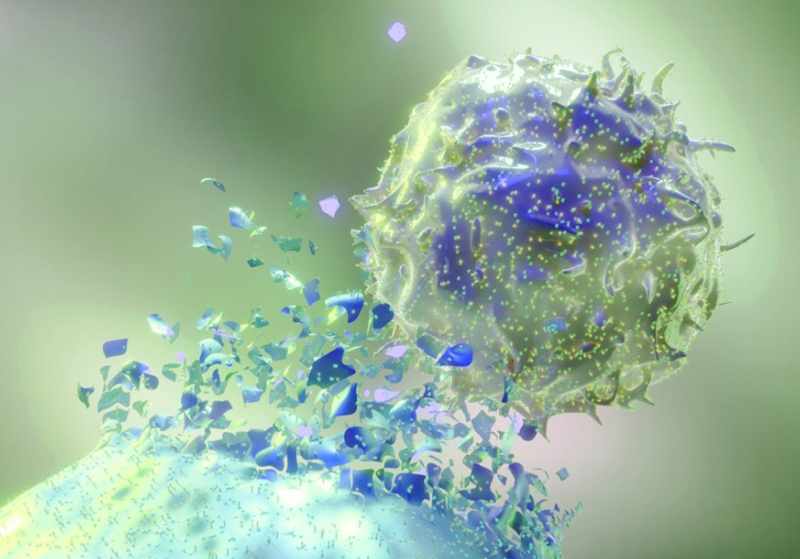
CAR-based cell therapies are revolutionizing the treatment of tumors, especially hematological ones (image: University of Texas/MD Anderson Cancer Center)
Published on 02/13/2026
Agência FAPESP – Researchers at the Ribeirão Preto Blood Center and the Center for Cell-Based Therapy (CTC) conducted a study using the NK-92 cell line to test new models of chimeric antigen receptors (CARs) with specific costimulatory domains, such as 2B4 and DAP12. The tests showed that these components helped make the cells “ready to attack,” thereby increasing their ability to destroy tumors. The results were published in the journal Frontiers in Immunology.
The CTC is one of the Research, Innovation, and Dissemination Centers (RIDCs) supported by FAPESP. It is based at the Ribeirão Preto Blood Center and is linked to the general and teaching hospital (“Hospital das Clínicas”) of the Ribeirão Preto Medical School of the University of São Paulo (FMRP-USP).
CAR-based cell therapies are revolutionizing cancer treatment, especially for hematological tumors. However, although it is already known which components work best in CAR-T cells, many questions remain about which intracellular signals make CAR-NK cells more effective.
The CTC’s research demonstrates that combining optimized co-stimulation with reversible pharmacological control can enhance the potency and efficiency of CAR-NK therapies, paving the way for new generations of cell therapies.
The research also evaluated using the drug dasatinib temporarily to control the activation of these cells. According to the Ribeirão Preto Blood Center Press Office, in animal models, CAR-NK cells with 2B4-DAP12, pretreated with dasatinib, showed better tumor control compared to traditional versions.
Those interested in learning more about the research can watch a video on the Ribeirão Preto Blood Center’s YouTube channel.
The article “2B4 co-stimulation and dasatinib modulation enhance anti-CD19 CAR-NK-92 cell cytotoxicity” can be read at frontiersin.org/journals/immunology/articles/10.3389/fimmu.2025.1675877.
Source: https://agencia.fapesp.br/57207


