


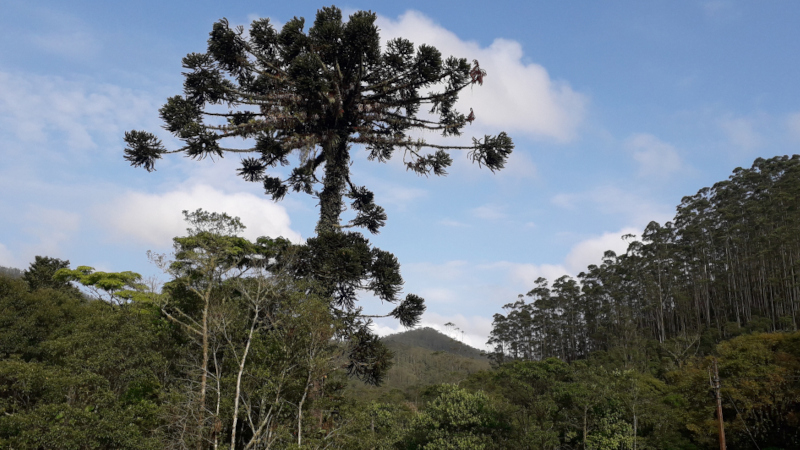
Specimen of araucaria (Araucaria angustifolia), a pine nut tree: the species is one of the most studied, according to a researcher survey. Because it provides food, it may be an option for reforestation with economic benefits (photo: Paulo G. Molin/NewFor)
Published on 12/01/2025
By André Julião | Agência FAPESP – The cost of forest restoration is a considerable obstacle, sparking discussions in recent years about how to make it economically viable. Since native wood management, carbon credits, and payment for ecosystem services are long-term solutions – the latter two with a nascent market – a group of researchers proposes exploiting non-timber forest products with added value to generate income from reforestation areas.
In an article published in the journal Ambio, a group led by researchers from the University of São Paulo (USP) points out that 59% of the plant species sampled in the Paraíba do Sul Valley region have some bioeconomic potential.
“The advantage of non-timber product management is that it’s based on the collection of leaves, branches, seeds, and fruits, constituting non-destructive management, keeping the forest standing and potentially bringing gains in the medium term,” says Pedro Medrado Krainovic, the first author of the study, which he conducted as part of his postdoctoral research at the Institute of Advanced Studies (IEA) at USP with a scholarship from FAPESP.
The work was also supported by two Science Centers for Development (SCDs), BIOTA Synthesis (project 20/06694-8) and Estratégia Mata Atlântica (SCD-EMA, project 21/11940-0), in addition to the NewFor project, which is part of the FAPESP Research Program on Biodiversity Characterization, Conservation, Restoration, and Sustainable Use (BIOTA-FAPESP).
The researchers analyzed 46 plots of forest, each 900 square meters (m²), in the Paraíba do Sul Valley, a region between the states of São Paulo, Minas Gerais, and Rio de Janeiro, from the NewFor database. In these areas, they identified all trees with a diameter greater than five centimeters at breast height. The total area sampled was 41,400 m².
Of the 329 species identified in the survey, 283 were native. Of these, 167 (59%) have some bioeconomic potential, according to a search conducted by the researchers of studies on the plants, including those on analytical chemistry, in vitro and in vivo studies, preclinical and clinical trials, and forestry practices. Of the species with potential, 58% have medical potential, 12% have cosmetic potential, and 5% have food potential. However, only 13% of the studies reached the final product stage. The araucaria (Araucaria angustifolia) and juçara (Euterpe edulis) were some of the species that appeared in the most studies; they are known for providing food.
The researchers estimated market interest by searching for patents filed worldwide based on the plants found. In this regard, 78 species (46.7%) have registered patents in 61 countries; however, only 8% of these patents are in Brazil.
“The number of patents is evidence of the economic potential of these species. It gives us an idea of what can already arouse interest and commercial potential, while those without patents show how much can still be found through research and development, such as new medicinal molecules, cosmetics, and even foods,” Krainovic explains.
Economic option
According to the authors, exploiting non-timber products is a way to offset the costs of restoration, even when another economic objective is defined, such as native wood extraction. Since the most valuable timber species have long life cycles, exploiting non-timber products can be an intermediate source of income while the wood is not ready to be extracted.
According to the Brazilian Forest Code, timber exploitation is prohibited in permanent preservation areas (APPs), including riverbanks, steep slopes, and mountaintops. In projects to restore these areas, which Brazil greatly needs, sustainable, low-impact management of non-timber product extraction can provide the funds for reforestation, while adding multifunctionality to forests that already fulfill important ecosystem functions, such as supplying water, protecting soil, sequestering carbon, and pollinating.
“It’s necessary to consider that the ultimate goal of ecosystem restoration is the return of ecosystem services, which are also important for agricultural activity. However, seeking sustainable ways to make these projects viable is a way to make restoration more attractive to rural producers,” the researcher points out (read more at onlinelibrary.wiley.com/doi/10.1111/rec.70089).
Job qualifications
Reforestation projects using native species are known to generate many jobs that don’t require qualifications. A 2022 study published in the British Ecological Society’s People and Nature journal estimated that Brazil could generate 2.5 million jobs if it meets the Paris Agreement target of restoring 12 million hectares by 2030. Some of the authors of the current study contributed to this study.
However, it is important to consider that the exploitation of forest resources must be managed in a way that does not lead to the overexploitation of species, which can result in deforestation instead of recovery. Rosewood (Aniba rosaeodora), an Amazonian tree valued for its essential oil used in fine perfumes, is an example from the past. Exploitation of this species peaked in the 1940s and 1950s. Today, the species is threatened with extinction.
The researchers also cite measures such as public procurement, certification, and other policies that could contribute to the opening of sustainable markets for non-timber products.
Cross-referencing the databases used in the study (abundance of sampled species, potential uses reported in the scientific literature, and registered patents) could guide future forest restoration projects in other Brazilian biomes.
“Rare, scarce species with significant economic potential could be added to active restoration projects involving the planting of seedlings. In turn, abundant and easily managed species that grow naturally can be better studied to find economic uses, stacking tangible and intangible values of forests and native species and creating ecological-economic multifunctionality,” Krainovic points out.
The article “Bioeconomic opportunities in restored tropical forests” can be read at link.springer.com/article/10.1007/s13280-025-02234-5.
Source: https://agencia.fapesp.br/56632


