


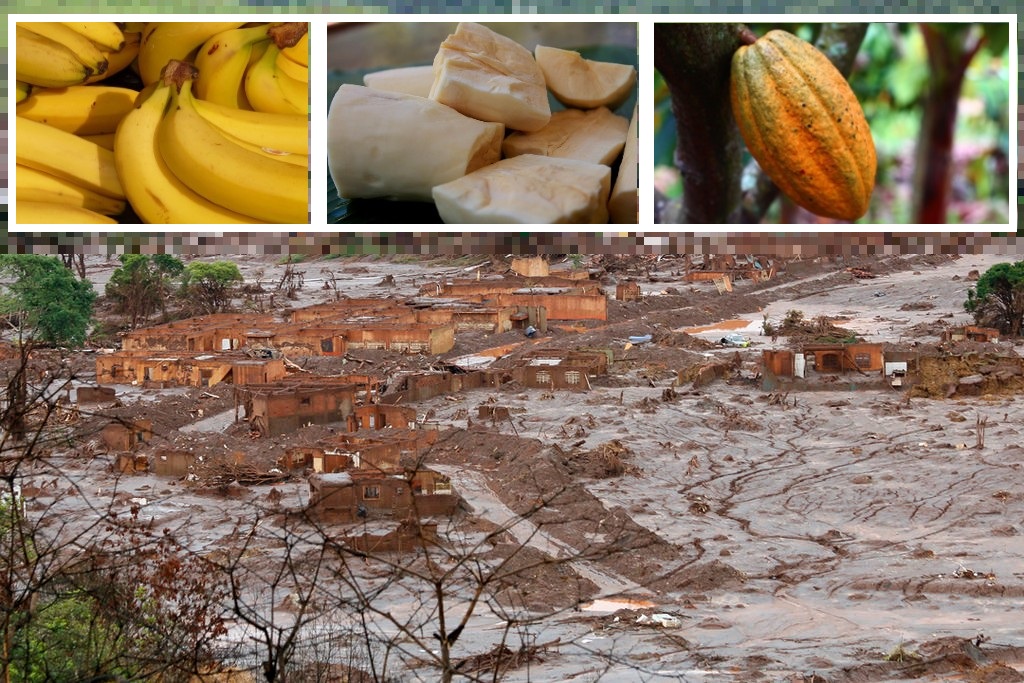
The research group warns that continued consumption of food grown in contaminated soil may pose a carcinogenic risk due to the long-term accumulation of potentially toxic elements in the body (montage of images from Pixabay and Wikimedia Commons)
Published on 12/15/2025
By Karina Ninni | Agência FAPESP – Scientists specializing in soil geochemistry, environmental engineering, and health affiliated with the University of São Paulo (USP) and the Federal University of Espírito Santo (UFES) in Brazil and the University of Santiago de Compostela in Spain assessed the risks of consuming bananas, cassava, and the pulp of cocoa grown in soils impacted by iron mining waste in the Doce River estuary in Linhares in the Brazilian state of Espírito Santo. The region has received the material since the Fundão tailings dam collapsed in the neighboring state of Minas Gerais in November 2015.
The concentrations of cadmium, chromium, copper, nickel, and lead in the soil are associated with the main constituent of the tailings: iron oxides. The team also found that consuming bananas grown in soil impacted by the tailings poses a possible health risk to children aged six years or younger.
“Our group has been studying the impacts of the dam collapse for years. We obtained the first samples seven days after the accident and immediately understood that there was an imminent risk of contamination of plants, soil, water, and fish. But the question remained: Does this contamination pose a risk to human health?” recalls Tiago Osório, an agronomist and professor in the Department of Soil Science at the Luiz de Queiroz College of Agriculture at the University of São Paulo (ESALQ-USP).
In an article published in Environmental Geochemistry and Health, the group reveal how plants access potentially toxic elements (PTEs) associated with the tailings and accumulate them in their edible parts. They also explain how this material enters the food chain. The article is part of Amanda Duim’s doctoral studies at ESALQ. Duim’s thesis has already yielded seven publications in international journals and won two awards in 2025: the USP Thesis Award in Sustainability and the Capes Thesis Award, conferred by the Brazilian Ministry of Education’s Coordination for the Improvement of Higher Education Personnel (CAPES). Duim received support from FAPESP through a doctoral scholarship.
FAPESP’s support for the group’s work includes two postdoctoral fellowships (20/12823-5 and 21/00221-3), two research grants (23/01493-2 and 22/12966-6), one scholarship from the Young PhD Retention Program and one scientific initiation scholarship.
High concentration
According to Duim, the first author of the article, what sets this study apart is that the team correlated the risk to human health with the transfer of PTEs from the soil to the plant. “The iron oxide content in the soil, which is the main constituent of the tailings, correlates with its content in the plant. We studied the passage of constituents from the tailings in the soil to the water, and then from the water to the plant, including its leaves and fruits.”
“First, we need to know which elements are there and in what quantities in order to understand the biochemical dynamics of their release,” Osório explains.
Duim began his doctoral studies in 2019, researching ways to use plants from flooded regions to clean up contaminated environments. “We evaluated cultivated and native species. In the case of the latter, we wanted to know how they affect the dissolution of iron oxide and, in this process, understand if and how the PTEs associated with this waste enter the plant, since different species accumulate PTEs differently,” explains the researcher. “The idea was to find the best native species for cleaning up contaminated environments, and we found more than one species that can fulfill this function, with results already published. In the case of cultivated species, we wanted to know if PTEs would be transferred to the fruits and edible parts of the plants,” she explains.
“We collected the soil and the plant, washed the plant, weighed the fresh biomass, dried the plant, weighed the dry biomass, and ground the roots, stem, leaves, and peeled fruits separately. Only then did we analyze all the parts to find out what was in each one. We dissolved the ‘plant powder,’ transforming it into a solution using various acids, and determined the concentration in the solution. We converted the calculation of the concentration of material in the solution and compared it with the weight of the diluted material, thus obtaining the PTE concentration in milligrams per kilogram of dry biomass,” Duim describes.
In bananas and cassava, all PTEs (except chromium) accumulated more in underground parts, such as roots and tubers, than in aerial parts. Cocoa, on the other hand, showed high PTE accumulation in the above-ground parts (stems, leaves, and fruits). Additionally, the concentrations of copper and lead in the fruit pulp exceeded the limit values established by the Food and Agriculture Organization of the United Nations (FAO).
Upon discovering that the cultivated plants had PTE concentrations higher than the recommended levels, including in the edible parts, the team decided to conduct a risk analysis on the fruits and tubers.
Health risks
The scientists estimated the risks of consuming bananas, cassava rhizomes, and cocoa pulp by calculating the risk quotient (RQ), risk index (RI), and total risk index (TRI) for children (under six years of age) and adults (over 18 years of age). The RQ is the ratio of the average daily intake of a chemical substance to its corresponding reference dose. The TRI is a fundamental metric for assessing potential non-carcinogenic health risks associated with exposure to PTEs. To indicate low risk, the TRI must be less than 1.
“These elements exist naturally in the environment. We’re exposed to them in lower concentrations. But in the case of a disaster like the one in Mariana, when exposure is expected to increase, we need to exercise extra caution,” says Tamires Cherubin, who has a Ph.D. in health sciences and is also an author of the study. The generally used methodology is to calculate the risk of the bioavailability of these elements given that exposure to certain concentrations can cause significant health problems such as kidney and heart problems, gastrointestinal discomfort, and lung damage from respiratory exposure. Other acute risks include skin problems and eye irritation.
The risk analysis calculation includes factors such as the consumption of locally grown plants by the population. The researchers estimated how much of the local population’s food came from outside the area and how much came from food grown there, based on data from the Brazilian Institute of Geography and Statistics (IBGE). Other factors include exposure duration (how many years a person consumes the product), consumption levels relative to adult and child body mass, and the time it takes for consumption to result in harmful effects.
“According to the reference daily intake doses for contaminants covered by the literature, we consider the limits of 0.05 mg/kg-1 for the presence of cadmium in fruits and 0.1 mg/kg-1 in tubers, 0.5–1.0 mg/kg-1 for the presence of chromium, 20.0 mg/kg-1 for copper, 0.5–1.0 mg/kg-1 for nickel, 0.8–2.3 mg/kg-1 for lead, and 50.0 mg/kg-1 for zinc,” Cherubin explains.
Although the TRIs for most of the elements analyzed were below the risk level (less than 1), indicating that consuming these foods grown in the Doce River estuary does not pose a significant threat to adults, the TRI for bananas in children exceeded 1, suggesting potential health impacts. The main risk factor was the higher concentration of lead in the fruit, which also had a higher cadmium content than the FAO recommends. According to the scientists, prolonged exposure to lead, even in low doses, is associated with irreversible damage to neurological development, including reduced IQ, attention deficits, and behavioral disorders.
The group warns that continued consumption of food grown in contaminated soil may pose cumulative risks in the long term. “Over time, considering the life expectancy in Brazil of around 75 years, there may be a carcinogenic risk since there’s a possibility of direct and indirect DNA damage,” says Cherubin. These mutations have the potential to result in a higher incidence of various types of cancer, including those affecting the central nervous system, gastrointestinal tract, and hematological system. “It all depends on the human body’s ability to absorb and metabolize these elements that are available in the environment,” says the researcher.
The article “From tailings to tables: risk assessment of potentially toxic elements in edible crops cultivated in mine tailing impacted soils” can be read at doi.org/10.1007/s10653-025-02770-9.
Source: https://agencia.fapesp.br/56828


