


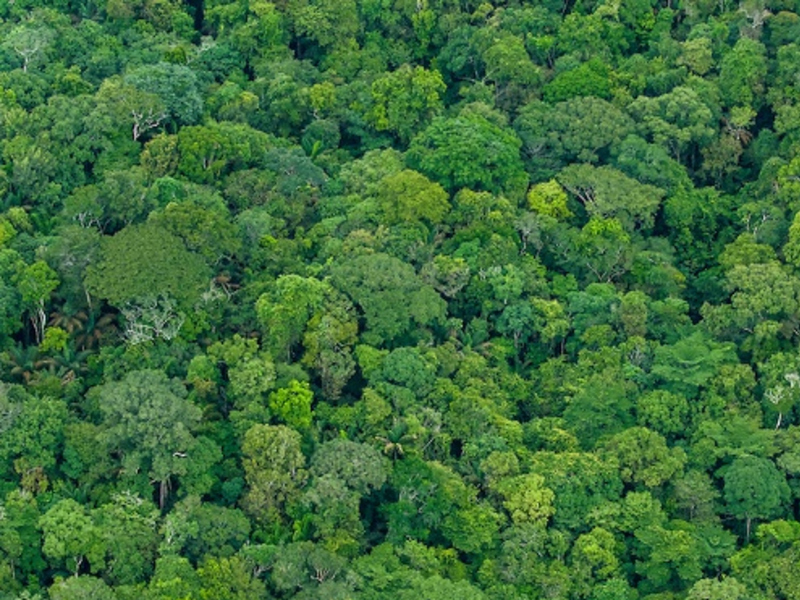
Unlike predatory illegal logging, management is based on scientific analysis, allowing for planned and controlled extraction (photo: Edson Vidal/ESALQ-USP)
Published on 03/09/2026
By Luciana Constantino | Agência FAPESP – The adoption of management techniques that reduce the impact of timber harvesting can promote the recovery of tropical forests, such as the Amazon, and store carbon in the long term while maintaining biodiversity and ecosystem services.
Research published in the Journal of Environmental Management provides evidence that these good practices increase above-ground biomass, unlike conventional logging. This reinforces the effectiveness of reduced-impact logging forest management (RIL-FM) as a strategy that reconciles timber production, forest conservation, and climate change mitigation.
Biomass, or living or dead organic matter (such as plants, trees, animals, and waste), is a key indicator for analyzing forest recovery and carbon sequestration.
The study was conducted from 1993 to 2023 on a farm near the municipality of Paragominas in the state of Pará, Brazil. The farm has an area dedicated to scientific experiments, especially those related to forestry and tropical forest management.
Over the 30-year period, tree diameters were measured 12 times in two management systems – RIL-FM and conventional – in addition to an unexploited control plot. Biomass stock was estimated for the entire forest, areas with exploited species, areas with exploitation potential, and areas with species without timber value.
According to the results, the area managed with reduced-impact techniques approached the structural conditions of a mature forest. This area had a positive biomass balance, with an average gain of 70.68 megagrams per hectare (Mg ha⁻¹). In contrast, the conventional management plot showed a biomass loss, with a negative balance of 11.35 Mg ha⁻¹, while the control plot remained practically stable.
Over time, including timber harvesting cycles, maximum biomass stocks of 353.42 Mg ha⁻¹ were achieved with RIL-FM, on average, in all analyzed species groups, ranking above the other evaluated areas.
“This 30-year monitoring effort has yielded unprecedented practical results and reaffirms the importance of including forest management in discussions on climate change mitigation. We’ve shown that reduced-impact management can clearly restore biomass and, consequently, carbon sequestration. As a result, the findings can help create methodologies for payment for ecosystem services, such as the carbon market, from these areas and contribute to updating legislation on sustainable management in tropical forests,” says research coordinator Edson Vidal of the Department of Forest Sciences at the Luiz de Queiroz School of Agriculture at the University of São Paulo (ESALQ-USP) in Brazil. Vidal is also one of the coordinators of the Tropical Forestry Laboratory (LASTROP) at ESALQ-USP.
Legislation
The Brazilian Forest Code (Law No. 12,651/2012) describes sustainable management as the “management of natural vegetation to obtain economic, social, and environmental benefits while respecting the mechanisms that sustain the ecosystem.” This management considers the use of multiple timber and non-timber species, as well as the products and by-products of flora.
Legislation for the Amazon also requires management plans every five years. The technical parameters of these plans follow a 2009 resolution of the National Environmental Council (CONAMA).
Unlike illegal predatory logging, sustainable management is based on scientific analyses that allow for planned and controlled extraction.
Reduced-impact logging employs techniques that minimize forest damage, including zoning, area registration, and detailed species planning with mapping of all commercial trees (called inventory). Staff training is also necessary. Additionally, it is necessary to select ideal trees for harvesting, cut vines and creepers, plan roads and trails, and minimize waste and damage to the remaining forest. Managed trees are directionally cut, respecting a minimum diameter, with planned removal and extraction cycles.
Last year, a group of scientists led by Vidal published an article showing that the distance between trees of a given species in a region can affect management. This is because minimum cutting distances specific to each species can favor pollen dispersal and genetic viability, allowing for conservation.
Economic alternative
Vidal points out that the recently published research highlights the feasibility of reconciling the economic use of forests with environmental conservation based on science and evidence-based public policies.
According to the National Forest Information System, timber production in Brazil comes mainly from planted areas. In 2023, 94% of log wood originated from these areas. That same year, BRL 35.1 billion worth of wood products were sold, BRL 22.2 billion of which was log wood.
The researchers argue that reduced-impact logging, which promotes biomass recovery and carbon sequestration, aligns with economic strategies discussed in the market, such as Reducing Emissions from Deforestation and Forest Degradation (REDD+) and Improved Forest Management (IFM) projects.
“I took the results we obtained to COP30, and the data sparked interesting discussions. We even formed a group to organize an event in May on forest management. During the conference, the main focus in this area was on forest restoration,” the researcher told Agência FAPESP. In November 2025, he was in Belém to participate in discussions at the United Nations Climate Change Conference.
Partnerships
The article was developed as part of the project “Moving Beyond the First Harvest Cycle in the Tropical Forests of the Brazilian Amazon”, funded by FAPESP and linked to the Amazon+10 Initiative – a program led by the National Council of State Research Foundations (CONFAP) involving State Research Foundations (FAPs) from 25 states, including São Paulo.
According to Vidal, the next step in the study will be to include institutions in the Amazon+10 Initiative with forest management data from states such as Amazonas, Mato Grosso, and Rondônia. This will allow for a more global comparison of biomass results. “From there, we can consider the contribution of forest management to Brazil’s NDC, for example,” he adds.
The Nationally Determined Contribution (NDC) is a key instrument for the goals of limiting global warming. Each country made an NDC commitment in the Paris Agreement to reduce its greenhouse gas emissions and adapt to climate change. The NDCs were due to be revised in 2025. By the start of COP30, 111 of the 160 countries had submitted their new targets.
The study also received support from FAPESP through five other projects (19/25820-7, 22/09047-9, 23/07753-6, 24/04038-7 and 24/14326-0), including doctoral scholarships and postdoctoral fellowships for researchers participating in the group.
The article “Impact of different management practices on tree biomass and carbon dynamics 30 years after logging in eastern Amazon” can be read at sciencedirect.com/science/article/abs/pii/S0301479725043130.
Source: https://agencia.fapesp.br/57405


