


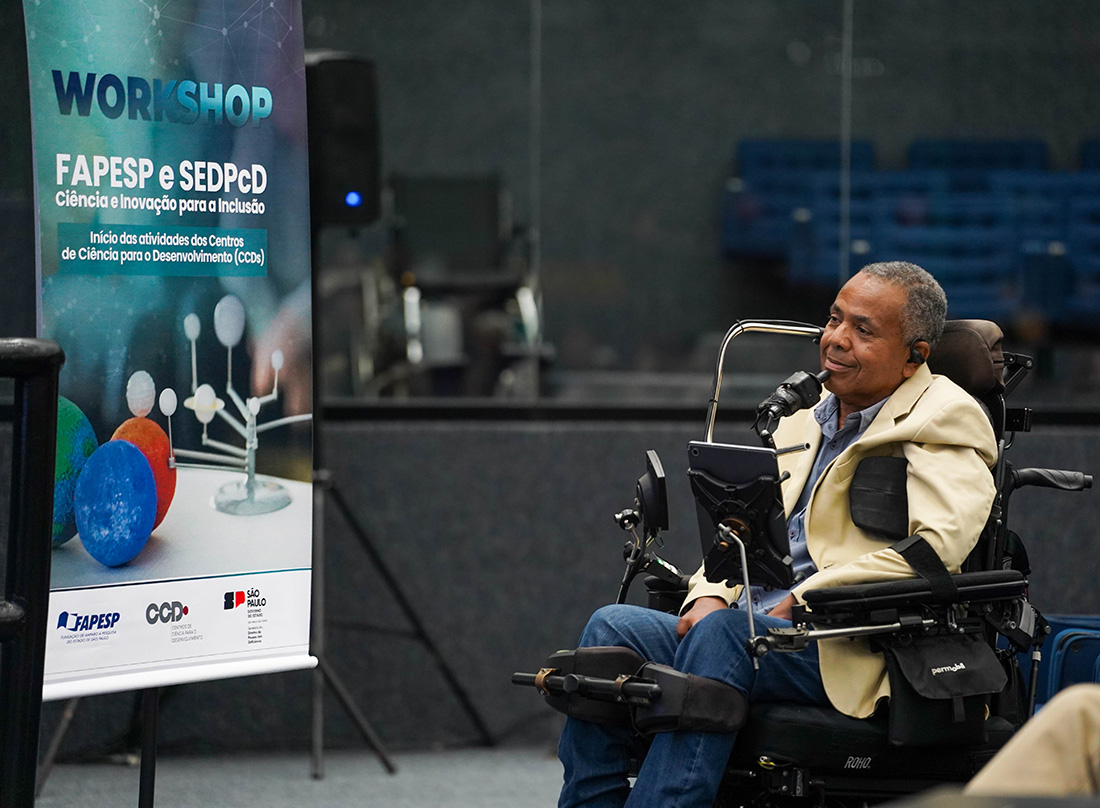
There are now eight Science Centers for Development supported by FAPESP and the State Department for the Rights of People with Disabilities (photo: Daniel Antônio/ Agência FAPESP)
Published on 09/29/2026
By Maria Fernanda Ziegler | Agência FAPESP – Brazilian Paralympic athletes are set to receive a major boost from science. The Multidisciplinary Center for Paralympic and Para-Sports Studies (CMEPP), which is part of the Biomedical Sciences Institute at the University of São Paulo (ICB-USP), aims to improve the quality of life for people with disabilities through sports. The center also seeks to enhance the performance of para-athletes in order to win more medals at the 2028 Los Angeles Olympics.
The CMEPP will also focus on non-athletes, encouraging people with mobility challenges to exercise at home with tools that use wearable technologies and XR (extended reality) games.
“There are very few studies conducted with Paralympic athletes, and we know that much of the knowledge about high-performance sports doesn’t apply to athletes with disabilities. One example is markers of overtraining [creatine kinase] or indicators of stress [cortisol and neutrophil-to-lymphocyte ratio], which don’t work for these athletes because they already have altered levels even before exercising,” said José Cesar Rosa Neto, coordinator of the CMEPP. Neto made this statement during the official launch of four new Science Centers for Development (SCDs) focused on people with disabilities. These SCDs are a partnership between FAPESP, the State Department for the Rights of People with Disabilities (SEDPcD), and universities in São Paulo.
The launch took place on April 9 in the SEDPcD auditorium.
The other three new centers are farther from Olimpo, but they also have ambitious goals. CIATec, the Center for Inclusion and Accessibility through Technology, is based at the University of São Paulo’s School of Arts, Sciences, and Humanities (EACH-USP). It aims to create a “Netflix of inclusive education”: a digital platform featuring adaptive educational games for students with autism spectrum disorder (ASD).
CIATec coordinator Carlos Bandeira de Mello Monteiro explained that artificial intelligence will adjust the difficulty and dynamics of the games in real time according to each student’s neurological profile, ensuring that everyone can play together.
Meanwhile, teachers are expected to benefit from research conducted by the Center for Assistive Technology and School Inclusion (CTAIE) at the São Paulo Medical School of the Federal University of São Paulo (EPM-UNIFESP), in collaboration with the Renato Archer Information Technology Center (CTI).
“We’re mapping accessibility needs in public schools to develop personalized assistive devices [such as 3D-printed orthoses and prostheses] and provide ongoing teacher training,” said Maria Cecília Martinelli, coordinator of the new SCD.

Marco Antonio Zago, president of FAPESP: “With the Science Centers for Development and other FAPESP programs, we’re no longer just an agency that supports individual scientists with grants and funding. We’re now an integral part of government initiatives” (photo: Daniel Antônio/Agência FAPESP)
Visual impairment
Blindness and low vision are the most prevalent disabilities, and the new Center for Research and Guidance on Visual Impairment (CPODV) at USP will focus on this population.
“Our work is to create strategies that expand access to cultural spaces and productions for people with visual impairments, using resources such as audio description, tactile materials, and assistive technologies to promote greater autonomy,” said Maria Célia Lima Hernandes, a professor at USP’s Faculty of Philosophy, Languages and Literature, and Human Sciences (FFLCH-USP) and coordinator of the CPODV.
“These are assistive technologies that use science, technology, and innovation to ensure the rights of people with disabilities. With the Science for Development Centers and other FAPESP programs, we’re no longer just an agency that supports individual scientists with grants and funding; we’ve begun integrating government initiatives and working toward the technological autonomy of the state of São Paulo,” said Marco Antonio Zago, president of FAPESP, during the launch ceremony for the new centers.
Currently, there are 83 SCDs in operation, with a total investment exceeding BRL 570 million.
Zago explained that due to the pandemic, project submissions declined, only rising again in 2022. “This resulted in a buildup of funds that were set aside and are now being used to create the Science Centers for Development – a way to unite the efforts of academia, government, and businesses in projects aimed at solving societal problems. In addition to investing in basic science, we discovered that the citizens who fund FAPESP would like to see a return on their investment in the form of immediate, direct solutions for society,” Zago reported.
The Foundation’s president noted that a new call for proposals will be issued to create more centers and expand the research strategy guided by public demands. Zago emphasized that the goal is to strengthen a model in which science directly contributes to resolving the state’s social and economic issues.
The Science Centers for Development operate under a co-funding model: for every BRL 1 requested from FAPESP, partner organizations contribute an identical amount. Funding is long-term, up to five years, and the results are expected to advance knowledge and improve public policy.
“During the pandemic, the value of science and research to society seemed evident, but we saw that this isn’t enough. In the 21st century, it’s the scientific community’s obligation to demonstrate its relevance, since society is more demanding and investments in science and technology must be justified. In this regard, the FAPESP Board created the Science Centers for Development, an initiative that demonstrates how research and the generation of knowledge can offer concrete solutions to the problems faced by governments,” said Vahan Agopyan, Secretary of Science, Technology, and Innovation for the State of São Paulo.
Agopyan stated that 18 departments participated directly or indirectly in the latest call for proposals to establish new SCDs. “We need to encourage this interaction and show that science can provide effective solutions to public administration challenges. The Department for People with Disabilities, for example, is the one that makes the most use of the science and technology infrastructure,” he emphasized.
Currently, SEDPcD has eight SCDs. “The ultimate goal of these centers is to ensure that people with disabilities have the support they need to achieve autonomy and allow science to provide real solutions to the obstacles the government faces in serving that population,” said Secretary Marcos da Costa.
Also participating in the ceremony were Ana Beatriz Oliveira, rector of the Federal University of São Carlos (UFSCar); Raiane Assumpção, rector of UNIFESP; Aluísio Segurado, rector of USP; Ignácio Poveda, from SEDPcD; Odilon José Roble, director of the School of Physical Education at the State University of Campinas (FEF-UNICAMP); and Dácio Roberto Matheus, rector of the Federal University of ABC (UFABC).
Source: https://agencia.fapesp.br/59302


