


The study has important implications for interpreting redox signaling and oxidative stress experiments (image: Edlane Linares et al./Free Radical Biology and Medicine)
Published on 09/29/2026
Agência FAPESP* – Free radicals and oxidants play important roles in regulating cellular responses. Hydrogen peroxide (H₂O₂), also known as oxygenated water, has been recognized for decades as one of the main mediators of redox signaling. However, detecting these molecules inside cells remains challenging due to their low concentrations.
To address this issue, researchers have developed genetically encoded fluorescent probes, such as those in the HyPer family, which can show in real time where and when H₂O₂ is produced in cells. These probes are considered highly specific to hydrogen peroxide.
However, a new study suggests that this specificity may not be absolute. Scientists at the Center for Research on Redox Processes in Biomedicine (Redoxoma) constructed a plasmid (a small circular DNA molecule) that carries additional genes to promote the production of the HyPer7 protein (the latest version of this family of probes) in bacteria. They then tested its reactivity under controlled laboratory conditions.
Redoxoma is a FAPESP Research, Innovation, and Dissemination Center (RIDC) based at the University of São Paulo’s Institute of Chemistry (IQ-USP).
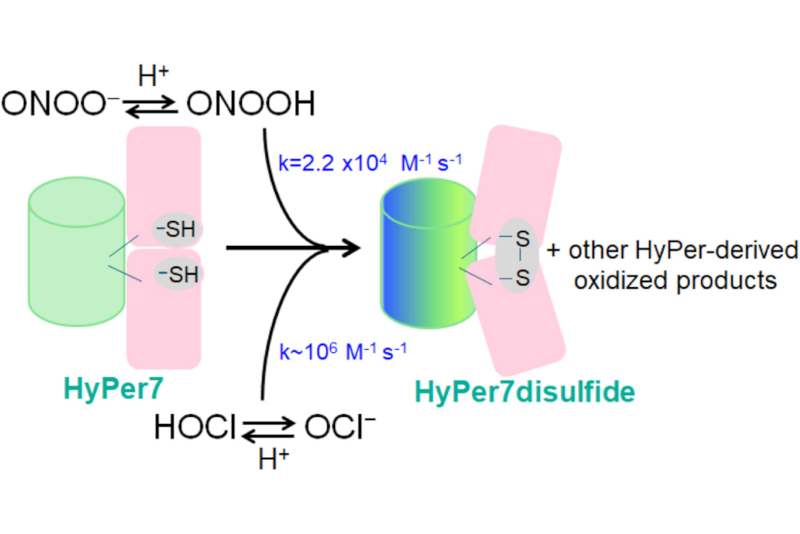
The results show that HyPer7 is oxidized not only by hydrogen peroxide but also by peroxynitrite (ONOOH) and hypochlorous acid (HOCl), two reactive species with important biological functions.
“HyPer probes have taken redox research to a whole new level, but it’s essential to understand exactly what they’re detecting. Our work shows that HyPer7 isn’t as specific to hydrogen peroxide as previously thought,” says Professor Ohara Augusto, coordinator of the study and a researcher at IQ-USP.
The results, published in the journal Free Radical Biology and Medicine, highlight the need for caution when interpreting experiments conducted with HyPer7 and related probes. “The redox field is very complex. You can’t conduct a single type of experiment and draw definitive conclusions. Just because you place the probe in the cell and it glows doesn’t necessarily mean that hydrogen peroxide was formed. You have to consider the context, whether there’s the possibility of peroxynitrite or hypochlorous acid forming, as occurs in inflammatory conditions, for example. If you have any doubts, you need to perform additional controls,” the researcher explains.
How HyPer7 works
Hydrogen peroxide is a central metabolite in redox biology. It is generated in different cellular compartments, such as mitochondria, peroxisomes, and the endoplasmic reticulum, as well as by membrane-associated NADPH oxidases. Unlike more aggressive oxidants, hydrogen peroxide exhibits limited and selective reactivity, making it an important mediator of cellular responses.
Despite its importance, detecting H₂O₂ in real time and at precise locations remains challenging. To address this issue, researchers developed the HyPer fluorescent probe, a protein designed to detect hydrogen peroxide in cells and organisms. Over time, this type of probe has been refined, culminating in HyPer7, a more sensitive version.
However, the IQ-USP professor notes that the original in vitro experiments evaluating this reaction with other biological oxidants, such as peroxynitrite and hypochlorous acid, were carried out under suboptimal conditions, which may have limited interpretation of the results.
To conduct the study, the researchers needed large quantities of the protein. To ensure high bacterial expression, they constructed a new plasmid. After purifying the protein and confirming its functionality, the researchers combined spectroscopic analyses with rapid kinetic measurements to compare how different oxidants reacted with the probe.
The experiments confirmed that H₂O₂ is the most specific oxidant for HyPer7. However, they also showed that the probe reacts with peroxynitrite and hypochlorous acid. The rates of these reactions vary; H₂O₂ oxidizes the probe faster than peroxynitrite but slower than hypochlorous acid. All three reactions primarily generate HyPer7 disulfide, though peroxynitrite and hypochlorous acid generate additional products as well.
Formed by the reaction between nitric oxide and superoxide, peroxynitrite is a potent oxidant that targets thiol groups in regulatory proteins, such as peroxiredoxins. These proteins are essential for maintaining cellular redox balance. Hypochlorous acid, in turn, is produced by immune system cells and is even more reactive. It reacts with virtually all thiols present in proteins, making it a potent, non-selective oxidant compared to H₂O₂ and peroxynitrite.
These results support the hypothesis that these probes can detect not only a specific molecule, such as hydrogen peroxide, but also the overall oxidation-reduction state of thiol groups in cells. Thiol groups are regions of proteins that contain sulfur and function as sensors and regulators of redox reactions, controlling various cellular processes.
“These probes are reversible,” explains Ohara Augusto. “When hydrogen peroxide is produced, the protein is oxidized and emits fluorescence. However, like any protein, it can be reduced by reducing agents in the cellular environment. So, although it’s typically used to detect hydrogen peroxide, it actually measures the difference in the oxidation state of the reactive thiols in HyPer. This is the basis of redox signaling.”
Since these tools are widely used in living cells and whole organisms, demonstrating their enhanced reactivity has important implications for interpreting experiments on redox signaling and oxidative stress.
The article “HyPer7: High-level bacterial expression and kinetics showing significant oxidation by peroxynitrite and hypochlorous acid” can be read at sciencedirect.com/science/article/abs/pii/S0891584925009992.
* With information from Maria Celia Wider of Redoxoma
Source: https://agencia.fapesp.br/59300


