


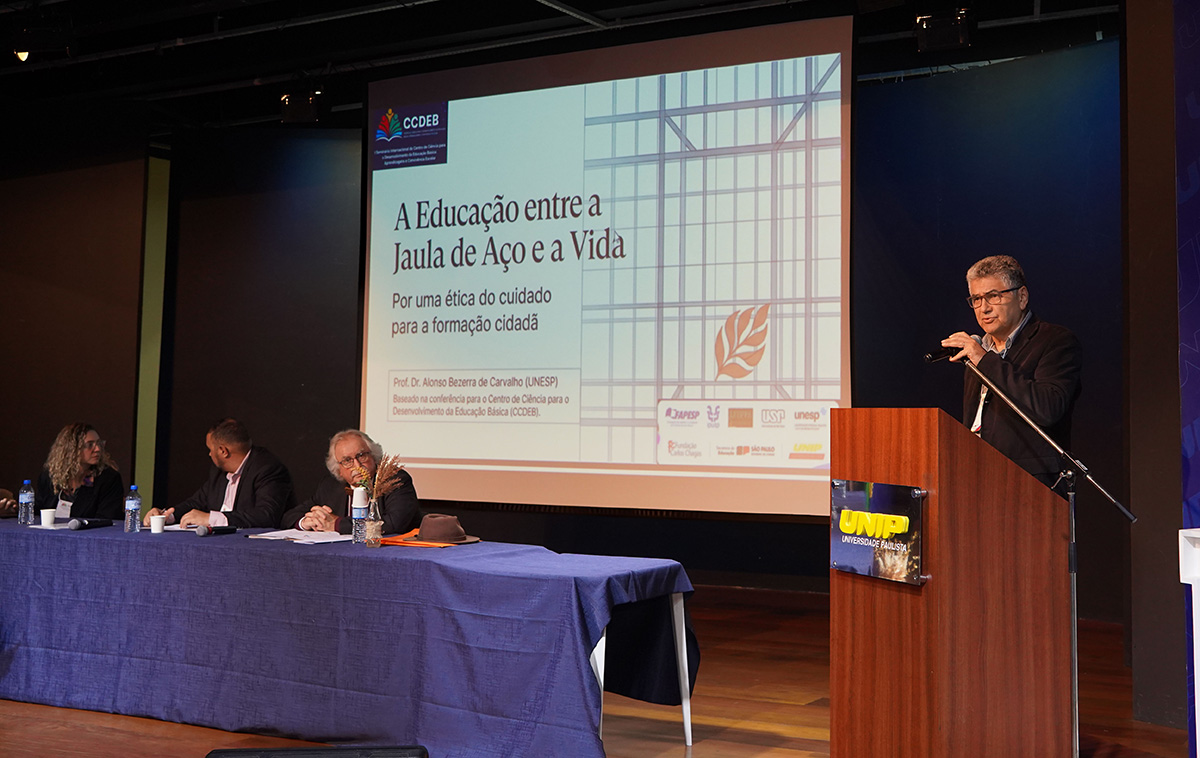
According to UNESP professor Alonso Carvalho, teachers’ ill health is not the result of individual weakness, but of the failure of educational policy (photo: Daniel Antônio/Agência FAPESP)
Published on 06/01/2026
By Maria Fernanda Ziegler | Agência FAPESP – Various countries have experienced an increase in cases of aggression among students, conflicts involving teachers, bullying, and threats. This situation poses an urgent challenge to school life, requiring an in-depth understanding and evidence-based responses. To discuss possible solutions based on effective public policies, researchers from eight countries participated in the 1st International Research Seminar of the Science Center for the Development of Basic Education, Learning, and School Coexistence (CCDEB), held on May 18 and 19 in the city of São Paulo, Brazil.
At the opening of the event, CCDEB director Marilene Proença Rebello de Souza emphasized that the group’s mission is to produce scientific knowledge to guide public policies focused on learning, social interaction, and addressing dropout rates, medicalization, and violence.
“There’s no learning without a welcoming, violence-free environment. Although many public policies focused on school coexistence are well-designed, they fail in implementation and evaluation. It’s therefore necessary to monitor results, understand what worked and what didn’t, and identify what needs adjusting,” added Daniele Quirino, deputy director of the CCDEB. The CCDEB is a Science Center for Development (SCD) supported by FAPESP and based at the Institute of Psychology at the University of São Paulo (IP-USP).
Teachers’ health issues
One of the highlights of the first day of the event was the lecture given by Professor Alonso Bezerra de Carvalho of São Paulo State University (UNESP), who discussed a study released in May by the Union of Public School Teachers of the State of São Paulo (APEOESP). The study found that 97% of education workers in São Paulo associate emotional distress with their work. The main symptoms reported were anxiety, panic disorder, depression, and sleep disorders.
According to Carvalho, the principal researcher at the CCDEB, this poor health is not the result of individual weakness but rather the failure of educational policy. He says it is a symptom of a structural collapse in school organization that “transforms teachers into mere goal-achievers and colonizes their subjectivity.” According to Carvalho, education operates under a Eurocentric and rationalist logic that devalues grassroots, indigenous, and Afro-Brazilian knowledge and represses human emotions.
“Students who fidget are hyperactive; those who get sad are depressed. Teachers who become indignant are unbalanced. Even after the end of political colonialism, the structures of domination have remained,” he said.
For Carvalho, schools distrust emotions and transform the school environment into a space of control. “Teachers are trained not to show vulnerability, and students, not to express their culture. The joy of learning is replaced by the obligation to produce results.”
He added that this context, in which competitiveness replaces friendship, creates fertile ground for violence, bullying, extreme attacks, and the deterioration of the school community’s well-being.
Carvalho also argued that the current educational model fosters a limited sense of citizenship. “Respect for the law is taught, but not outrage in the face of injustice. Voting is taught, but not the right to strike or occupy. Passive tolerance is promoted, but not active solidarity. The result is a mutilated civic education that prepares spectators, not protagonists of democratic life,” he said.
In response, Carvalho proposes a decolonial education of the passions that recognizes anger, sadness, joy, and indignation as political and pedagogical forces. “Democracy isn’t the realm of apathy, but of regulated passions,” he stated, citing philosophers Aristotle and Spinoza to argue that emotions should be channeled toward collective action rather than repressed.
Conflicts such as cases of racism should not be silenced by automatic punishments but rather transformed into spaces for dialogue and collective reconstruction. “The colonizing response is to silence conflict with administrative punishment. The decolonial and ethical response, however, is to bring the conflict to the center of the circle. It’s listening to the victim’s pain, the aggressor’s confusion, and the silence of the audience, transforming sad passion into joyful, conscious political action,” he said.
He added, “Sick teachers are those who are reduced to producers of results. We need schools that heal the soul.”
Integrating academic research with public management
The CCDEB is a collaborative network that combines academic research and public management. The center is the result of a partnership between USP, UNESP, the Carlos Chagas Foundation, and the São Paulo State Department of Education. It consists of 240 researchers from all regions of Brazil and eight other countries: Angola, Cuba, the Dominican Republic, Argentina, Mexico, Costa Rica, Portugal, and France.
According to Marco Antonio Zago, president of FAPESP, the Science Centers for Development emerged from a dialogue between the foundation and public officials. The goal was to address real problems in São Paulo society based on science. “There are 83 SCDs, with direct investment from FAPESP of BRL 571 million and matching funds totaling nearly BRL 1 billion. It’s currently the largest public policy program in the country,” Zago stated at the opening of the seminar.
Five SCDs have already been approved in the field of education, with an investment of BRL 27 million from FAPESP.
Learn more about the program at ccd.fapesp.br/.
Source: https://agencia.fapesp.br/58270


