


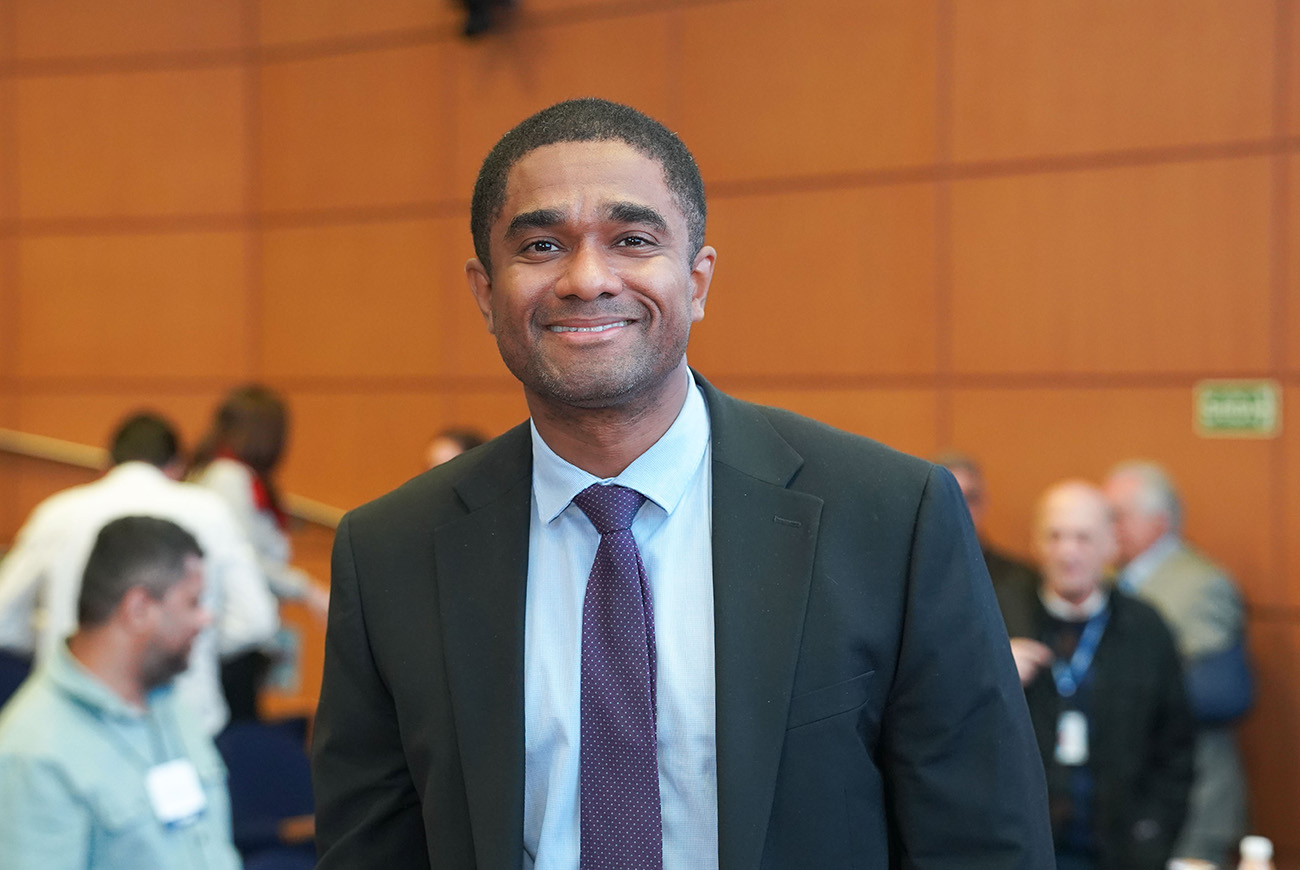
“Although it’s intuitive to seek cooperation with countries in the Global North, which are more technologically advanced, the scientific partnership with Argentina has unique strategic value due to the horizontal, equal, and complementary nature of the relationship between the two countries,” stated Mané Jr. (photo: Daniel Antônio/Agência FAPESP)
Published on 06/15/2026
By Maria Fernanda Ziegler | Agência FAPESP – In a world marked by multiple simultaneous crises – including climate change, pandemics, armed conflicts, humanitarian emergencies, and the weakening of the multilateral system – science diplomacy is crucial for maintaining international cooperation. Against the backdrop of geopolitical fragmentation marked by fierce rivalry between the United States and China, diplomat and physicist Ernesto Mané Jr. championed science and innovation as instruments of sovereignty and regional integration.
He presented this message during the 3rd FAPESP 2026 Conference on May 29 in the Foundation’s auditorium. Mané Jr., the head of the Science, Technology, and Innovation Sector at the Brazilian Embassy in Buenos Aires, emphasized the role of science in fostering connections between Brazil and Argentina, even amid global challenges and instability.
”Although it’s intuitive to seek cooperation with countries in the Global North, which are more technologically advanced, the scientific partnership with Argentina has unique strategic value due to the horizontal, equal, and complementary nature of the relationship between the two countries,” stated Mané Jr., who has a unique profile among Brazilian diplomats. He holds a Ph.D. in nuclear physics from the University of Manchester in the United Kingdom, has served as a researcher at the European Organization for Nuclear Research (CERN) – the world’s largest particle physics laboratory, located in Switzerland – and has completed postdoctoral research at the National Laboratory for Particle Physics in Canada.
According to the diplomat, the scientific partnership with Argentina is important for building a robust and sovereign regional scientific and technological infrastructure, which goes far beyond a simple learning relationship between nations.
The Royal Society defines scientific diplomacy as collaboration in which science and diplomacy mutually reinforce each other to benefit society. This topic is dear to FAPESP. The Foundation has historically encouraged initiatives in internationalization, scientific cooperation, and academic mobility.
“This movement is only possible because academics are central actors in this process. Their shared commitment to knowledge enables them to act beyond the ideological constraints of periods such as the bipolar era,” stated Celso Lafer, former president of FAPESP (2007–2015) and moderator of the lecture. Lafer also served as Brazil’s Minister of Foreign Affairs twice: in 1992 and from 2001 to 2002.
Mané Jr. emphasized that cooperation between the two countries remains important, even in light of the profound reorientation of Argentina’s science, technology, and innovation policy since Javier Milei took office in 2023. The current administration has been marked by severe budget cuts, a focus on economic results, and the reclassification of the former Ministry of Science, Technology, and Innovation into a department primarily focused on innovation.
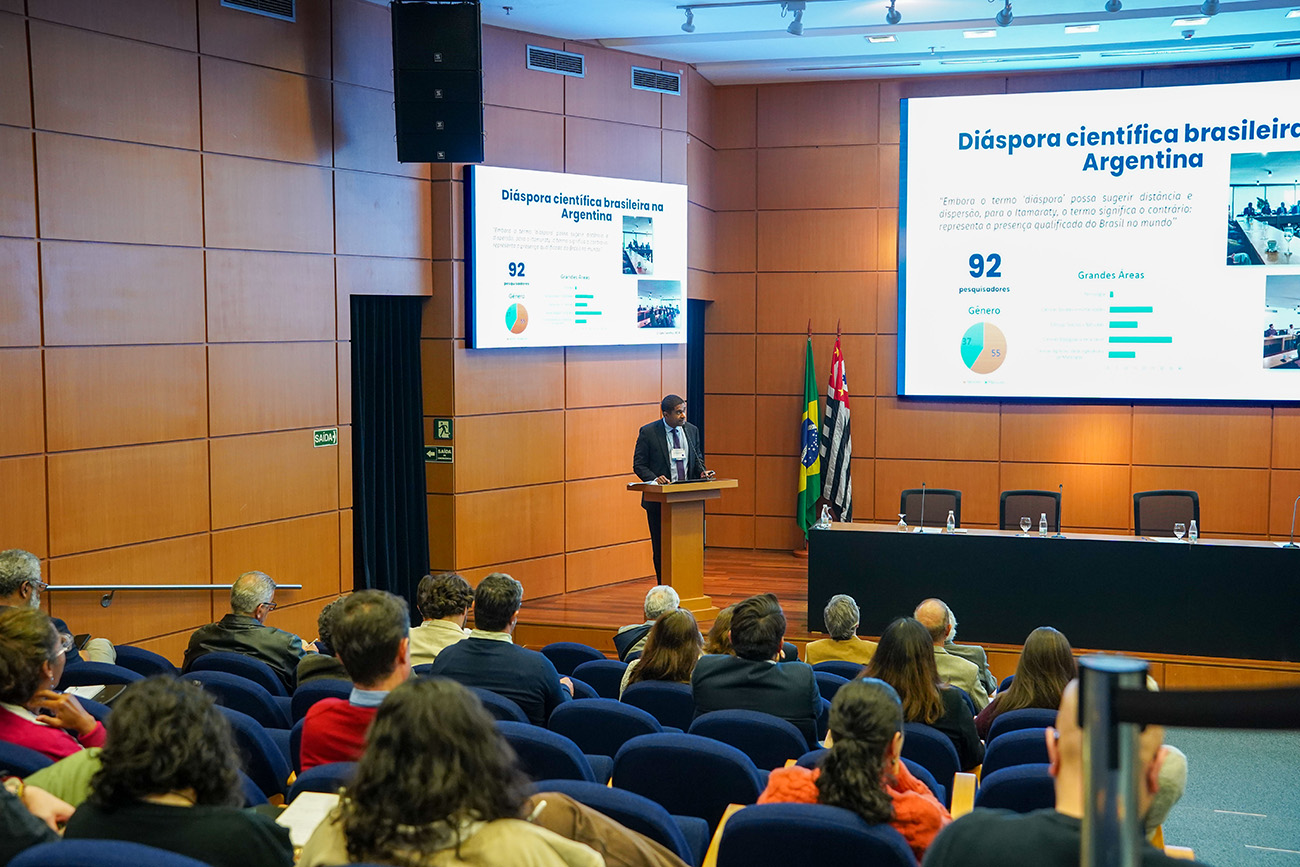
With Argentina’s federal budget constrained, the diplomat recommended that São Paulo institutions seek partnerships directly with provinces and local agencies, highlighting the Scientific Research Commission of the Province of Buenos Aires (photo: Daniel Antônio/Agência FAPESP)
According to a report by the Ibero-American Observatory, the country lost 5,750 scientific jobs between December 2023 and December 2025, equivalent to 7.5 scientists leaving the research ecosystem daily. Argentina has also begun ranking among the countries with the lowest investment in research and development in the region.
“Despite the crisis, Argentina has a very strong tradition in science and education, with five Nobel Prizes, an advanced educational system, and historic partnerships that have been very useful to Brazil,” Mané Jr. said.
Mané Jr. highlighted the nuclear sector as an example. Argentina has significant expertise in this field and exports nuclear reactors. He noted that INVAP, an Argentine public company, is responsible for the basic design and construction of the Brazilian Multipurpose Reactor, a research reactor with various purposes, such as producing radioisotopes, testing nuclear materials and fuels, and conducting laboratory analyses.
Other notable areas of collaboration include space science, Antarctic research, and the shared use of major infrastructure. “Argentine researchers are currently the largest group of foreign users of Sirius, the Brazilian particle accelerator,” he noted.
Due to the severe constraints on Argentina’s federal budget, the diplomat recommended that São Paulo institutions seek partnerships directly with provinces and local agencies. He highlighted the Scientific Research Commission of the Province of Buenos Aires (CIC) as a strategic channel because it operates centers and laboratories independent of the federal government.
Mané Jr. also presented the results of an unprecedented mapping of the Brazilian scientific diaspora in Argentina conducted by the Embassy’s Science, Technology, and Innovation Sector. This predominantly female network is concentrated in the biosciences and health fields. It has organized itself spontaneously and has become a strategic asset for the Innovation Diplomacy Program (PDI), an initiative that uses Brazil’s network of embassies and consulates to promote the Brazilian science, technology, and innovation (ST&I) ecosystem abroad. “These researchers serve as natural ambassadors for Brazilian science in Argentina, maintaining active cooperation regardless of political fluctuations,” he stated.
When asked about the importance of South-South cooperation on climate change with a focus on African countries at the end of the lecture, Mané Jr. responded from historical, personal, and strategic perspectives. He highlighted that this relationship is part of Brazil’s trajectory of attracting talent and strengthening diplomatic ties through knowledge.
“My father is from Guinea-Bissau and came to Brazil on a scholarship in the 1970s to study economics at the University of São Paulo. Therefore, Brazil-Africa South-South cooperation is part of my history as well. Beyond that, I find this type of cooperation extremely important. It’s a long-term endeavor based on educational, scientific, and technological ties that ensure regional development and collective survival,” stated Mané Jr., who also heads the environmental sector at the Brazilian Embassy in Buenos Aires.
The full text of the conference “Scientific Diplomacy in Times of Geopolitical Fragmentation: Networks, Innovation, and South-South Cooperation” is available at youtu.be/1HAM6ZwbL8c.
Source: https://agencia.fapesp.br/58416


