


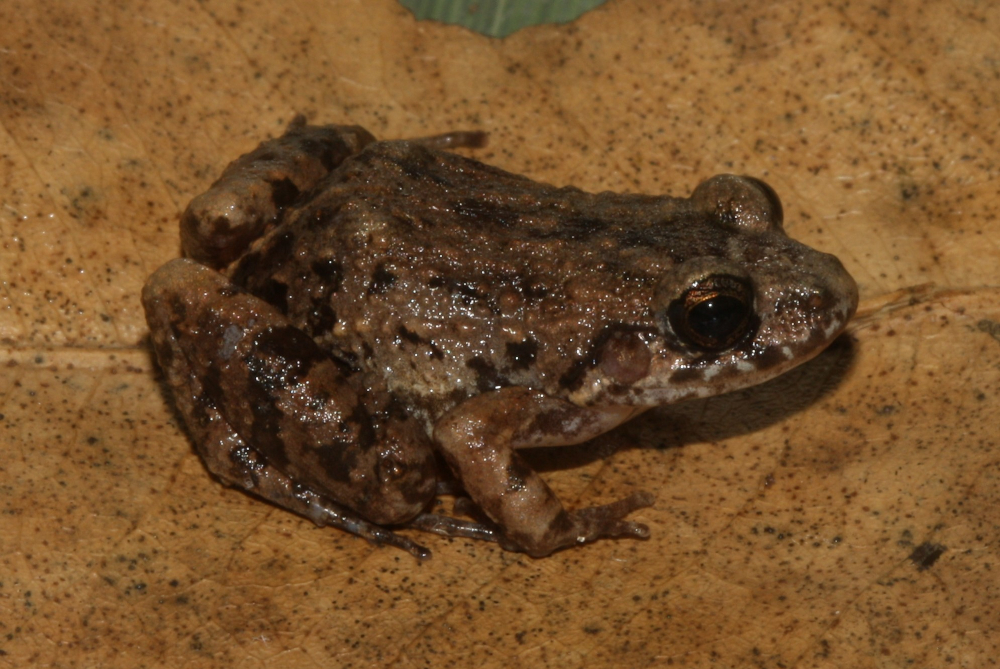
In addition to expanding scientific knowledge about Neotropical amphibians, identifying new species has a direct impact on conservation strategies (photo: CBioClima)
Published on 08/10/2026
Agência FAPESP* – Scientists from Brazil and other countries have discovered a new species of frog in the flooded forests of the western Amazon. They named it Adenomera varcena. This finding significantly advances our understanding of Amazonian biodiversity and cryptic diversity, or cases in which two or more animals appear identical but are actually different species. To distinguish this species, the researchers analyzed details such as the frog’s call and DNA.
The results were published in the journal Ichthyology & Herpetology. The authors of the article include Célio F. B. Haddad, a professor at São Paulo State University (UNESP), and Thiago R. Carvalho, a professor at the Federal University of Minas Gerais (UFMG). Both are members of the team at the Center for Research on Biodiversity Dynamics and Climate Change (CBioClima) – a Research, Innovation, and Dissemination Center (RIDC) funded by FAPESP.
The discovery resulted from expeditions conducted in the Upper Juruá River region in western Acre, specifically in forest fragments near the Moa and Crôa rivers, close to Cruzeiro do Sul. To confirm that this was a new species of frog, the researchers cross-referenced various pieces of information. They examined DNA analyses, call recordings, body shape (morphology), habitat data, and compared it with specimens already preserved in scientific collections.
The name varcena refers specifically to Amazonian floodplain forests, which are ecosystems that flood at certain times of the year. This is the environment where the frog was found. The article emphasizes that using this type of habitat is a new finding for the genus Adenomera, which typically inhabits dryland forests.
The Adenomera varcena differs from other species physically in that it lacks a dark spot on the underside of its forearm. Additionally, its mating call is unique, consisting of a short sound with a slow rhythm and specific acoustic characteristics.
The discovery of this new frog species highlights just how much of the Amazon’s biodiversity remains unknown, particularly with regard to morphologically similar species (cryptic diversity). The study also reveals that many lineages of Adenomera have yet to be formally described, underscoring the need for further research to better understand the diversification of this group of amphibians in the Amazon.
“Since we don’t yet know in detail the species’ ecological requirements and its natural history [reproductive period and mode], it’s difficult to predict the impacts of climate change, which may alter the seasonal flooding patterns of the floodplain forest ecosystem in this region of the Amazon,” says Carvalho. “Since the species has a preference for this specific ecosystem, it’s possible to suggest that these changes in flood dynamics may influence – though we don’t know to what extent – the species’ reproductive behavior. In a scenario of accelerated loss of natural areas, the formal description of a new species underscores how much more effort we still need to make to advance studies on our biodiversity. Species may become locally extinct even before they’re formally recognized as species through their naming and description.”
In this regard, Professor Haddad warns that although new amphibian discoveries are frequent, science is engaged in a race against time to accurately catalog Brazil’s biota in the face of environmental degradation. “Currently, the pace of ecosystem destruction outpaces the capacity of taxonomic studies to keep up. Consequently, species that haven’t yet been described are omitted from lists of threatened fauna and remain legally and environmentally vulnerable. Thus, describing new species serves as a tool that aids in their protection. Furthermore, deepening our knowledge of actual biodiversity expands our understanding of the evolution of organisms, consolidating an essential pillar for both pure science and conservation strategies,” he says.
In addition to expanding scientific knowledge about Neotropical amphibians, identifying new species has a direct impact on conservation strategies. Without proper taxonomic recognition, rare species or those restricted to certain environments may be overlooked in environmental policies and extinction risk assessments.
The research involved collaboration between Brazilian and international institutions, bringing together scientists from UFMG, UNESP, the University of São Paulo (USP), the Federal University of Uberlândia (UFU), and the University of Ecuador (PUCE-Quito).
The article “A New Species of Terrestrial Foam-Nesting Frog (Adenomera, Leptodactylidae) from the Várzea Forests of Western Amazonia” can be accessed at bioone.org/journals/ichthyology-and-herpetology/volume-114/issue-2/h2025033/A-New-Species-of-Terrestrial-Foam-Nesting-Frog-Adenomera-Leptodactylidae/10.1643/h2025033.short.
* With information from CBioClima
Source: https://agencia.fapesp.br/58932


