


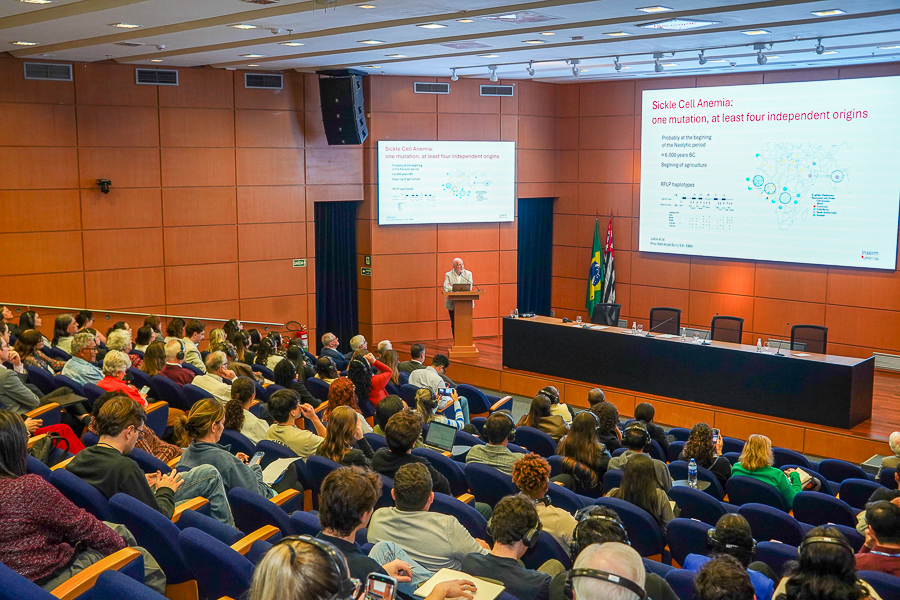
The fifth event in the lecture series took place on July 31 at the Foundation’s headquarters (photo: Daniel Antônio/Agência FAPESP)
Published on 08/24/2026
By Maria Fernanda Ziegler | Agência FAPESP – Sickle cell anemia is a disease caused by a genetic mutation that alters the shape of red blood cells, causing inflammation and severe pain throughout the body. Despite its severity, this condition has been neglected because it primarily affects Black people and those in low-income countries. However, it has helped shape modern medicine, ushering in a new chapter in genetics.
French researcher Jacques Elion, a professor at Université Paris Cité and a world-renowned hematology expert, made this assessment during the fifth event of the FAPESP 2026 Conferences series, held on July 31 in the Foundation’s auditorium.
“All this knowledge can now be applied to sickle cell anemia in a two-way process. Drugs already used to treat other diseases can be repurposed to treat patients with sickle cell anemia more quickly, without the need for new safety tests,” Elion noted.
The journey to understanding the disease since its initial description in 1910 has been long. Seven years later, researchers discovered the sickle-shaped red blood cells that accumulate in blood vessels and cause inflammation and a variety of symptoms throughout the body.
In 1949, Linus Pauling identified the cause of these symptoms as a defect in hemoglobin S, an iron-containing protein found in red blood cells. This defined sickle cell anemia as the first molecular disease in the history of medicine, as its cause was identified as a physical defect in a single molecule: hemoglobin. This discovery was not limited to sickle cell anemia; it contributed to advances in understanding and treating other diseases.
According to Elion, this greater understanding has driven the development of technologies such as gene therapy, which is now used to treat inflammatory diseases and cancer, as well as gene editing and bone marrow transplantation. Meanwhile, medications developed for diabetes, hypertension, chronic inflammation, and high cholesterol can be repurposed for patients with sickle cell disease, thereby accelerating the development of new therapeutic strategies.
Despite these advances, the hematologist believes that the most sophisticated therapies remain out of reach for most people with sickle cell anemia. “There must be a balance between scientific progress and accessibility since 90% of patients are born in low-income countries that lack the resources and infrastructure to offer expensive treatments such as gene therapy and transplants. That’s why I have more faith in accessible therapies, such as hydroxyurea and neonatal diagnosis through the heel prick test,” he emphasized.
Hydroxyurea, an oral medication originally used to treat leukemia, has become a cornerstone of sickle cell anemia treatment. It reduces pain crises and improves the production of fetal hemoglobin, which is immune to the mutation that causes red blood cells to deform. The newborn screening test, which is mandatory in Brazil and provided free of charge by the SUS (the acronym for the national public health network, the Sistema Único de Saúde), detects sickle cell anemia and other diseases within the first few days of a baby’s life, enabling early treatment.
According to Elion, the number of new cases of sickle cell anemia is expected to rise by 2050, increasing from 300,000 affected newborns per year worldwide to more than 400,000. This underscores the importance of neonatal screening.

Elion (Université Paris Cité) is an internationally recognized expert in molecular genetics and sickle cell disease, with extensive experience in research, patient care, and international cooperation (photo: Daniel Antônio/Agência FAPESP)
A global burden
As Elion explained, studies on the disease have revealed that the hemoglobin mutation, which causes red blood cells to take on a sickle shape, arose independently during the Neolithic period (around 6,000 BCE) in at least three locations in Africa, as well as in India, coinciding with the onset of agriculture.
“Through migration routes and the slave trade, the mutation spread, becoming a global burden. Although sickle cell anemia is known to predominantly affect Black populations, today we find white patients in Greece, Italy, and Portugal who bear the weight of this millennia-old legacy.”
In the scientist’s view, this is a disease rooted in inequality. “In poor countries [where 90% of cases are concentrated], only 10% of children survive to age 15. In contrast, in wealthy countries, the 10-year survival rate is 99%,” he said. “Science has advanced, but treatment will only be universal when there's education, funding, and public policies that reach all patients, regardless of race or origin.”
In addition to unequal access, Elion points out that sickle cell anemia faces the barrier of racial prejudice. According to Elion, this prejudice helps explain the lack of interest from funders and the historical neglect surrounding the disease. “In poor countries, it’s still common for healthcare professionals to believe that children with sickle cell anemia won’t survive for many years. This distorted perception compromises care and reinforces stigmas,” he warned.
The researcher recounted a striking episode he experienced while working at a pediatric hospital in a poor Parisian neighborhood. “Patients [with sickle cell anemia, most of whom were Black] in more serious condition were transferred to referral hospitals in the city’s wealthier area. At one point, a doctor asked me why we were only sending Black patients there,” he said. “That made me reflect deeply on how racism interferes with healthcare.”
FAPESP President Marco Antonio Zago, who attended the opening ceremony of the conference, emphasized that the intersection of molecular genetics and translational medicine has profoundly transformed our understanding of sickle cell anemia. “I met Jacques Elion during a visit to France in the 1980s. That meeting led to a lasting partnership between Brazil and France. Furthermore, Elion helped establish neonatal screening programs in Brazil,” said Zago, a physician by training who contributed to the study of sickle cell anemia and thalassemia (a type of hereditary anemia). He played a key role in developing diagnostic and treatment methods for these diseases.
According to Zago, Elion played a key role in establishing sickle cell anemia as the primary model of molecular disease in modern medicine. He used it as a foundation for advances in translational medicine due to his extensive experience in research, patient care, and international cooperation, particularly in Africa, the Caribbean, India, and Brazil. Elion is also a long-standing partner of the University of São Paulo (USP) and the Ribeirão Preto Blood Center.
The lecture “Sickle cell anemia: From genetic origins to the search for a cure” is fully available at youtu.be/ovzGkHM1hAg.
 See more images about this and other FAPESP-related article on the Flickr profiles GCOM FAPESP and FAPESP Memory Center.
Source: https://agencia.fapesp.br/59043


