


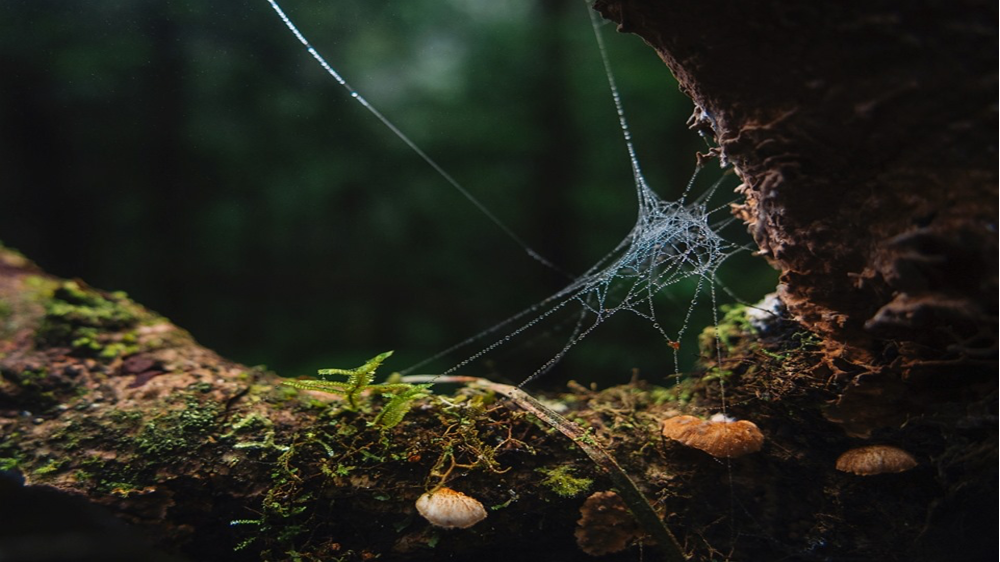
Globe-shaped cobweb. This type of web is built close to the bark of tree trunks for protection from the rain. Requiring more silk than orb webs, they demand more effort to repair (photo: João Burini/Primal Shutter)
Published on 06/29/2026
By André Julião | Agência FAPESP – In the dense forests of the Ecuatorian Andes, the survival of a spider relies not only on its skills to prey on insects but also on its capacity to resist a threat coming from the skies. A new study revealed that heavy rainfall that impacts the region acts as an “ecological filter”, bombarding spider webs and, in the process, determining which species and silk architectures are able to master each environment.
The study was conducted according to a gradient ranging from the torrential storms of the plains to the light rain of the altitude forests; supported by FAPESP, the research revealed that the survival of a spider web depends on two main factors: its shape and the location in which it was built. Its results were published in April in the journal Ecology and Evolution.
The study is part of the “Expansion, Enhancement, and Modernization of the Butantan Institute’s Zoological Collections, with an Emphasis on the Taxonomy and Systematics of Neotropical Haplogynid Spiders (Arachnida, Araneae)” project, coordinated by Antonio Domingos Brescovit, a researcher at the Butantan Institute in the state of São Paulo, Brazil, and a co-author of the study. It also featured support from the Natural Sciences and Engineering Research Council of Canada (NSERC).
Researchers compared the three classic “arachnid engineering” strategies used to deal with the impact of raindrops: orbicular webs (plain and circular), cobwebs and sheetwebs (both of them three-dimensional, dense and robust).
“So-called orb webs are typically built in open areas to intercept flying insects and suffer significant damage from rain. Cobwebs, on the other hand, are built under leaves, where they are protected from the rain. Sheetwebs, in turn, are usually too large to fit under a single leaf, so they tend to be built near tree trunks, where they’re partially protected by the tree canopy,” explains the Ecuadorian Leticia Avilés, a professor at the University of British Columbia (UBC) in Canada and the lead author of the study.
One would expect orbicular webs, the most common type of which are two-dimensional, to exist only in areas with low rainfall since they are the most vulnerable to rain. However, the opposite is true.
“Since they require little silk to build, they don’t demand as much investment from the spiders. The fact that they’re severely damaged by rain isn’t a problem since they’re routinely rebuilt, not least because captured insects also damage them,” Avilés adds.
The most resistant webs, sheet-shaped cobwebs, are virtually absent from areas with heavy rainfall because they contain a hundred times more silk than orb-shaped and simple cobwebs. This is because the damage represents a significant cost for the species that build them. Coincidentally, the only spiders that produce this type of web in areas with high rainfall tend to live in groups, known as social spiders.
“In these communities, they live together to share the cost of maintaining and repairing the webs,” says the Taiwanese researcher Yu-Heng Lin, the first author of the study, who conducted the research during his doctoral studies at UBC.
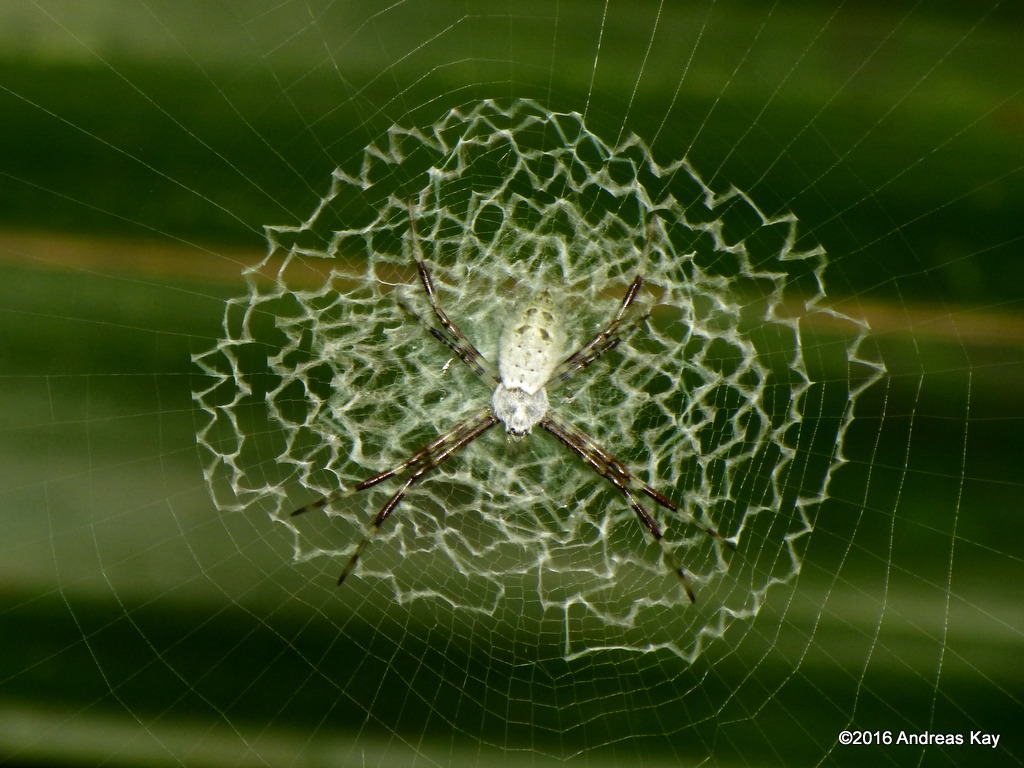
A spider of the genus Argiope in Ecuador on an orbicular web. Although this structure is more vulnerable to rain, it can be repaired quickly by the arachnids (photo: Andreas Kay/Flickr)
Climate change
To arrive at the results, the researchers analyzed webs in five forest areas in the eastern Andes of Ecuador. One of the criteria for selecting the sites was altitude, which also determines the rainfall pattern in that region.
In the lower-elevation areas (less than 1,000 meters above sea level), rainfall is typically heavy during the study period, exceeding four millimeters per hour. At the higher-elevation sites (up to 3,440 meters above sea level), rainfall does not exceed two millimeters per hour – essentially a drizzle.
At least 30 to 55 spiders were sampled at two or more points in each area, and the effects of at least three rainfall events per web were recorded. A total of 207 webs were examined in the observational study, and 86 were examined in the experiment that manipulated the conditions.
This experiment was conducted at the lowest elevation and with the second-highest rainfall intensity. One-square-meter tarps were placed over 31 webs, while 55 others remained unprotected. As expected, the tarps served the same function as leaves do for cobwebs, significantly reducing damage. “Without the experiment, we’d only be showing correlations rather than causality – the direct effect of rainfall on the webs,” Avilés explains.
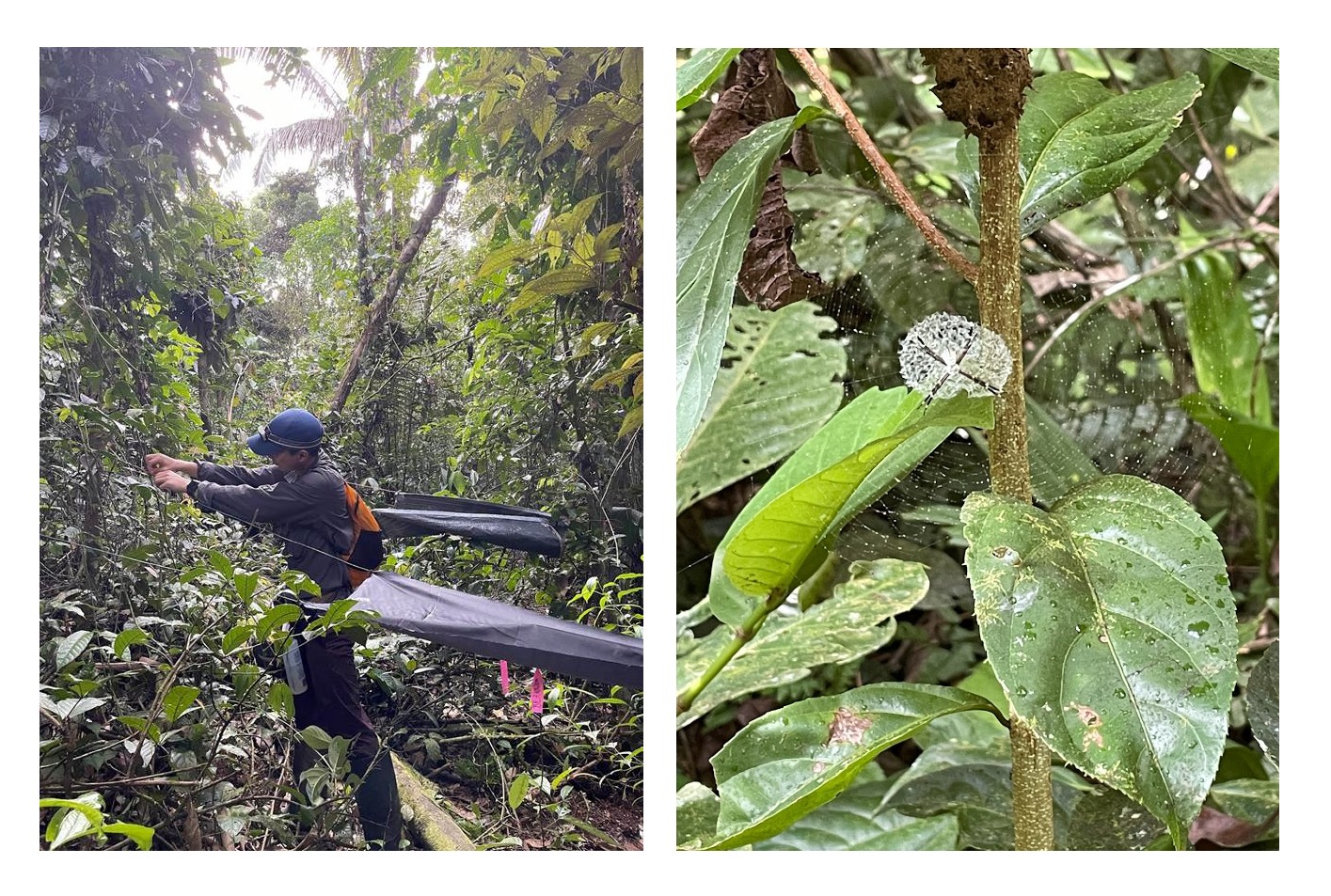
Yu-Heng Lin, the first author of the study, places a tarp over the webs to protect them from the rain and observe the effect. On the right is an orb web from the genus Argiope (photos: Emilia Luzuriaga Cáceres and Yu-Heng Lin/UBC)
Ultimately, the results suggest that changes in rainfall patterns could alter spider communities, which has implications for the conservation of species and the ecosystem services they provide, such as insect control.
“If there’s less rainfall where it currently rains a lot, the vegetation may change, reducing the availability of plants that serve as shelter for webs that are more vulnerable to rain. Conversely, excessive rainfall where it’s dry could reduce the number of prey since webs will be damaged more frequently,” says Brescovit from the Butantan.
“By demonstrating the interaction between web type, microhabitat use, and vulnerability to rain, our study provides tools for predicting the impact of climate change on local spider communities,” Avilés concludes.
The article “Spider web architecture and rainfall damage: observational and manipulative studies along a precipitation gradient on the tropical Andes” can be read at onlinelibrary.wiley.com/doi/full/10.1002/ece3.73432.
Source: https://agencia.fapesp.br/58539


