


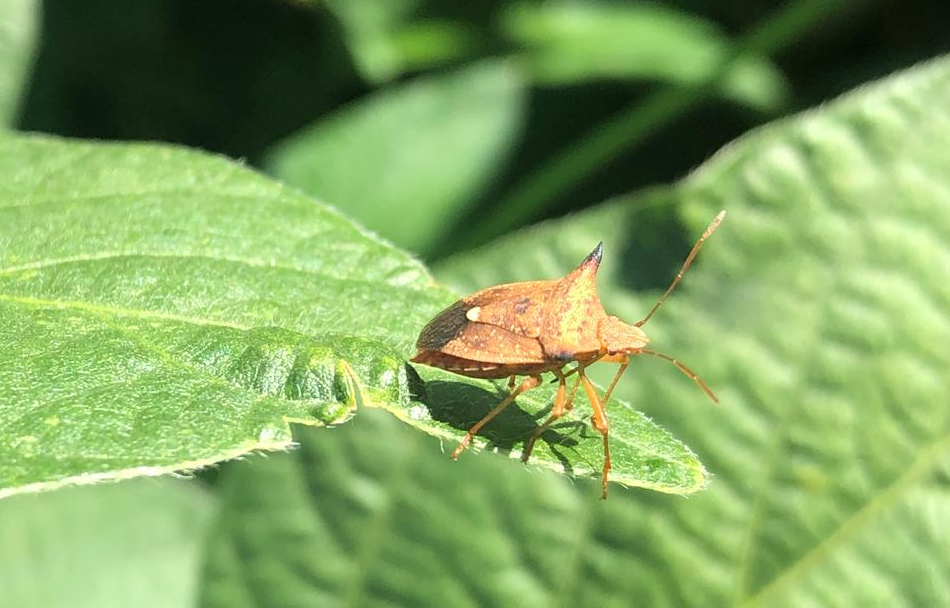
A sustainable agricultural strategy combines different control methods, using pesticides only as a last resort (image: Larissa Chamma)
Published on 11/13/2026
By Karina Ninni | Agência FAPESP – Through a genetic breeding program, Brazilian researchers have identified four soybean seed lines that are tolerant to stink bug infestation. This discovery paves the way for developing a cultivar that can reduce the need for chemical insect control in fields.
The study, which was supported by FAPESP, was published in the journal Pest Management Science (PMS) by researchers from the São Paulo State University (UNESP) in Botucatu, the University of São Paulo (USP), and the Federal University of São Carlos (UFSCar).
The group focused on two parental lines – one tolerant and one non-tolerant to stink bugs – as well as 12 recombinant lines – hybrids generated from the parental lines that exhibit either tolerance or susceptibility to the pest. The experiment was conducted in two soybean-producing regions under management scenarios with and without insecticide application. One test field was Fazenda Lageado, which is part of the Faculty of Agronomic Sciences (FCA) at UNESP in Botucatu. The other test field was the Experimental Station of the Department of Plant Genetics and Breeding at the Luiz de Queiroz College of Agriculture (ESALQ) of USP in Anhumas, in the municipality of Piracicaba.
“We tried to work in two contrasting environments. Botucatu has a higher altitude and a milder climate. Anhumas [Piracicaba] has a lower altitude and a warmer environment. We tried to represent the variety of environments in which soybeans are cultivated in the country,” explains Larissa Chamma, co-author of the work conducted during her doctoral studies in the Department of Agricultural Production at FCA-UNESP. She points out that very little research has been done on seed quality under pest attack and how the plant’s genetics react to different climates and soil conditions, even though the natural tolerance of soybeans is a central component of integrated pest management. This sustainable agricultural strategy combines different control methods, using pesticides only as a last resort.
“The study connects genetic improvement to pest management and its impact isn’t just treating tolerance to the stink bug, in terms of applying or not applying insecticide. It shows that the response of genotypes depends on the environment and the management regime. We started thinking from the perspective of genetic improvement, and then the article also addressed the issue of management, which was very important for publication in PMS. The question shifts from ‘What is the best lineage?’ to ‘What lineage is more stable and useful under different real-world cultivation conditions?”’ emphasizes biologist Rômulo Pedro Macêdo Lima, who is also an author of the study.
FCA-UNESP professor Edvaldo Aparecido Amaral da Silva, Chamma’s advisor, points out that the strategy does not rule out the need for integrated pest management. “Selection and seed improvement are part of a series of strategies that can help the environment. They won’t eliminate the need for chemical insecticides completely, but they will make life easier for farmers, reduce costs, and minimize environmental problems.”
According to the researcher, 30% of grain crops – of all types, not just soybeans – can be lost due to stink bugs.
Four scenarios
The team built upon a previous study by the Soybean Breeding Program at the Department of Genetics at ESALQ-USP, led by Professor José Baldin Pinheiro, which initially encompassed 180 inbred lines formed through repeated crosses between genetically similar individuals. “We performed an initial phenotyping, selecting materials that contained the characteristics we were interested in: resistance to stink bugs, high productivity, and high seed physiological quality. Based on that selection, we designed an experiment to determine how this material would perform in environments with and without chemical control of stink bugs,” says Chamma.
In both experimental areas, liming (the addition of limestone to the soil to reduce acidity and improve nutrient uptake by the roots) and mineral fertilization were carried out prior to sowing according to soil analysis results. Pest and weed control were performed using herbicide, and fungicide was applied when necessary.
Seeds intended for exposure to chemicals were treated with fungicide, insecticide, and inoculants according to the manufacturer’s recommendations. Insecticide applications were based on pest monitoring, occurring weekly or whenever the “cloth-beating” method detected at least one stink bug per square meter.
“In commercial fields, farmers know when to apply insecticide using the following method: They place a cloth in the middle of the soybean plants and shake the plants to see how many stink bugs fall off. If there’s one stink bug per square meter in a field intended for seed production, they know they must apply it,” says Chamma.
She notes that the Anhumas and Botucatu regions had stink bug populations above this threshold, which is considered the maximum tolerable level for soybean seed production. In the Anhumas region, the population peaked at five stink bugs per square meter, while in Botucatu, it reached approximately three stink bugs per square meter. The species detected in both regions were Nezara viridula, Piezodorus guildinii, Diceraeus melacanthus, and Euschistus heros.
The following compounds were applied to the plots treated with insecticide: thiamethoxam + lambda-cyhalothrin, chlorantraniliprole + bifenthrin, imidacloprid + beta-cyfluthrin, deltamethrin, and imidacloprid + bifenthrin. In the insecticide-free treatment, none of these compounds were used; however, soil preparation and control with herbicides and fungicides were carried out.
“In the two experimental areas, we had a control group without insecticide and another group with insecticide. There were two environments, but we treated them as if there were four, which was important because there were two differences to consider: the climatic difference and the difference in the control group. We found that the environment where no insecticide was applied was more effective for identifying genotypes tolerant to the stink bug pest because it exerts greater selection pressure,” Lima explains.
Eight physiological characteristics of the seeds related to germination, vigor, and longevity were evaluated to determine the plants’ responses when exposed to stink bugs. “We used a robust method with genotype-environment interaction analyses that included the use of statistical models. We discovered that the genetic factor strongly influences the longevity of seeds under different levels of stink bug infestation. The weight of environmental effects was predominant for initial seed vigor characteristics,” Lima describes.
Longevity
In summary, the study revealed that seed longevity is more strongly influenced by genetics than environmental factors. The scientists even suggest that it could serve as an indicator for predicting the overall performance of seeds under pest stress.
“Seed longevity showed comparatively stronger genetic control than environmental control. This is a trait associated with the physiological quality of the seed, and it may one day be incorporated into breeding programs,” Chamma notes.
“Currently, little is done to improve the quality of seeds. There’s a demand for other things, such as plant tolerance to diseases, stress, and water deficiency or excess, and seed quality is left for later,” Amaral clarifies.
According to Amaral, longevity is important because a seed with a longer lifespan retains its vigor, a component of physiological quality. “Longevity is shelf life, but with vigor. It isn’t enough for the seed to be alive. It has to be alive and in good condition. The greater the vigor, the greater the ability to withstand adversity, germinate faster, emerge, form a plant quickly, and begin photosynthesis. That’s what farmers want because it brings profits.”
“Relying solely on chemical management in the large-scale crops we have in Brazil is unsustainable, as it favors the selection of insect populations that are resistant, leading to the development of significant resistance. The ideal approach is integrated pest management – a combination of breeding practices, which is what we’re doing, with insecticide application, biological control, and other tools. That way, it’s possible to apply chemical insecticides only when it’s truly necessary,” Chamma notes.
The article “Genotype-by-environment interaction informs selection for seed physiological quality and stink bug tolerance in soybean under pest management contrasts” can be read at scijournals.onlinelibrary.wiley.com/doi/10.1002/ps.70904.
Source: https://agencia.fapesp.br/59614


