


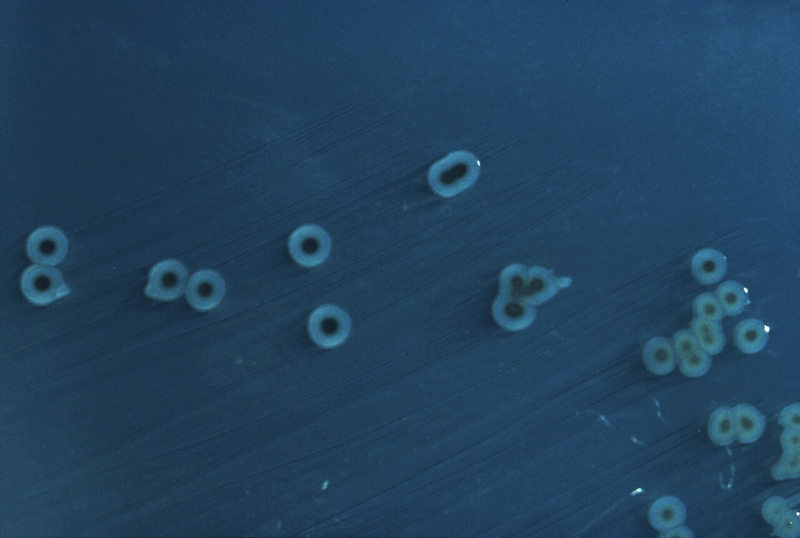
In total, 128 types of toxins were identified, of which 45 are very different from known toxins or had never been described by science (image: CDC/Wikimedia Commons)
Published on 06/01/2026
Agência FAPESP* – Researchers at the University of São Paulo (USP) in Brazil have discovered 45 new toxins produced by Salmonella bacteria, some of which are associated with foodborne infections. The study was conducted at the Center for Research in Bacterial and Bacteriophage Biology (B3 RIDC) and was published in the journal PLOS Biology. It shows that these substances primarily act in the competition among microorganisms for space and resources. The study also suggests that these substances may inspire the development of new antibiotics, in-depth studies with humans, and biotechnological applications in the future.
The B3 is one of the Research, Innovation, and Dissemination Centers (RIDCs http://cepid.fapesp.br/en) supported by FAPESP.
To investigate the microscopic arsenal used by the pathogen, the team analyzed genetic data from Salmonella and its type VI secretion system (T6SS), which is a spear-like system that the bacterium uses to inject effectors, such as toxins that interfere with the functioning of other cells, into the environment or directly into competing microorganisms. Using computational tools, the team analyzed the genetic material of 6,165 samples from 149 different serovars of Salmonella enterica, identifying potential toxins and comparing sequences among different bacteria. They also inferred their functions based on similarities to known proteins.
A total of 128 types of toxins were identified, 45 of which were very different from any known toxin and had never before been described by science. “This result implies that the diversity of bacterial toxins and antitoxins worldwide is very high, with new varieties emerging or diverging radically from known related variants,” explains Robson Francisco de Souza, leader of the bioinformatics group at the Laboratory of Protein Structure and Evolution at USP, a researcher at the B3 RIDC, and one of the authors of the study.
The identified molecules act in different ways. Some compete with other bacteria, while others affect eukaryotic cells, including those of fungi, yeasts, algae, and even mammals. “It’s possible that some of them play a direct role in human infections, but to confirm that hypothesis, we’d need to identify which strain carries the genes targeting eukaryotes and experimentally assess their effect on cells and infection,” the researcher notes.
This diversity is also reflected in the distribution of the effectors discovered among the different Salmonella groups. The article shows that each group has a unique combination of molecules secreted by the T6SS. This suggests that the bacterium selects and maintains specific effectors based on environmental pressures. “The evolution of these systems and this diversity are driven by both gene recombination, which frequently occurs to generate and activate new toxins, and by natural selection, which, in a scenario of biological conflict, fuels an arms race among bacteria,” states Souza.
The data also suggest that Salmonella subgroups collected from natural environments have a greater number of effectors than those collected from patients. This indicates that toxin diversity increases in contexts with a greater variety of competitors. “This happens because, as new challenges and adversaries emerge, the microorganism needs to develop new tools to excel in these disputes over resources,” the researcher explains.
According to Souza, these findings should improve our understanding of bacterial competition strategies and pave the way for new clinical and biotechnological applications. “We may even have applications that we can’t yet anticipate,” he predicts. “We believe this because some of our previous work has shown that important eukaryotic proteins originated from bacterial toxins,” he adds, highlighting the potential of these compounds in different biological contexts.
Souza emphasizes that the field is far from exhausted. “Bacteria such as Salmonella, Acinetobacter, and other organisms still offer opportunities to understand the role of these toxins in ecological interactions,” he states. “We’re continuing to invest in developing software and pipelines to automate this type of analysis and expand the investigation to new lineages, such as archaea and lesser-known bacteria, which present even more opportunities for this type of discovery,” he concludes.
The article “Systematic identification of Salmonella T6SS effectors uncovers diverse new families and lipid-targeting activities” can be read at journals.plos.org/plosbiology/article?id=10.1371/journal.pbio.3003680.
* With information from Bianca Bosso from the B3 RIDC
Source: https://agencia.fapesp.br/58273


