


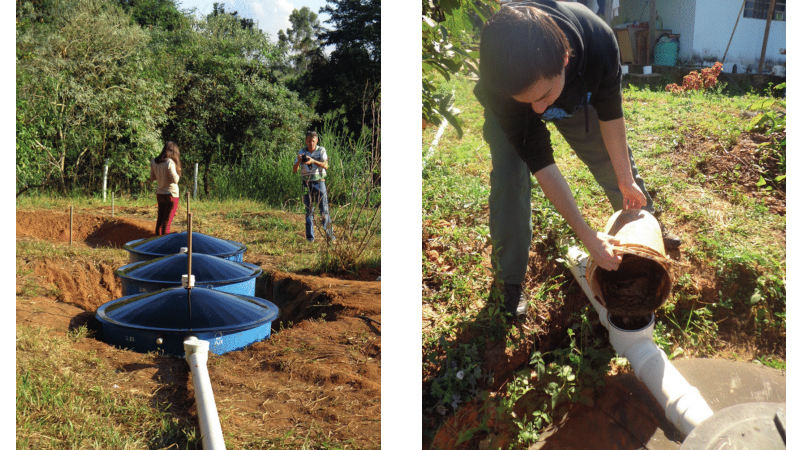
On the left, a biodigester septic tank installed in Holambra, in the Campinas region. On the right, the monthly addition of cattle manure to the check valve before the first chamber (photos: Isabel Figueiredo)
Published on 03/30/2026
By Karina Ninni | Agência FAPESP – The system for reusing wastewater from toilets to produce biofertilizer on small farms is being adopted in Brazil and neighboring countries due to its ease of implementation. This system uses biodigester septic tanks (BSTs). It consists of three 1,000-liter water tanks arranged in sequence. The first two tanks are responsible for anaerobic digestion, and the third tank stores the final effluent. Farmers use the reservoir according to their crop irrigation schedule. The retention time of the liquid in the system ranges from 25 to 35 days.
However, BSTs raise concerns about public health safety because contact with the liquid can lead to exposure to waterborne diseases, especially during application. This is often done using buckets, watering cans, or hoses directly onto the soil without personal protective equipment or isolation of the irrigated area. To handle the liquid, one should wear closed-toe shoes, rubber gloves, a mask, and goggles. The system area should also be cordoned off to prevent people and animals from stepping on the tank lids, which could cause them to break.
“In Brazil, there are thousands of systems installed, and their use is also expanding throughout Latin America. And we view this as a positive social technology that’s easy to implement,” notes Adriano Luiz Tonetti, a professor at the School of Civil Engineering, Architecture, and Urbanism at the State University of Campinas (FECFAU-UNICAMP) in the state of São Paulo, Brazil. He is also the co-author of an article published in Environmental Monitoring and Assessment. “What we question is the idea that effluent is a biofertilizer that can be applied superficially with a watering can or hose or incorporated into the soil simply by spreading it over it.”
“We visited the outskirts of Campinas and I saw a farmer applying effluent to a guava tree. We walked around the property and returned to the same spot, and there was a dog lying on the ground at the base of the tree. It must have drunk that water, rolled around there, and then gone inside the house and come into contact with a child. If there was a pathogen in that water, all the conditions were created for the cycle to be completed,” the researcher warns.
To minimize the risks of this practice, environmental engineer Caroline Kimie Miyazaki of FECFAU-UNICAMP conducted a quantitative microbiological risk assessment for her master’s thesis. She estimated the probability of infection based on specific exposure scenarios involving use of the system. Under Tonetti’s guidance, Miyazaki also suggested modifying the outlet of the last water tank. Instead of dispensing the liquid through a faucet, she suggested distributing it through a pipe buried below ground level.
She also suggested eliminating one of the steps in the recommended method: adding cattle manure mixed with water to the first tank every 30 days. According to tests conducted by Tonetti’s research group, this practice does not affect the efficiency of the biofertilizer at the end of the process, and handling the material is the main way farmers become contaminated.
The authors’ final proposal concerns the size of the tanks used in the system and, consequently, how long it takes for the effluent to travel from the first tank to the last. “In theory, the liquid stays in this set of three tanks for about a month, given that a person uses 10 to 15 liters of water per day for flushing. Four people in a family use about 60 liters a day. But the tanks hold 1,000 liters, and that’s another point we’re questioning. Does it really need to stay there for a month? We’re already working with 500-liter tanks, which are much cheaper, and we’ve reduced the time the liquid spends in the system.”
FAPESP supported this research through its Regular Research Grant.
Risks
The case study was conducted in Campinas, where a municipal social program provided 136 BST units to rural families. At the same time, UNICAMP launched a monitoring program that involved collecting and analyzing Escherichia coli in order to identify potential contamination risks and propose improvements.
The exposed groups were defined based on the following categories to assess the risks: workers, children, the local community, and families. An occupancy parameter of 3.5 people per household was adopted as well. The exposure routes for the scenarios were based on the accidental ingestion of effluent, soil, or feces. The ingested dose calculation was adapted for each scenario, taking its specific characteristics into account.
Six exposure scenarios related to the system’s use were mapped by the scientists: ingestion during BST maintenance activities (including the addition of fresh cattle manure), ingestion during surface irrigation activities with effluent, ingestion during recreational activities after irrigation with effluent, indirect contact via objects after irrigation with effluent, recreational or water-use activities after BST effluent runoff reaches a surface water body, and consumption of groundwater after contamination caused by the application of BST effluent to the soil surface.
Simulations were conducted for each scenario based on 19 parameters, including the hand-to-mouth transfer rate, the volume of soil ingested by a child, the proportion of infectious pathogenic strains, the frequency of activities, and the presence of E. coli in the final effluent.
According to international organizations, there are two widely used criteria for assessing the acceptability of the health risks posed by such activities. One criterion is the annual risk of infection. The other is the DALY (disability-adjusted life year), which combines the years of life lost due to premature death and the years lived with a condition that reduces quality of life. The DALY represents a “healthy year of life lost” for an individual or population.
The “addition of bovine feces” and “surface irrigation” scenarios exceeded the minimum acceptable risk threshold for the average annual risk of infection per person per year. The first scenario exceeded the reference value in 95% of the simulations, corresponding to 44 cases of infection per person every hundred years. These results suggest that direct contact with fresh feces is a potentially dangerous source of contamination for workers. Regarding DALYs, this scenario was the most critical again: only one case fell within the value recommended by the World Health Organization (WHO). In the second scenario, 99% of cases exceeded the reference value.
Safety
According to the scientists, the study aimed to improve the safety of the method from a health perspective. “We proposed that a pipe emerge from the last box – a pipe with holes throughout – buried about 30 cm below ground level, surrounded by gravel. The liquid will seep into the soil without coming into contact with farmers, children walking around the property, or animals,” Tonetti summarizes. According to Tonetti, his student Miyazaki demonstrated that if the irrigation system is placed below ground level, the contamination risk will be acceptable to any national or international entity.
In addition to the safety of workers and their families, there is also the issue of food microbiological safety. “The question everyone asks is whether any pathogens in the water will end up in the plants. We’ve already investigated that. The ratio of the size of the pathogen to the size of the pores in the plant roots is highly disproportionate. It’s like drinking a soda through a straw and suddenly swallowing an elephant. The pathogen doesn’t pass through the root. It’s too big. That’s also why we strongly advise against using watering cans and hoses when applying fertilizer. To be safe, it must be applied underground,” says Tonetti.
The article “Risk assessment of a septic tank variant used for blackwater treatment” can be read at link.springer.com/article/10.1007/s10661-025-14530-4.
Source: https://agencia.fapesp.br/57628


