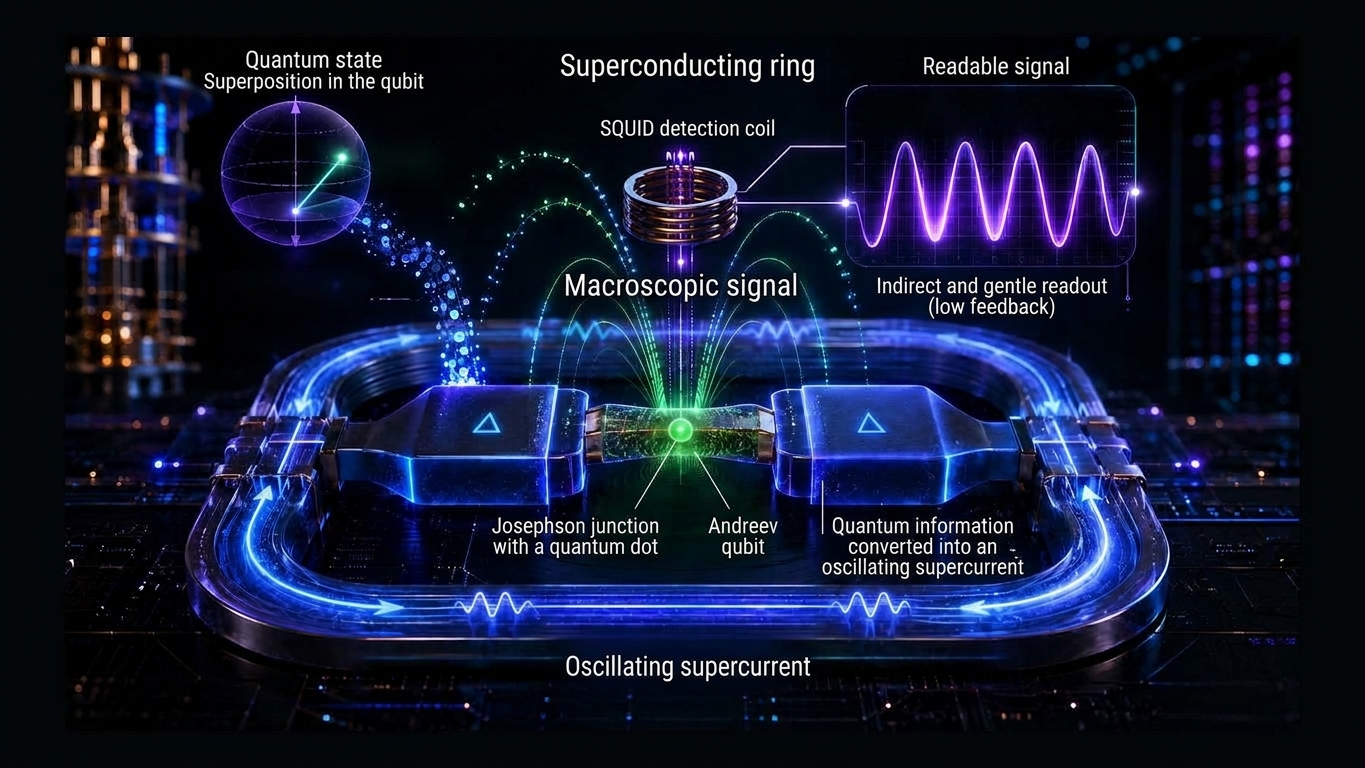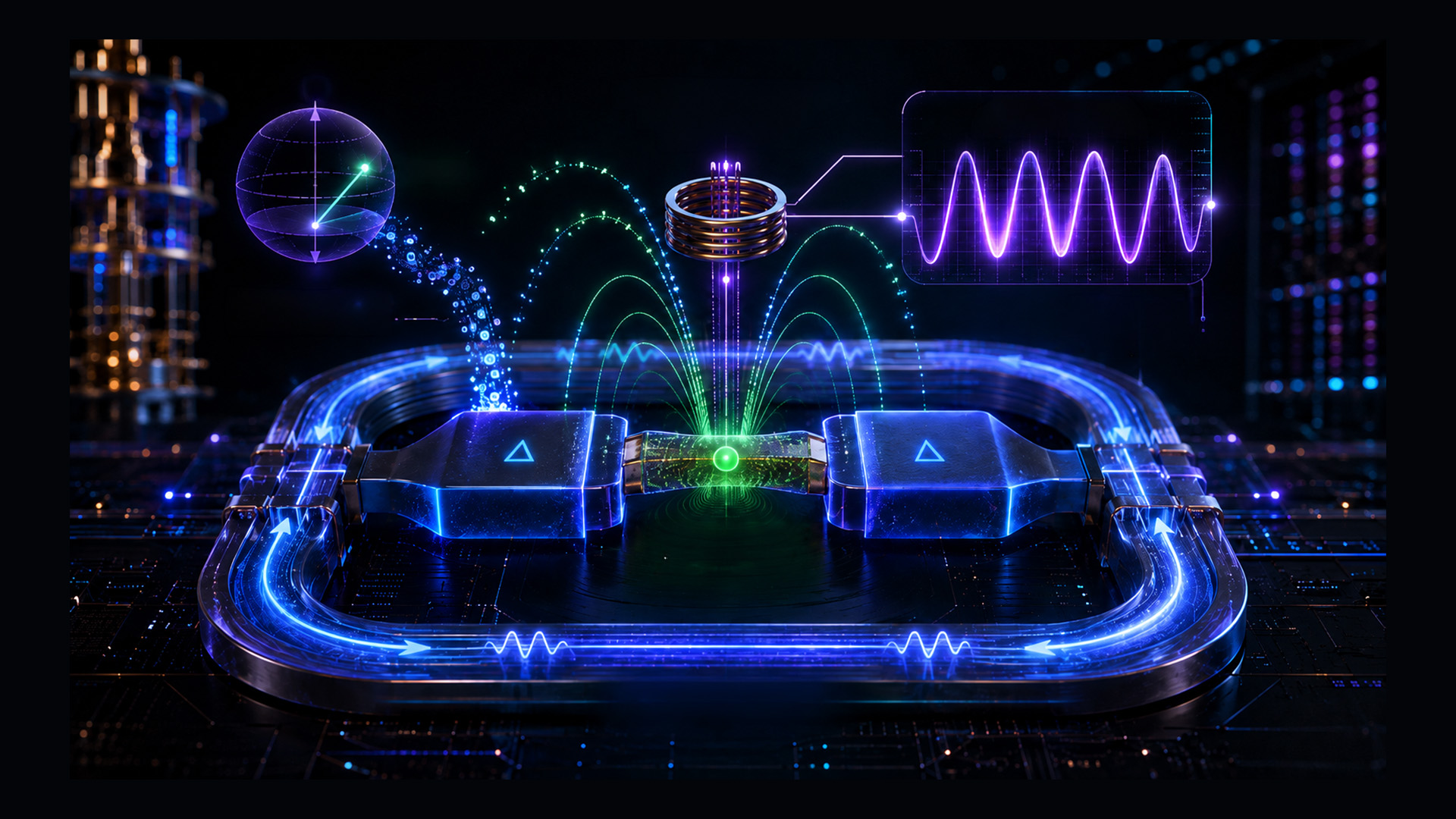
Schematic of a readout of an Andreev qubit without using auxiliary qubits (image: Marcus Egues and José Carlos Egues, with assistance from ChatGPT)
Published on 10/19/2026
By José Tadeu Arantes | Agência FAPESP – One of the fundamental challenges of quantum computing is obtaining information from a quantum bit, or qubit. Unlike a conventional bit, which can be read repeatedly without altering its content, direct measurement of a quantum system typically causes the state to collapse before it can be determined. In other words, reading the information modifies it.
A new study with support from FAPESP proposes circumventing this problem by utilizing a unique property of a certain type of qubit called an “Andreev qubit.” This qubit produces an oscillating electric supercurrent through its own quantum dynamics. This supercurrent would serve as a macroscopic indicator of the qubit’s state, enabling its reconstruction in a virtually non-destructive manner.
The study was published in the journal Physical Review B Letters and was led by José Carlos Egues, a full professor at the São Carlos Institute of Physics at the University of São Paulo (IFSC-USP) in Brazil, and Yugui Yao of the School of Physics at the Beijing Institute of Technology in China. According to the authors, this method could eliminate the need for ancillas, auxiliary qubits used in current techniques for non-destructive quantum readout.
Before delving into these dynamics, it is important to understand the context of the phenomenon. Qubits are the fundamental units of information in quantum computers. While a classical bit can only be 0 or 1, a qubit can exist in various superpositions of these two states. This property gives quantum computing some of its most powerful characteristics but also makes the information extremely vulnerable to interaction with the environment and the measurement process itself.
“In the conventional formulation of quantum mechanics, a projective measurement causes the system to assume one of the states associated with the measured quantity. Thus, if a qubit has been prepared in a certain superposition of 0 and 1, its direct measurement tends to destroy that superposition and, consequently, the information it contained,” says Egues.
To overcome this difficulty, “quantum nondemolition measurements,” or QND, were developed. In many of these protocols, the qubit’s information is transferred to an auxiliary quantum system called an ancilla. The word “ancilla” comes from Latin and means “slave” or “servant.” Today, figuratively speaking, the term is used to refer to something that serves another thing. In this case, measurements are taken on the ancilla to preserve the original qubit as much as possible.
While the procedure is effective, it requires preparing the ancillas, coupling them to the qubit, transferring the information, and performing successive measurements, which can be time-consuming. In systems with many qubits, this additional infrastructure can represent considerable experimental overhead.
“Our strategy is different. Instead of transferring the information to an auxiliary qubit, we seek to obtain it from a signal produced by the qubit under study itself,” says the researcher.
As previously mentioned, the qubit under study is an “Andreev qubit.” It is named after the Soviet physicist Alexander Andreev (1939–2023), who, in 1964, described a quantum process characteristic of the interface between normal and superconducting materials. These states, known as “Andreev states,” are produced by this process and confined to the nanoscale region separating two superconducting materials. They can be used to encode the basic states 0 and 1, as well as their superpositions.
“In the system under consideration, this region is a quantum dot – that is, a nanoscale structure in which electrons are spatially confined – formed in an indium arsenide [InAs] nanowire connected to superconducting materials on both sides. It’s in this environment that the states characterizing the Andreev qubit are formed,” Egues explains.
One property of this system is the circulation of a “supercurrent.” This is an electric current that flows without resistance. The study showed that when the qubit is in a superposition of its basic states, the supercurrent exhibits an oscillating component over time. This oscillation, produced by quantum interference between the states that comprise the superposition, carries information about the qubit’s state. “It’s precisely that property that we use to read the qubit. It’s that supercurrent that lies at the heart of our proposal,” the researcher points out.
Schematic of a readout of an Andreev qubit without using auxiliary qubits. In the proposed device, the qubit’s quantum information appears as an oscillating supercurrent circulating in a large superconducting loop. The magnetic signal generated by this current is detected by a small coil coupled to a SQUID, allowing the qubit’s state to be inferred with minimal perturbation (image: Marcus Egues and José Carlos Egues, with assistance from ChatGPT)
A signature of the quantum state
Any qubit state can be geometrically represented by a point on the so-called “Bloch sphere.” Each point on the surface of this sphere corresponds to a specific superposition of the basic states 0 and 1, and the position of a point is defined by two angles. One angle indicates the proportion in which states 0 and 1 contribute to the superposition, and the other angle indicates the phase relationship between them. Therefore, knowing these two angles is equivalent to knowing the state of the qubit.
“Our study showed that this information is encoded in the supercurrent itself. The supercurrent has a constant component and a fluctuating component. The value of the constant component and the amplitude of the oscillation reveal the proportion of each state (0 and 1) in the superposition, and the moment when that oscillation begins reveals the phase relationship between them. Thus, by measuring how the current varies over time, it’s possible to reconstruct the initial state of the qubit,” Egues explains.
However, there is another important aspect to this phenomenon. In superconducting systems of this type, an electric voltage is usually necessary to cause the supercurrent to oscillate rather than remain constant over time. This is known as the “AC Josephson effect.” In the system studied, however, the current can oscillate without the application of any external voltage. “Our system generates a supercurrent that varies over time like an alternating current but without voltage. It’s the very evolution of the qubit’s state that produces that oscillation,” says Egues.
Thus, the current constitutes a macroscopic manifestation of the system’s microscopic quantum dynamics. It is precisely this bridge between the two scales that the researchers exploit to read the qubit.
The Andreev qubit is incorporated into a closed superconducting circuit through which the aforementioned supercurrent circulates. Near this circuit, a SQUID (superconducting quantum interference device), an instrument extremely sensitive to weak magnetic fields, is placed.
As the supercurrent flows through the circuit, it produces a magnetic field that varies with it. The SQUID detects these variations and uses them to determine how the current is behaving. This behavior provides information about the qubit’s state, so it is possible to reconstruct that state without directly measuring it.
Egues uses a simple analogy: “We can think of the qubit as one compass and the SQUID as another compass. The current in the circuit produces a magnetic field, and the SQUID ‘senses’ that field. Since the coupling between the two is very weak, the effect of the measuring instrument on the qubit tends to be very small.”
This issue is crucial because, in quantum physics, the measuring instrument is not a passive observer. By interacting with the system, it produces feedback that can alter what one intends to measure. The influence of the measuring device on what is being measured caused great perplexity among physicists in the early days of quantum physics. However, it is inevitable. It is, so to speak, an intrinsic characteristic of material reality. The proposed device also has feedback. However, simulations carried out in the study indicated that it can be reduced to values so small that they become irrelevant.
“Our method doesn’t eliminate the fundamental problem of quantum measurement. But it can approach the limit of a non-destructive readout and, at the same time, avoid the use of auxiliary qubits – the ancillas – employed in other non-destructive quantum measurement protocols,” Egues notes.
There is another advantage. After each measurement, there is no need to reset the qubit to its initial state. Measurements can be performed successively as the system evolves, enabling the tracking of its dynamics over time.
Within the limits of the margin of error
The researchers also sought to determine if the approach would work despite the inevitable imperfections of a real experiment. To accomplish this, they ran simulations that incorporated noise into the measurements and took into account the feedback caused by the small detection coil.
Depending on the number of measurements considered, the simulations yielded accuracies of 99.52%, 99.81%, and 99.85%. These results fall within the standard thresholds adopted in quantum error correction schemes.
The study is entirely theoretical. However, according to Egues, this does not mean that the device depends on nonexistent components or future technological advances. “All the numbers we used are realistic. In principle, this can be achieved. In fact, we used parameters from existing systems in our calculations. What doesn’t yet exist is that geometry, that setup that we proposed,” he argues.
This distinguishes the work from other theoretical proposals whose realization depends on advances in material or device fabrication. The detection of extremely small currents and magnetic fields by SQUIDs, for example, is an established technology.
The proposal thus combines two results. The first result is in fundamental physics: the prediction of an oscillating supercurrent similar to the AC Josephson effect but generated by the qubit’s own coherent evolution without an external voltage. The second result is technological: using the characteristics of this current as a signature that allows the qubit’s state to be reconstructed with minimal perturbation.
If the prediction is confirmed through experimentation, the method could provide a simpler architecture for reading Andreev qubits by eliminating the need for ancillas and successive resets. It could also exploit a promising feature of these systems by accessing microscopic quantum information through a macroscopic electric current produced by the qubit itself.
The article “Andreev qubit readout from dynamic interference supercurrent” is available at journals.aps.org/prb/abstract/10.1103/6gkt-hghj.
Source: https://agencia.fapesp.br/59422