


Scientists at UFSCar developed the new method in collaboration with researchers at the University of Bath in the United Kingdom (image: Almeida et al./ACS Electrochemistry)
Published on 05/12/2026
Agência FAPESP* – Researchers affiliated with the Center for Development of Functional Materials (CDMF), at the Federal University of São Carlos (UFSCar) in the state of São Paulo, Brazil, have demonstrated an electrochemical strategy capable of producing amines directly from molecular nitrogen (N₂). The CDMF is a FAPESP Research, Innovation, and Dissemination Center (RIDC). This method could pave the way for more sustainable production of chemical inputs widely used in industry.
Amines are a functional group characterized by the presence of a nitrogen atom bonded to one or more alkyl or aryl (aromatic ring) groups. Derived from ammonia, amines play crucial roles in biological systems and various industrial applications. In everyday life, they can be found in common products such as medicines and cosmetics, where they act as active ingredients or stabilizers.
However, the production of amines typically relies on complex chemical processes that are often based on intermediates derived from fossil fuels or involve energy-intensive steps.
The scientists at UFSCar developed the new method in collaboration with researchers from the University of Bath in the United Kingdom. They published their findings in ACS Electrochemistry.
The research shows that isopropylamine and diisopropylamine, important compounds in chemical synthesis and industrial applications, can be synthesized using gaseous nitrogen and acetone in an electrochemical process carried out in an aqueous solution under ambient conditions.
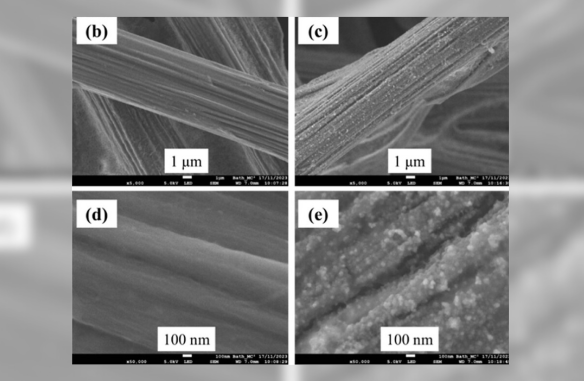
The researchers demonstrated that the reaction can occur directly in an electrochemical system in which nitrogen is activated on a molybdenum disulfide-modified electrode. This material acts as a catalyst, facilitating the formation of carbon-nitrogen bonds and enabling the conversion of molecular nitrogen into nitrogen-containing organic molecules.
Experiments indicated that the process can generate detectable amounts of isopropylamine and diisopropylamine from nitrogen and acetone when an electric potential is applied.
Electrification of chemical synthesis
One of the main advantages of this approach is that the reaction occurs at room temperature and atmospheric pressure in an aqueous medium. In principle, this allows the process to be powered by renewable electricity, such as solar or wind.
Furthermore, this strategy avoids intermediate steps that are common in the chemical industry, such as the prior production of ammonia or the use of molecular hydrogen. This simplifies the synthesis chain.
According to the authors, although production rates are still relatively low, their work demonstrates the feasibility of a promising concept: producing nitrogen-containing organic molecules directly from N₂ via electrosynthesis. They claim that improvements in catalyst design, electrode structure, and reaction conditions could significantly increase the efficiency of the process.
The study contributes to international efforts to develop cleaner chemical pathways aligned with the energy transition. The goal is to transform abundant molecules into higher-value products using electricity.
The article "Sustainable electrosynthesis of propylamines through nitrogen reduction on a MoS2 catalyst" can be read at pubs.acs.org/doi/10.1021/acselectrochem.5c00490.
* With information from the CDMF
Source: https://agencia.fapesp.br/58081


