


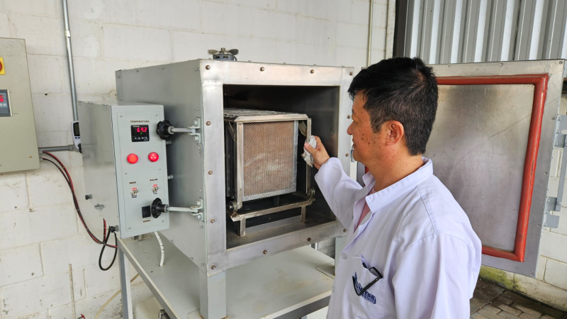
Thermal desorption chamber containing the system’s hydrocells during the process of releasing adsorbed water. The hydro-battery module is inserted into the heated chamber to promote the desorption of vapor, which is subsequently condensed in the water recovery system (photo: IGTPAN)
Published on 10/06/2026
By José Tadeu Arantes | Agência FAPESP – Researchers at São Paulo State University (Unesp) in Brazil have developed a new system for capturing water directly from atmospheric humidity in collaboration with the Granado Institute of Polyacrylonitrile Technology (IGTPAN), a private research institution located in the São Paulo municipality of Jacareí. The technology uses a superabsorbent polymer produced from recycled textile waste that can capture water vapor from the atmosphere and release it as liquid water later on.
The system is based on modules called hydrocells and is described in the journal NPJ Clean Water. These hydrocells function as “sponges,” absorbing moisture from the air. Unlike conventional absorption, in which the liquid penetrates the interior of the material, these hydrocells retain water vapor molecules trapped only on their surface. The system then converts the captured moisture into liquid water through moderate heating. In nearly a year of experimental tests, the prototype produced 4 to 6 liters of water per day with relatively low energy consumption.
“This approach could serve as a decentralized alternative for water supply in arid and semiarid regions where conventional sources, such as aquifers or desalination, are often limited by high energy costs and infrastructure demands,” says Valquiria de Campos, a researcher, professor at the Unesp Institute of Science and Technology in Sorocaba, and the corresponding author of the article.
According to Nilton Granado, a researcher at IGTPAN and the inventor of the equipment, “The sustainable production of drinking water from the available atmospheric reservoir anywhere in the world will be vital for large cities, which already lack that resource.” This is the case for Lima, Peru, for example, which has 11.2 million inhabitants and an average annual rainfall of just six millimeters. It is the third-largest city in the world located in a desert.
“For that reason, the development of equipment that extracts water from the atmosphere could offer domestic solutions for producing drinking water in the near future,” Granado says. The Brazilian technology used to produce the superabsorbent polymer employed in the equipment has already been patented in Brazil and the United States.
The core element of the technology is a cross-linked polymer called PANSAP (poly(potassium acrylate-co-acrylamide)) obtained by recycling polyacrylonitrile (PAN) fibers. PAN fibers are commonly known as “acrylic fiber” and are widely used in the textile industry. The process involves recovering the polymer from the textile fibers and subjecting it to an alkaline hydrolysis reaction. This reaction converts the material into a new superabsorbent polymer (SAP) that is highly hygroscopic – capable of absorbing large amounts of water – and can be formed into sheets.
According to Campos, using textile waste was the best option for producing the polymer. “We could have used commercial polyacrylate, but it wouldn’t have been as efficient for adsorption and sheet production,” he explains. The process of extracting polyacrylonitrile from the fabric relies on well-established industrial chemical routes. The result is a material that forms a three-dimensional network, retaining liquid in its pores. Each gram of the polymer can absorb 200 to 300 grams of liquid water. In air, the polymer becomes saturated when it adsorbs 80% of its mass in water.
The entire process is based on the concept of the circular economy, which transforms waste into resources. In addition to reusing clothing and fabric scraps, which are typically discarded into the environment, the method recovers ammonia released during the chemical reaction used to produce the polymer. This ammonia is then converted into ammonium phosphate, a fertilizer used in agriculture. “That significantly reduces waste generation and improves the environmental performance of the process,” Campos emphasizes.
“Furthermore, from an economic standpoint, water production based on the superabsorbent polymer obtained from textiles is much more advantageous than other methods that use advanced materials,” the researcher argues. In recent years, several studies have investigated using so-called metal-organic frameworks (MOFs) to capture water from the air. These porous crystalline materials are formed by combining metal ions or clusters with organic ligands, creating highly ordered, three-dimensional structures with networks of nanoscale pores.
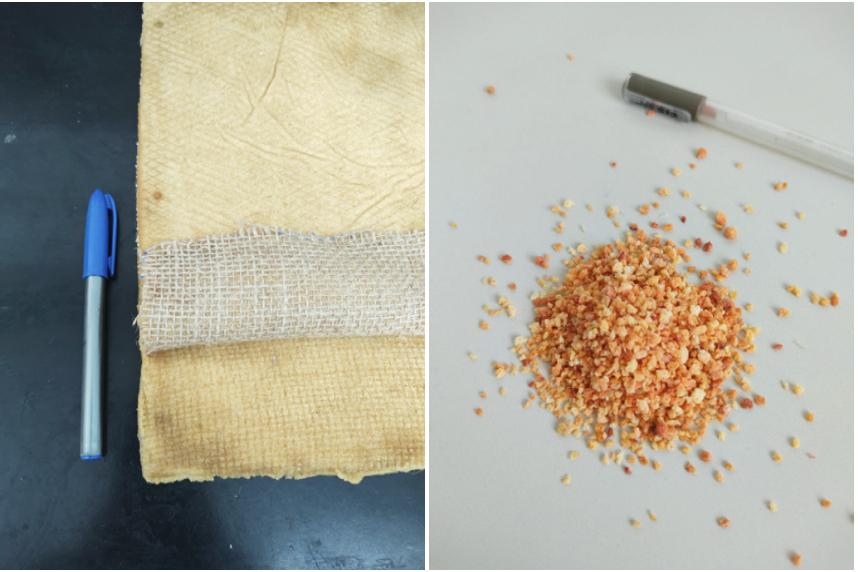 On the left, fabrication of polymer plates containing PANSAP laminated onto a jute matrix and subsequent encapsulation in a metal structure to form the adsorbent module; on the right, PANSAP in granular form (photo: IGTPAN)
Reduced cost
“Although MOFs perform well in the laboratory, they’re expensive and difficult to produce on a large scale. The estimated cost of producing our polymer is around $2.50 per kilogram, whereas some MOFs can cost thousands of dollars per gram. How are we supposed to provide emergency assistance to populations in need of water at a price like that?” Campos points out.
In experiments conducted during the study, the new polymer demonstrated an adsorption capacity of approximately 0.43 grams of water per gram of material in environments with relative humidity between 69% and 90% when in plate form. The complete system consists of polymer-containing plates – the hydrocells – grouped into modules called hydro-batteries. Ambient air circulates through the plates, allowing the material to capture moisture. The plates are then heated to temperatures between 55 °C and 80 °C, releasing the vapor, which is condensed and collected.
Campos notes that the temperature range was a critical issue in the system’s development. “The temperature can’t be too high. When we tested the plates at temperatures above 100 °C, we found that it degraded the polymer, resulting in water with an ammonia-like odor. Lowering the temperature solved the problem. When we lowered the temperature to the 60 °C to 65 °C range, the water came out tasteless,” says the researcher.
The water produced by the system is highly pure because it essentially results from a condensation process similar to distillation. Chemical analyses revealed an absence of detectable organic contaminants and low levels of ammonia (0.09 milligrams per liter), which are well below international safety limits. Since the water is virtually demineralized, the researchers recommend adding mineral salts, a common procedure in desalination systems.
One of the key features of the system is that it can be powered by solar energy. “In the experimental prototype, we used a hybrid system combining electric heating, direct solar radiation, and photovoltaic panels. Under full sunlight, four 580-watt photovoltaic panels were sufficient to supply all the energy needed to operate the equipment. That configuration allows for operation either connected to the power grid or fully off-grid, which is a key feature for isolated communities,” Campos reports.
According to the researcher, the energy issue must always be considered alongside cost and social applicability. “There’s no point in having a device that collects water but consumes a prohibitive amount of energy to operate. We prioritize solutions that are simpler and cheaper than other proposals in the literature,” she emphasizes.
Another important finding of the study was the stability of the material over multiple use cycles. Tests showed that the polymer can undergo more than 2,500 cycles of adsorption and desorption (the process by which water retained on the surface is released) with minimal loss of performance. Based on these data, the authors estimate that the system could have a service life of more than ten years depending on the operating conditions. Furthermore, the modular nature of the technology allows for expansion of production capacity. A single unit containing approximately 10 kilograms of adsorbent material can produce about 6 liters of water per day. Systems with hundreds or thousands of modules could supply sufficient volumes for small communities.
Campos points out that the system has already moved into an applied phase: “We’re preparing for a field test in the Lima region of Peru, in a community that relies on artisanal fog collection systems and water delivery by tanker trucks.”
FAPESP supported the study through a Research Grant, which was awarded to Campos.
The article “Scalable hydrocell technology based on recycled polymers for atmospheric water harvesting” can be read at https://nature.com/articles/s41545-025-00534-7.
Source: https://agencia.fapesp.br/59345


