


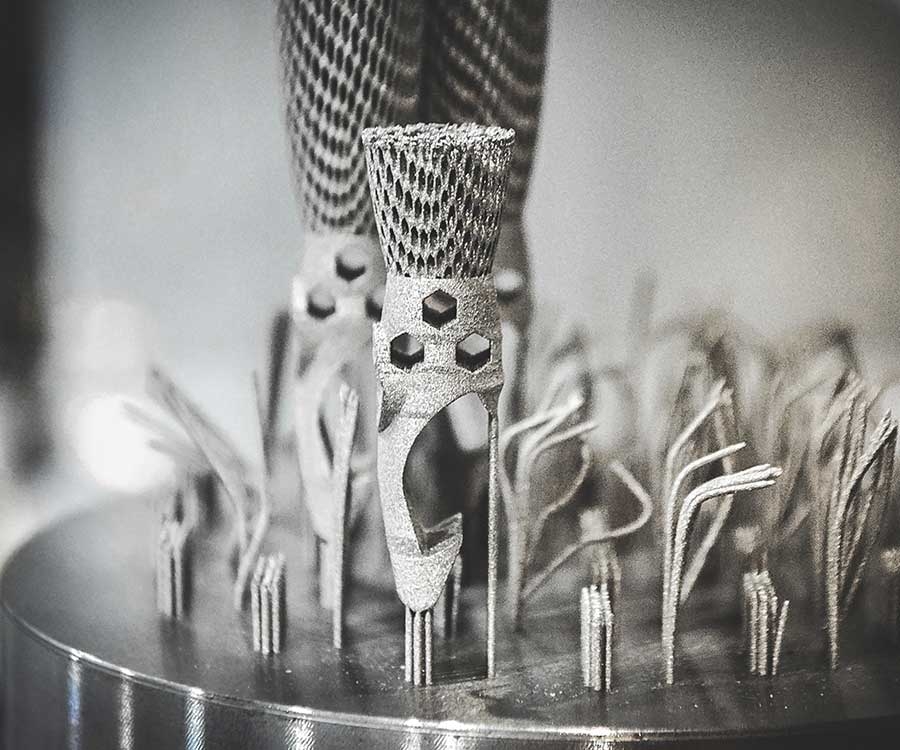
The tool developed by the startup offers predictive simulation solutions. It allows real machinery to be digitized and all variables to be adjusted in the virtual environment, eliminating the costly cycle of trial and error (image: Eigendauer)
Published on 02/23/2026
By Roseli Andrion | Agência FAPESP – In the mechanical industry, a hidden challenge accumulates annual losses that reach the order of millions. High-value components, such as aircraft gears, vehicle springs, and wind turbine axles, are often discarded because finishing machines cannot be adjusted properly the first time.
The industry figures are impressive. According to consulting firm ITS Inc., fatigue failures in mechanical components cost about 4% of gross domestic product (GDP) annually in the United States. A single critical failure in a component can generate USD 2 million in repair costs. In industrial reduction gearboxes, repair costs range from USD 10,000 to USD 100,000 per catastrophic occurrence, according to Sumitomo Drive data.
To mitigate these losses, Eigendauer, an engineering startup focused on surface integrity, developed software that simulates finishing processes even before parts enter the production line with support from FAPESP’s Innovative Research in Small Businesses Program (PIPE). Eigendauer is incubated at IncubAero and is linked to the Department of Aerospace Science and Technology (DCTA) of the Technological Institute of Aeronautics (ITA) in São José dos Campos in the state of São Paulo, Brazil.
Called MIP (Manufacturing Interaction Platform), the solution works as a “digital twin” of the peening equipment. It allows the actual machinery to be digitized and all variables to be adjusted in the virtual environment, thus eliminating the traditional and costly cycle of trial and error.
The main focus of the technology is shot peening. During this process, small metal spheres are fired at the surface of components to create compressive residual stress, which acts as an invisible form of armor that protects parts from cracking and fatigue.
This technique converts mechanical energy into durability, making parts two to three times more resistant. According to industry technical data, this procedure can increase the service life of fatigue-prone components by up to 1,000%. The Society of Automotive Engineers (SAE) reports that over 70% of aircraft turbine blades and 90% of automotive springs worldwide undergo this treatment.
Grand View Research projects that the global market for this technology will reach USD 2.3 billion by 2033, growing at an annual rate of 7.2%. The aerospace sector accounts for 45% of the demand, followed by the automotive sector (25%) and the energy sector (15%).
Control of complex variables
Shot peening involves dozens of interdependent variables, such as ball speed, impact angle, air pressure, and type of shot. “The market has finishing processes that aren’t yet fully utilized and many variables to be controlled,” explains Mariana dos Santos Souza, CEO and co-founder of Eigendauer.
The unique feature of the software is predictive simulation. While expensive competing equipment (such as European models costing € 1.5 million) only monitors what occurs during the process, the Brazilian platform allows for prior optimization of parameters.
The project was made possible with support from FAPESP’s PIPE program. In the first phase, the team developed a minimum viable product (MVP) focused on shot peening and grinding. Currently, the software is at TRL (Technology Readiness Level) 5, where it is validated in a relevant environment.
Since then, the team has decided to focus solely on shot peening. “We’re going to put it in the cloud to market it better,” explains Souza. “A software-as-a-service [SaaS] model facilitates customer access.”
Saving time, material, and energy
The benefits of the solution include decarbonization and energy efficiency. Without simulation, the conventional process involves programming the machine, processing the part, and inspecting it, often using ultraviolet light to detect microscopic flaws. If the result is unsatisfactory, the material is discarded and the process is restarted.
With the digital twin, however, it is possible to set the ideal parameters to achieve the necessary coverage before activating the machinery. Its applications range from nationalizing imported components to reducing noise in electric vehicles and maintaining drilling equipment in the oil and gas sector.
Obstacles of conservatism
Despite its technical soundness, the startup faces industrial conservatism. “The industrial market is conservative, and no one wants to take risks,” ponders Souza. To overcome this barrier, the company is adopting a progressive validation strategy: providing technical consulting services while improving the product.
Recently, a customer requested that the system be developed specifically for their product. This is the classic dilemma: the customer recognizes the value and wants exclusivity, but is not willing to pay the real cost of that exclusivity. “The industry doesn’t want to invest, and investors don’t want to take risks on disruptive solutions,” she laments.
This mindset is not exclusive to Brazil. “There have been talks with Germany, Japan, and the United States, but no one wanted to take a chance,” she says. Europe controls about 40% of the global market for shot peening machines thanks to its robust automotive and aerospace industries, yet innovation in simulation software still faces challenges.
Although engineers are generally convinced of the benefits, they still need to convince decision-makers. “When it comes to approval, because there are no indicators, it either takes too long or isn’t approved at all. The investment is considered more than the possible long-term return.”
Eigendauer is now seeking funding for a technical-economic feasibility module that will use scientific literature to automatically calculate the return on investment (ROI) of the process. “We identified that the great difficulty lies in proving that the shot peening process is economically viable,” explains Souza. “Based on the literature, it’ll be possible to understand whether or not it is. The customer will be able to simulate parameters in the software we already have.”
At the same time, the startup participates in international trade shows to increase its visibility. It recently attended the Web Summit in Lisbon. Additionally, one of the partners attended the Royal Academy of Engineering’s Leadership in Innovation Fellowships (LIF) Global program in England. LIF Global seeks to empower and internationalize startups, and it has a partnership with the National Council for Scientific and Technological Development (CNPq) – the development agency linked to the Brazilian Ministry of Science, Technology, and Innovation. “We’ve been thinking about internationalization since the beginning,” says Souza.
The multidisciplinary team reinforces the startup’s global ambitions. In addition to administrator Souza, co-founders André Oliveira and Guilherme Guimarães hold doctorates from the ITA, and Patrícia Lohrer holds a doctorate from RWTH Aachen University in Germany. The company’s name reflects this connection by combining the German terms eigenspannung (stress) and dauerhaft (durability).
In line with Industry 4.0, Eigendauer plans to capture 5% of the global market share by 2033. “We’ll likely have to offer the product off the shelf in a software-as-a-service model to facilitate access,” the CEO summarizes. In a scenario where efficiency and sustainability are imperative, Brazilian technology aims to replace waste with precise calculations.
Source: https://agencia.fapesp.br/57261


