


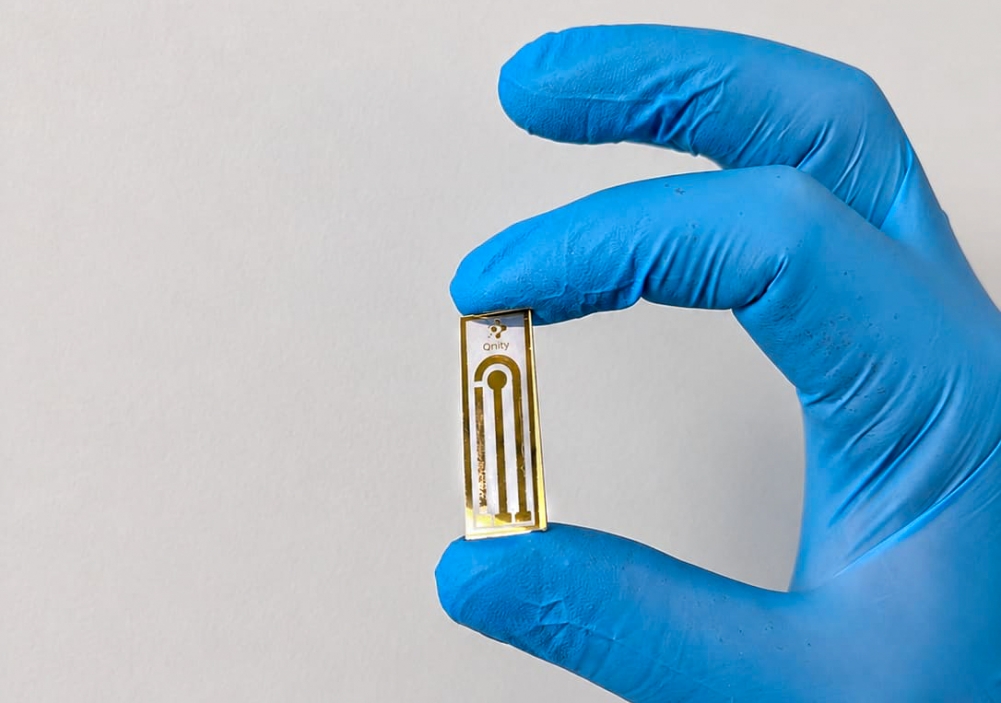
Prototype chip for measuring affinity between compounds (image: Qnity)
Published on 08/24/2026
By Roseli Andrion | Agência FAPESP – Although molecules can’t speak, they leave clues about whom they prefer to interact with. Quickly deciphering this “chemical communication” could reduce time and costs in the early stages of new drug development.
To help the pharmaceutical industry with this process, which involves identifying the most promising molecules for therapeutic applications from among hundreds or even thousands of candidates, the São Paulo-based startup Qnity has developed a sensor that can precisely measure the affinity between compounds based on their quantum properties.
Launched at São Paulo State University (UNESP) in Brazil in collaboration with the University of Oxford in the United Kingdom, the project is supported by FAPESP’s Innovative Research in Small Businesses (PIPE) program. The company is seeking new investments to complete the development of the platform.
“Our goal is to demonstrate that cutting-edge science, including quantum technology, is being developed in Brazil,” Diego Stone, the CEO of Qnity, based in São Carlos, tells Agência FAPESP.
Trial and error
When two molecules approach each other, their electrons interact first. This process involves quantum phenomena such as electron tunneling, whereby particles can cross energy barriers that, according to classical physics, they should not be able to overcome. Qnity’s technology transforms these interactions into information indicating which compounds are most likely to serve as candidates for new drugs.
Currently, before a drug enters animal or human trials, scientists engage in a quiet process of trial and error. They analyze thousands of molecules to determine which have the greatest ability to bind to a predetermined biological target. This target could be a viral protein, a cancer-associated marker, or a structure linked to neurodegenerative diseases, such as Alzheimer’s and Parkinson’s.
The greater the affinity between the molecule and the target, the greater the likelihood that the molecule will be useful in subsequent stages of development. “That way, the industry can identify which compounds are most likely to become drugs before investing in later phases,” Stone explains.
At this initial stage, the technology developed by the São Paulo-based company could be a key differentiator. Instead of relying on expensive optical sensors, the system uses electrochemical sensors integrated with microfluidic channels to measure the quantum properties of molecular interactions. This approach allows one to obtain equivalent information using a simpler platform; a single drop of solution is all that is needed to measure the binding affinity between molecules.
While conventional electrochemistry measures the physical flow of ions moving through an aqueous solution, the startup’s approach directly observes the quantum properties generated by the interaction between the electrons of two molecules. “After all, it’s the electrons that are actually interacting,” Stone notes.
In addition to accelerating the selection of the most promising molecules, Stone believes the reduced cost will make the technology more accessible. The goal is to serve not only large pharmaceutical companies and research centers with significant investment capacity, but also universities, biotech startups, and small laboratories.
Other applications
The company’s decision to begin commercial operations in the drug discovery phase is strategic because this segment does not require complex regulatory approval. Since the platform is exclusively used in the research phase, it does not need to undergo the rigorous regulatory processes required for drugs or medical devices by agencies such as Brazil’s National Health Surveillance Agency (ANVISA) or the European Medical Device Regulation (MDR).
Although drug discovery is the first commercial application of Qnity’s platform, it can also be used to identify biomarkers, which are biological markers that indicate the development of diseases such as certain types of cancer. In this case, the equipment can function as a high-precision sensor for diagnostics.
The company is conducting proof-of-concept trials with national and international partners and has begun discussions with research institutions and pharmaceutical companies. However, the device is still in the refinement phase. The integration of the chip, microfluidic channels, electronic components, and user interface must be completed.
Portable device
The project is currently at Level 5 on the international Technology Readiness Level (TRL) scale, which ranges from 1 to 9. The researchers aim to transform the laboratory setup into a portable device that can be used directly at clients’ facilities. They expect this device to be ready for pre-sale by 2028.
To meet this deadline, the company is adopting a multifaceted funding model that involves submitting proposals to government funding programs such as the Brazilian Innovation Agency (FINEP) and FAPESP’s PIPE Invest program. Additionally, the company relies on support from units of the nonprofit National Industrial Training Service (SENAI) organization, including the electrochemistry hub in Curitiba and the Integrated Manufacturing and Technology Center (CIMATEC) in the state of Bahia.
Meanwhile, Qnity is seeking to expand its international presence. The company operates a laboratory in the United States, negotiates with multinational corporations, and plans to implement pilot projects in Brazil, focusing on analyzing the pharmacological potential of compounds and extracts derived from Brazil’s biodiversity.
This scenario could be particularly beneficial for researchers studying rare and neglected diseases, which historically receive less funding due to the high financial risk involved. According to the World Health Organization (WHO), neglected tropical diseases affect approximately 1 billion people worldwide. Rare Diseases International, a global alliance representing people living with rare diseases worldwide, estimates that more than 300 million people live with one of the more than 6,000 known rare diseases.
The Facts & Figures 2025 report from the International Federation of Pharmaceutical Manufacturers & Associations (IFPMA) indicates that developing new drugs takes an average of 10 to 15 years. The estimated cost from initial research to commercial launch is approximately USD 2.6 billion, which includes the costs of all failed projects.
Source: https://agencia.fapesp.br/59042


