


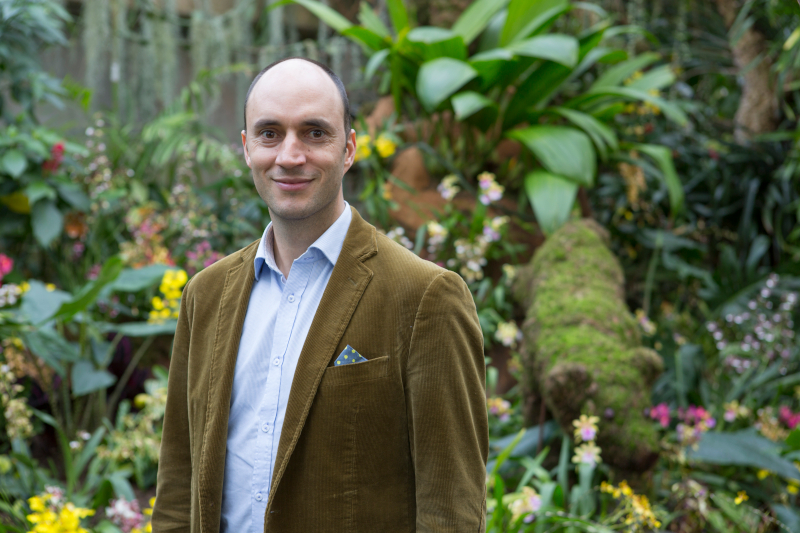
Antonelli: “It’s relatively easy to connect people with the importance of preserving biodiversity because they have a personal connection to it. We’re a scientific institution, but we also take the opportunity to inspire people through the beauty of our collections and the experience of visiting our gardens” (photo: Kew Gardens)
Published on 06/16/2026
By Elton Alisson, from London | Agência FAPESP – In early 2019, Brazilian biologist Alexandre Antonelli was given a monumental mission when he took over as Executive Director of Science at the Royal Botanic Gardens in Kew (better known as Kew Gardens) in London: to digitize and open to the world a collection spanning 400 years of the natural history of the world’s flora. This involved making approximately 6.4 million plant specimens and over one million fungi, collected from every corner of the planet, accessible remotely.
The first Brazilian to serve as the scientific director of the world’s most famous botanical garden complex, Antonelli celebrated the completion of this effort in early June. It was the largest scientific project in the British institution’s history and mobilized hundreds of collaborators and researchers from various countries, including Brazil.
During a visit by the Brazilian delegation from FAPESP Week London to the British institution, the scientist revealed in an interview with Agência FAPESP that the British megaproject was largely inspired by a Brazilian initiative: Reflora. Launched in 2010 by the CNPq with support from FAPESP in the state of São Paulo, Reflora pioneered the recovery of specimens of Brazilian flora deposited in foreign herbaria through high-resolution images.
In the following conversation, Antonelli discusses the concept of “digital repatriation,” the strategic role of local herbaria in preserving global botanical heritage, and Kew Gardens’ collaboration with Brazil in ethnobotany, ecological restoration using artificial intelligence, and the fungal bioeconomy.
Read key excerpts from the interview below:
Agência FAPESP – Kew Gardens has just completed this major digitization project. What were the main motivations behind the initiative, and what has been achieved so far?
Alexandre Antonelli – When I arrived at Kew, digitization had already been identified as the institution’s top scientific priority. There was concern that researchers and conservationists around the world didn’t have easy access to specimens from their regions of origin. That was problematic. Another concern was accelerating scientific progress. Today, to describe a new species, you have to travel to various herbaria, open cabinets, and make comparisons, or request loans by mail and wait months for them to arrive – a very time-consuming process. We wanted to streamline that to prevent biodiversity loss and improve scientific outcomes, such as species descriptions and studies in evolution and ecology. We worked hard to secure funding from the British government and carried out an intensive four-year project. We involved about 150 people here at Kew and over 1,500 collaborators in other countries to extract data. It was a success; we finished on time and within budget. Yesterday, we were visited by the UK Minister for the Environment, Mary Creagh, to mark the digitization of the last herbarium specimen [a pressed, dried plant sample mounted on cardboard for museum preservation].
Agência FAPESP – How did the Brazilian Reflora project influence the British initiative?
Antonelli – Reflora was the world’s first project for the digital repatriation of Brazilian collections held abroad, and it was an inspiration to us. We were key collaborators on the project, which was conducted in partnership with the Rio de Janeiro Botanical Garden. Now, we intend to digitize the rest of our collections using that model.
Agência FAPESP – Digital repatriation is part of a global cultural repatriation movement that seeks to return historical artifacts taken during colonialism. How does the institution position itself regarding that debate?
Antonelli – There’s a historical debt. Botanical exploration was an imperialist tool. The classic example is the diversion of rubber from the Amazon to Southeast Asia. When I took over, there was a lot of attention on the fact that a Brazilian was leading an institution like Kew. That brings with it the responsibility to democratize and share that knowledge. We’ve never received requests for physical repatriation, and under British law, that would be complicated. However, we are open to long-term loans and send many herbarium specimens to researchers worldwide who need the physical material. Digitization allows us to do many things, but not everything.
Agência FAPESP – Historically, many records of Brazilian flora ended up in European institutions. How has that situation changed?
Antonelli – Botanical exploration was led by Europe for centuries, resulting in immense collections from Latin America here, in the United States, and in other institutions in the Northern Hemisphere. The situation has been changing. Recent studies indicate that the description of new species is increasingly taking place closer to their regions of origin and that primary reference material [so-called “type” specimens] is being kept in the country of occurrence [where the specimens were collected].
Agência FAPESP – In practice, how does digitization function as a tool for repatriating knowledge?
Antonelli – With digitization, the goal isn’t necessarily to move the object, but to democratize access. Today, any researcher in Brazil or elsewhere can virtually access our collections with the same ease as making a purchase on an e-commerce site. The future of botany lies in that interconnectedness. You can find a plant and access global data about it. You can understand its distribution and use that information to make decisions. For example, you can assess the environmental impact of a new highway.
Agência FAPESP – What role do regional herbaria play in global science, and why is the strategy of distributing duplicate samples still crucial?
Antonelli – Local collections, even small ones, are disproportionately important to global science relative to their size. One of the challenges in the coming years is mobilizing resources to digitize those smaller herbaria, which are vital to the global biodiversity network. We receive about 20,000 donations per year for two reasons: the pursuit of knowledge by experts based here and risk mitigation. History has shown us – with the fires at the National Museum [in 2018] and the Butantan Institute [in 2010] – that concentrating an entire collection in a single location is a strategic mistake. The ideal protocol is to create duplicates. By distributing samples among different institutions, we reduce the risk of catastrophic loss of that heritage. In addition to added security, our herbarium remains an essential meeting place for researchers worldwide.
Agência FAPESP – What is the size and significance of the Kew Gardens collection?
Antonelli – The herbarium contains approximately 6.4 million specimens. In addition to the dried specimens, we have a large collection of materials preserved in alcohol, such as flowers and fruits that lose their shape when pressed, as well as a fungal collection of 1 million specimens that we’ve also digitized. In southern England, we maintain the Millennium Seed Bank, the world’s largest wild seed bank, with about 2.5 billion seeds from over 40,000 species. Our herbarium isn’t the largest in the world in terms of the number of specimens, but it’s probably the most important because it holds the largest number of “types” [reference specimens used as a standard for the original description of a species]. We have around 300,000 types.
Agência FAPESP – How does the funding model work for an institution of this size?
Antonelli – We’re a nonprofit foundation. About a third of our funding comes from the government for basic operations and maintenance of the UNESCO [United Nations Educational, Scientific, and Cultural Organization] World Heritage Site. Another third comes from the garden’s own activities, such as ticket sales and events [like the winter light show and Christmas at Kew]. The rest comes from philanthropy and research grants. Yesterday, for example, I met with about 100 potential donors to present our work. Our annual budget is around £150 million [over USD 201 million], and we have 1,500 employees. Additionally, we have over 750 scientists working in more than 100 countries.
Agência FAPESP – What are the current pillars of Kew Gardens’ scientific collaboration with Brazil?
Antonelli – We’ve identified four areas. The first is expanding Reflora data by linking records to sustainable uses, such as medicinal applications, and integrating them into international databases. The second is ethnobotany. We collaborate with indigenous communities in the Amazon to characterize the species they use and repatriate knowledge about objects [derived from plants, such as baskets or staffs] among the 100,000 plant artifacts we keep here, some of whose production techniques have been lost. The third is conservation and restoration. The Kunming-Montreal Global Biodiversity Framework [adopted in December 2022 at a United Nations conference] established the goal of protecting and restoring 30% of the planet. Brazil has protected areas, but there are gaps in the protection of threatened species in their original habitats. We assist with mapping data and technological tools. In restoration, we collaborate in the Atlantic Forest with researchers such as Pedro Brancalion [from the Luiz de Queiroz College of Agriculture at the University of São Paulo] and Bernardo Strassburg [from the International Institute for Sustainability], using remote sensing and artificial intelligence. I’m leading a pilot ecological corridor project in Rio de Janeiro that uses those technologies to prioritize restoration areas, capture carbon, and understand how biodiversity recovers locally. The fourth area is the exploration of Brazilian fungi, their species diversity, molecules, and properties. That has the potential to strengthen the country’s bioeconomy.
Agência FAPESP – What stage is that pilot restoration project in the Atlantic Forest at?
Antonelli – We’re in the experimental phase, developing methodologies across 500 hectares that we can later scale up with "investable" products. The project involves a mosaic of private, municipal, and state lands with different uses. We work with local communities to identify the most effective restoration model that delivers socioeconomic benefits. I volunteered for three years on the International Advisory Panel for Biodiversity Credits [a global initiative launched in 2023 and led by France and the United Kingdom that aims to structure the biodiversity credit market], and Brazil’s Ministry of the Environment has shown great interest in that. At a recent workshop, we discussed the idea of high-integrity biodiversity credits. The topic is set to be presented at the upcoming COP on Biodiversity [the biennial conference of the Convention on Biological Diversity organized by the United Nations, which brings together world leaders to discuss rules and targets for nature conservation] in Armenia. We’re seeking innovative financing solutions to address the substantial global economic gap in conservation and restoration.
Agência FAPESP – In addition to Kew, you have a personal conservation foundation in Brazil. What is the goal of that initiative?
Antonelli – I established a nonprofit foundation in Macaé de Cima [Rio de Janeiro state] called the Antonelli Foundation for Biodiversity Research and Conservation. We lead an initiative called ARAÇÁ [the Atlantic Forest Research and Conservation Alliance] and have built a research station open to researchers and students, where we coordinate monitoring efforts, ecological studies, and the description of new species. It isn’t an institutional project of Kew, although it involves researchers from here. It’s a personal project with local action and national and international partnerships, including several collaborators in the state of São Paulo.
Agência FAPESP – How has the scientific community’s dialogue with policymakers been regarding biodiversity loss?
Antonelli – We have excellent contact with the British government while maintaining our academic independence. Dialogue with politicians is constant. As in many other countries, we face economic and budgetary challenges, competing with sectors such as health and education. Internationally, we have excellent collaborations with Brazil, and I actively participate in biodiversity and climate COPs. I’m one of the lead authors of the upcoming global biodiversity report by the IPBES [the Intergovernmental Science-Policy Platform on Biodiversity and Ecosystem Services, an entity created in 2012 to systematize accumulated scientific knowledge on biodiversity and inform international policy decisions]. Biodiversity loss remains a serious challenge, and our job is to translate science so that it can be applied in practice, regardless of the global political landscape.
Agência FAPESP – Some believe it’s harder to raise public awareness about biodiversity loss than climate change because it’s a less visible issue in people’s daily lives. Is that also your view?
Antonelli – That does make sense, but there’s another side to it. Climate change is dramatic, but mitigation efforts take decades to yield noticeable results. Biodiversity conservation, on the other hand, allows for quick, visible results at the individual level, such as growing plants that attract pollinators in your own backyard. In that sense, it’s relatively easy to connect people with the importance of preserving biodiversity because they have a personal connection to it. We’re a scientific institution, but we also take the opportunity to inspire people through the beauty of our collections and the experience of visiting our gardens. That reinforces the importance of caring for the environment.
Source: https://agencia.fapesp.br/58418


