


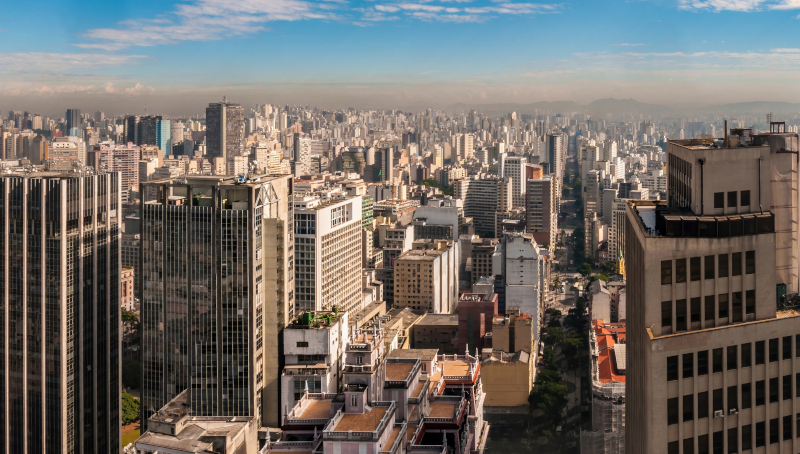
Since 1900, the global average temperature has risen by approximately 1.2 °C. In the city of São Paulo, however, the daily high, which occurs around 1 p.m., has risen by 2.4 °C (image: Wilfredor/Wikimedia Commons)
Published on 05/25/2026
By Elton Alisson | Agência FAPESP – Over the past 125 years, minimum and maximum air temperatures in the city of São Paulo, Brazil, have risen well above the global average. According to data from the Intergovernmental Panel on Climate Change (IPCC), the global average temperature has risen by approximately 1.2 °C since 1900, and the land surface temperature has risen by 2 °C. In the capital of the state of the same name, the daily maximum temperature, typically recorded around 1 p.m., has risen by 2.4 °C, with the increase becoming particularly pronounced since 1950. The daily minimum temperature, typically recorded at 6 a.m., has increased by 2.8 °C since the early 20th century.
Humberto Ribeiro da Rocha, a professor at the Institute of Astronomy, Geophysics, and Atmospheric Sciences at the University of São Paulo (IAG-USP), made these observations during a lecture presented at the meeting “Extreme Heat and Water Events: Mitigating the Adverse Effects of Climate Change on Urban Health,” organized by FAPESP and the Dutch Research Council (NWO) on May 7 in the Foundation's auditorium.
Through studies conducted within the framework of the Center for Water and Food Security in Critical Zones – a Science Center for Development (SCD) supported by FAPESP – Rocha and researchers Miguel de Carvalho Diaféria, Rodrigo Lustosa, Ana Nogueira Campelo, and Denise Duarte have found that temperature disparities in São Paulo relative to the global average are related to the urban heat island effect. This phenomenon occurs in urbanized areas that experience significantly higher temperatures due to the replacement of vegetation with construction materials, such as asphalt, concrete, and masonry.

: “Extreme Heat and Water Events: Mitigating the Adverse Effects of Climate Change on Urban Health” was organized by FAPESP and the Dutch Research Council (photo: Daniel Antônio/Agência FAPESP)
In a new study, the researchers affiliated with the center examined the relationship between the urban heat island effect and vegetation coverage in 70 cities in the state of São Paulo. They used land surface temperature data obtained via satellites from NASA’s Landsat program between 2013 and 2025.
The analyses revealed that surface temperatures in the most urbanized areas of Greater São Paulo reach up to 60 °C in the summer – a level typically seen in large industrial warehouses. In contrast, temperatures in cooler areas with greater vegetation cover and bodies of water reach a maximum of 25 °C.
Other findings from the study, which is currently in press, showed that temperatures in the hottest urbanized areas of the region were, on average, between 7 °C and 12 °C higher than in cooler areas during the summer.
“When we examined the distribution of heat islands across the state of São Paulo, we observed a high concentration in the northeastern region, where large-scale sugarcane cultivation occurs, and specifically in some cities like those in the São Paulo Metropolitan Area, where the hottest areas are those with the highest population density. But the phenomenon is not limited to large cities; small towns also exhibit well-established heat islands,” Rocha noted.
Effects of heat waves
Through a new project supported by the SCD and the municipal “Sampa Adapta” (“São Paulo Adapts”) initiative, led by the São Paulo City Environment Department, the researchers began measuring air temperature in the São Paulo Metropolitan Area. They did so to identify the effects of heat waves on a regional and local scale, at the level of streets and residences. They analyzed data obtained from 25 weather stations at street level and inside homes and schools, as well as from dozens of stations operated by the Center for Climate Emergency Management (CGE) of the Civil Defense of the State of São Paulo.
The analyses revealed that over the past 15 years, very hot afternoons have been recorded during heat waves in various locations across the Metropolitan Area, with temperatures ranging between 30 °C and 34 °C. At night, the air temperature around 10 p.m. reaches 28 °C.
“This data is critical because that’s when most people go to sleep,” said Rocha.
Under these conditions, the heat index inside homes was exacerbated by consecutive nights with temperatures around 30 °C. “Many buildings lacked sufficient thermal insulation against external heat and, at night, acted like small, heated ovens that retained the heat,” Rocha explained.
The Sampa Adapta initiative integrates public management, science, and social participation to strengthen and improve public policies that address the effects of extreme heat in São Paulo. The researchers at IAG-USP are responsible for installing and analyzing data obtained by sensors to estimate air temperature at street level, both indoors and outdoors.
Nature-based solutions
The implementation of nature-based solutions (NbS) can contribute to cooling the air on a local scale, the researcher noted.
By analyzing data from weather stations, the SCD researchers assessed the relationship between average street-level air temperature in Greater São Paulo and vegetation shading conditions in urlban experiments. The results corroborated the effectiveness of vegetation cover in promoting the “oasis effect,” which provided local cooling of up to 7 °C compared to urbanized streets.
“We have several indications that urban revegetation in the Metropolitan Area, and more broadly in the state of São Paulo, isn’t only a potential opportunity, but also a viable solution for urban cooling during extreme events,” he stated.
Partnership with the Netherlands
The event marked the culmination of over a decade of collaboration between FAPESP and the NWO. FAPESP President Marco Antonio Zago noted that the Netherlands ranks among São Paulo’s top ten scientific partners.
“One of the characteristics of this collaboration is that it doesn’t involve a large number of projects, but they’re always of high quality and selected with extreme care, resulting in articles and solutions that are widely cited in the scientific literature,” Zago said.
Lilianne Sweere, a policy officer at the NWO, celebrated the synergy found in the five projects selected for the next five years. “We were very pleased with the discussions and the positive attitude toward working beyond their own projects and seeking opportunities beyond the current timeline,” she said.
Similarly, Julia Rather, also from the NWO, expressed her pride in the 12-year collaboration. “It’s wonderful to see researchers talking and collaborating so much,” Rather said, inviting everyone to FAPESP Week, which will take place in the Netherlands in October 2027.
Raul Machado, FAPESP’s Institutional Relations Manager, emphasized that the goal of the joint event is to multiply the results and partnerships between Brazilian and Dutch researchers in the coming years.
“We’re very pleased to implement this initiative because FAPESP Week isn’t just an occasion to present scientific projects. It’s also an opportunity to forge partnerships. Our goal is to triple that consistent number of relationships,” he stated.
The event also featured Thelma Krug, vice-chair of the IPCC from 2015 to 2022 and a member of FAPESP’s Board of Trustees. She emphasized the urgency of preparing cities for scenarios that could exceed 1.5 °C warming this century.
“The human influence on global warming is unequivocal and rapid. Without it, we’d be unable to explain the changes observed since 1950,” Krug noted. She added that the IPCC will release a special report in 2027 focusing exclusively on cities, given their critical potential for mitigation.
Source: https://agencia.fapesp.br/58185


