


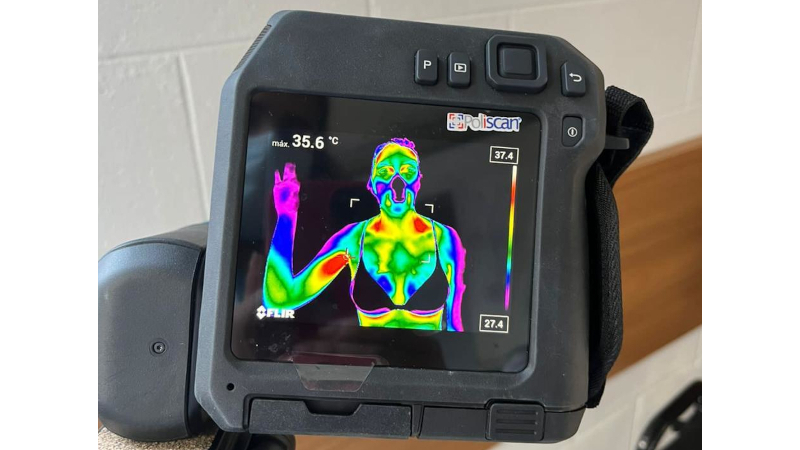
An infrared thermography camera captured the increase in temperature in the supraclavicular region, which indicates greater BAT activity (image: Laura Ramos Gonçalves Gomes/FCA-UNICAMP)
Published on 02/02/2026
By Fernanda Bassette | Agência FAPESP – A study conducted by researchers at the State University of Campinas (UNICAMP) in São Paulo, Brazil, warns about the impact of the so-called “yo-yo effect” on women’s metabolic health. The study shows that women who have experienced repeated cycles of intentional weight loss followed by unintentional weight regain have a poorer cardiometabolic profile and lower brown fat activity, which helps burn energy. These findings reinforce the idea that the problem is not only the fluctuation in weight itself, but also the progressive accumulation of body fat over time.
Supported by FAPESP, the study was published in Nutrition Research and conducted at the Metabolism and Diabetes Research Laboratory at UNICAMP’s Center for Diagnosis of Diseases of the Digestive System (GASTROCENTRO) under the supervision of Ana Carolina Junqueira Vasques and the co-supervision of Bruno Geloneze. The study also included the participation of Laura Ramos Gonçalves Gomes and Isabela Solar.
According to Vasques, the study focused on evaluating the activity of brown adipose tissue (BAT), a type of fat that has attracted growing scientific interest in recent years due to its potential role in managing obesity, diabetes, and dyslipidemia.
Unlike white fat, which stores energy, BAT burns glucose and lipids to produce heat and contribute to energy expenditure. “This tissue is rich in mitochondria, which are structures responsible for energy production in cells, giving it its brownish color and high metabolic activity,” the researcher explains.
Until just over a decade ago, it was believed that brown fat only existed in newborns and helped maintain body temperature. However, in 2009, studies showed that adults also have BAT, particularly in the supraclavicular region, including the neck, above the collarbone, and around the spine. Since then, the number of studies on the subject has grown rapidly.
The UNICAMP study involved 121 women between the ages of 20 and 41 with various body mass index (BMI) ranges. The participants were divided into two groups: those with no history of yo-yo dieting, and “cyclers,” who were defined as women reporting three or more episodes of intentional weight loss followed by unplanned weight regain of at least 4.5kg over the past four years. This pattern is often associated with restrictive dieting to lose weight.
The decision to only study women was not random. In addition to the laboratory already having a robust database of women, the researcher explained that there are significant differences between men and women in terms of the amount and activity of brown fat. “The study focused on young women who were still outside the menopause period precisely to avoid hormonal interference that alters the distribution of body fat. Additionally, women tend to suffer from greater aesthetic pressure and often resort to restrictive diets, which increases the occurrence of the yo-yo effect,” she points out.
Hot and cold
To assess brown fat activity, participants underwent a controlled cold exposure protocol (18 °C), which is considered the main stimulus for BAT activation. First, they were placed in a heated room. Then, they were transferred to a cooler environment where shivering was not induced. “If the individual starts to shiver, they’ll expend additional energy. That’s why the temperature was maintained at 18 °C, which is considered manageable cold,” Vasques explains.
In both environments, BAT activity was monitored at various times. An infrared thermography camera captured the increase in temperature in the supraclavicular region, which indicates greater BAT activity. “This camera takes images and captures exactly the hottest regions, painting them in a different color. Based on the intensity of this color, we can quantify how much BAT is activated in each participant,” Vasques explains. Indicators such as body fat percentage, visceral fat, blood glucose, lipid profile, and blood pressure were also analyzed.
Initial results showed that women who were referred to as “cyclists” and had a history of yo-yo dieting had more body fat, greater accumulation of visceral fat, and worse metabolic indicators. They also had lower brown fat activity. Initially, yo-yo dieting appeared to be associated with a reduction in BAT. However, when the researchers performed a more in-depth statistical analysis, they found that this relationship was not direct, but rather modulated by fat accumulation.
“The yo-yo effect probably acts indirectly. Over successive cycles of weight loss and regain, there’s a progressive worsening of body composition, with recovery predominantly of fat and not muscle mass. Therefore, what really explains the lower brown fat activity isn’t the yo-yo effect alone, but rather excess body fat,” she says.
This occurs because each restrictive diet triggers the body’s defense mechanisms, which attempt to regain the lost weight by reducing basal energy expenditure, altering hunger and satiety hormones, and making the metabolism more efficient at storing energy. “When a person regains weight, it comes back mainly in the form of fat, not lean mass,” the researcher explains. In the long term, this process favors an increase in body and visceral fat percentages, which are directly linked to reduced BAT activity.
Although BAT activity cannot be measured in routine examinations (it is only measured in research settings), Vasques says that, from a clinical point of view, the study shows that obesity management cannot focus solely on weight loss. “Obesity treatment strategies should prioritize body composition quality, long-term sustainable fat percentage reduction, and muscle mass preservation with multidisciplinary approaches and lasting behavioral changes,” she says.
Vasques also points out that, although brown fat can be stimulated by factors such as physical activity, reduction of body fat, and exposure to cold, it should not be seen as an isolated solution for weight loss. “Its most relevant role is improving glucose and lipid metabolism and helping protect against diabetes and cardiovascular disease,” she concludes.
The article “Weight cycling in women: A challenge for cardiometabolic health, not for brown fat” can be read at sciencedirect.com/science/article/abs/pii/S027153172500137X.
Source: https://agencia.fapesp.br/57076


