


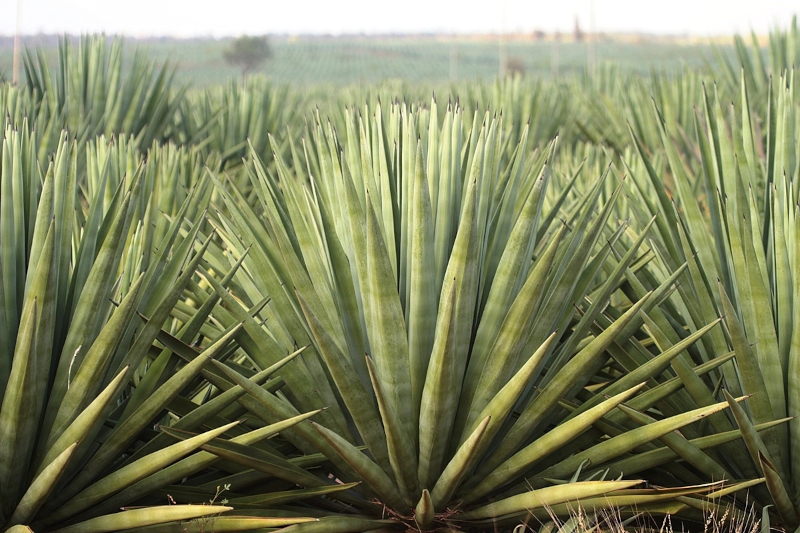
Brazil is the world’s largest producer of sisal (Agave sisalana), producing 93,000 metric tons of fiber in 2024 (imagem: subhashc/iNaturalist)
Published on 10/06/2026
By Karina Ninni |Agência FAPESP– The agave plant, native to Mexico, was introduced to Brazil via the state of Bahia in the early 20th century. It is used to produce sisal fiber (Agave sisalana) and tequila (Agave tequilana), as well as nectars and sweeteners. According to the Brazilian Institute of Geography and Statistics (IBGE), Brazil is the world’s largest producer of A. sisalana, with 93,000 metric tons of fiber in 2024. Agave is currently being studied as a source of biofuels; however, one challenge of cultivating it for this purpose is its initial growth period.
“Agave is a plant that grows slowly at first and then shoots up. The time it takes to reach that point is two and a half to three years,” says Gonçalo Amarante Guimarães Pereira, head of the Genomics and Bioenergy Laboratory (LGE) at the Institute of Biology of the State University of Campinas (IB-Unicamp) and coordinator of the study.
To accelerate this growth, the LGE team has been studying biochar, among other compounds. This carbon-rich material is obtained through the thermal degradation of organic matter through pyrolysis, a combustion reaction that uses the oxygen in the fuel molecule. “We’ve shown that with the most effective biochar-based treatments, we were able to generate 60% more biomass,” says Pereira.
Pedro Henrique Narciso Ferreira, also from the LGE and the first author of the study, explains that the effectiveness of biochar depends heavily on the type of biomass from which it is derived. “We tested three different types of biomass to produce biochar: sugarcane, coffee, and agave. We wanted to see if they had a similar effect on the soil, microorganisms, and plant growth and to investigate the characteristics of the biochar produced from each.”
The goal was to strike a balance between improving soil quality to promote plant growth and increasing the amount of carbon sequestered. Biochar is a globally recognized, promising approach for this purpose. “Depending on the pyrolysis temperature, it’s possible to favor a specific type of biochar,” Ferreira summarizes. “We wanted something that would improve soil quality, benefit the plants, and enable high rates of carbon sequestration.”
Juliet Emilia Santos de Sousa, a member of the LGE and the Soil Geochemistry Study and Research Group at the Luiz de Queiroz College of Agriculture at the University of São Paulo (Esalq-USP), explains that if the pyrolysis temperature is too high, the resulting material may be so recalcitrant that it does not release into the soil. “Another important point is that soils vary greatly. If we consider just color, which is a striking attribute, in the semiarid region, we find white, black, and red soils. Just by looking at them, it’s clear that each has different properties and will therefore interact with the biochar and the plant differently.”
The authors of the study, published in the journal Biomass and Bioenergy, explain that not all soils benefit from the use of biochar. Studies indicate that it has a more positive impact on tropical soils than temperate ones. When applied to carbon-rich soil, it has no apparent effect. Generally, sandy soils can accommodate more biochar than soils that already contain a significant amount of organic matter.
FAPESP supported the project through a Direct Doctoral Scholarship awarded to Ferreira. The team’s studies are part of the Brazilian Agave Development (Brave) Program and have been supported by Shell Brazil through the research and development clause in oil production contracts overseen by the National Agency of Petroleum, Natural Gas, and Biofuels (ANP).
Sugarcane, coffee, and agave
In the first experiment, the team used biochar derived from sugarcane bagasse that was produced by rapid pyrolysis in a fluidized-bed reactor. In this type of reactor, solid particles are suspended and agitated by an upward flow of gas or liquid. This causes the mixture to behave like a fluid and optimizes heat transfer. The biochar was incorporated into the soil in pots at rates of 0% (control group), 5%, 10%, and 20% of the total pot volume. The plants were monitored for 26 weeks. After this period, the team assessed the biometric and biomass parameters of the plants. They also characterized the soil samples from the pots using physical, chemical, and biological analyses.
In the second experiment, the team used biochar produced from Coffea arabica husks. The experimental design was the same as the trial with sugarcane bagasse biochar, and the study was conducted over nine weeks.
The third experiment evaluated the effect of biochar derived from agave biomass produced and characterized by the Laboratory of Biotechnology Applied to Bioenergy and the Environment (BIOMA) at the Faculty of Agricultural Engineering (Feagri) at Unicamp. In this case, in vitro-propagated A. sisalana plants were used. The experiment followed the same design as the previous two, and the presented data correspond to the first eight weeks of plant development.
“Pyrolysis produces biochar, oil, and gas. Generally, this oil is liquid. But in the case of agave, the pyrolysis process produces a grease that clogs the reactor’s piping. The major challenge is developing a reactor that prevents that clogging so downtime doesn’t occur," reveals Jean Constantino Gomes da Silva, co-author of the article.
He developed a reactor specifically for this purpose. As a result, the group was able to produce agave biochar using the leaves and bulb of the plant. “We’re already considering a potential refinery that would operate using agave processing waste.”
Results
To evaluate the growth of the plant, the group measured its leaf area. “We use a camera to photograph the plant from above, which allows us to track its growth by analyzing the leaf area. Using software, we count the pixels in the image and convert them into square centimeters. This enables us to monitor the plant’s development on a weekly or biweekly basis without destroying it,” says Ferreira. According to him, the amount of biochar used had a greater impact on leaf area than the type of biomass used as the raw material.
“The 10% biochar increased the leaf area and biomass of Agave sisalana . Intermediate concentrations, regardless of the biochar’s origin, proved to be better for microbiota and plant growth, but at higher concentrations, such as 20%, we observed growth equivalent to that of the control group, or even a reduction in plant growth,” the first author explains.
The research team found that moderate doses (5% to 10%) increased microbial activity and the function of enzymes that make nutrients available to the agave. “The use of biochar stimulates all types of microorganisms, but the interaction between the rhizosphere and the biochar – that is, the molecules secreted by the roots – ends up stimulating only those that are beneficial to the plant. That happens naturally. But the group is also studying synthetic inoculants to ‘force’ a situation more conducive to microorganisms that benefit plant growth,” summarizes co-author Marcelo Falsarella Carazzolle. Additionally, the researchers are selecting the most interesting microorganisms.
“We believe that biochar leads to a change in the enzymatic profile associated with microorganisms that benefit agave because the plants induce the growth of appropriate microorganisms through exudates, which are substances secreted by the roots,” Pereira adds.
According to Gabrielle Henriquetto Cassiano, a member of the team, enzymatic activity depends heavily on soil nutrients. “The mineralization of nutrients, which is mediated by enzymatic activity, can be greater or lesser depending on the availability of those nutrients to the plant and microbiota, the two sources that absorb those elements.”
Biofuels and carbon credits
According to Pereira, the idea is to use agave grown with biochar to produce various products. “With plants suited for ethanol production, we’ll produce ethanol. We’ll also produce biogas and pure CO₂, which is very valuable. For comparison, ethanol costs $600 per metric ton. CO₂ costs between $500 and $1,200 per metric ton, and today, we’re just releasing it into the atmosphere.”
For the scientist, biochar is truly “black gold,” as the international press has called it. “Biochar buried in the soil generates the most valuable carbon credits there are. People have been getting $200-$250 per metric ton. One of our partner companies, under a contract with France, says it sells a metric ton for up to $500.”
The production and use of biochar are becoming public policy in Brazil. The Ministry of Development, Industry, Commerce, and Services (MDIC) and the Brazilian Association of Technical Standards (ABNT) established Special Study Commission 328 to define the technical framework for pyrogenic biochar in Brazil.
The article “Influence of biochar on agave development and on soil characteristics from a Brazilian semi-arid region” can be read at https://sciencedirect.com/science/article/abs/pii/S0961953425009080 .
Source: https://agencia.fapesp.br/59347


